Book: The Architecture of Hasmukh C. Patel : Selected Projects 1963-2003

With a career spanning four decades and a self-made legacy of some of the most significant works of Independent India, Hasmukh C. Patel’s architecture speaks volumes about the architect he embodies and the grit he possesses. A narrative of his personal and professional journey – the book showcases select 51 projects that summarise Patel’s architectural idiom in its entirety.

Book Cover: Looking between the expressed columns and the main wall of the front facade while entering the Newman Hall in Ahmedabad,1963

“…………………The human being is at the centre of my creative efforts…………………This is the only thing I understand and the only thing I practice.” – Hasmukh Patel Continue reading Book: The Architecture of Hasmukh C. Patel : Selected Projects 1963-2003

M.G.A.H.V. Student and Faculty Housing : MO-OF Architects

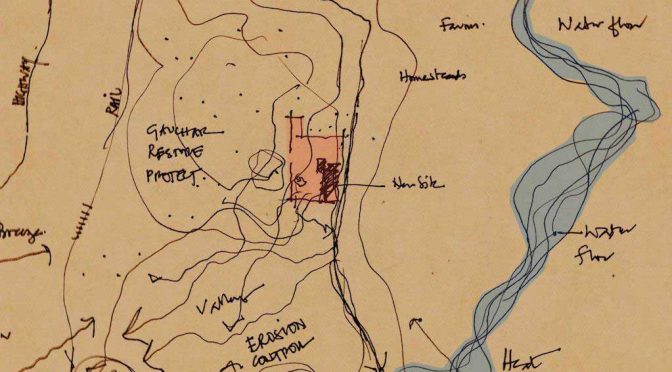
Set against the vast, arid landscape of Wardha, the Mahatma Gandhi Antarrashtriya Hindi Vishwavidyalay [M.G.A.H.V.] Student and Faculty Housing does not flaunt its existence, despite a seemingly overwhelming scale. Designed by the Mumbai-based MO-OF Architects, the project is an attempt at a ‘non-design’ process in which “architecture is no longer either implicitly or explicitly seen as a dominant system, but rather simply as one of the cultural systems.”

Masterplan
Master Plan

Amidst central plains of India, lies the inconspicuous town of Wardha – among the most historically significant centres of the Indian Independence Movement and Gandhi’s avant-garde socio-educational experiments. In this spirit, it nurtures the growth of the Mahatma Gandhi Antarrashtriya Hindi Vishwavidyalay [M.G.A.H.V.], established to globally promote and develop Hindi language and literature. Continue reading M.G.A.H.V. Student and Faculty Housing : MO-OF Architects

The Atelier: Biome Environmental Solutions

Inspired by an effectual educational approach, The Atelier by Bengaluru-based Biome Environmental Solutions embodies a conscious architecture which stems from the understanding that, “The permanence of a building may no longer be a prerequisite in its design.……it is necessary to allow material recovery and recycling, or reconstruct the same building elsewhere – anything but create debris that will occupy landfills.” 

It is well known that children in their formative years are responsive to their everyday surroundings, experiences, and routines. Borrowing from this, The Reggio Emilia Approach focuses on the centrality of the hundred languages of children wherein they require utmost freedom in order to value the infinite resources of their hands, eyes, and ears and of forms, materials, sounds, and colours. Designed by Bengaluru’s Biome Environmental Solutions, this pre-school is an example of a sustainable building whose design submits to the enhancement of a sensorial, exploratory learning experience. Continue reading The Atelier: Biome Environmental Solutions

Book: Christopher Benninger: Architecture for Modern India

A monograph on the work of Prof. Christopher Charles Benninger chronicles buildings that express his transition from an architect in India to an Indian Architect outlining and emphasising on the core values of his work and the changing nature of the context that it negotiates with.

A 1972 Photograph shows Christopher Benninger with Balkrishna Doshi on the CEPT Campus, Ahmedabad.
A 1972 Photograph Shows Christopher Benninger with Balkrishna Doshi on the CEPT Campus.

Continue reading Book: Christopher Benninger: Architecture for Modern India

Book: Boombay: From Precincts to Sprawl : Kamu Iyer

As a memoir-cum-historical and cultural repository, Boombay: From Precincts to Sprawl by Kamu Iyer captures the zeitgeist of an era in Mumbai from 1940s to the present.  

Boombay
Cover

“This book is different. Kamu Iyer is an architect who has lived in Mumbai all his life. He is observant, analytical and visual. He understands how people use spaces – especially public spaces. And he has a sense of History.” writes Charles Correa in his foreword to Boombay. Continue reading Book: Boombay: From Precincts to Sprawl : Kamu Iyer