
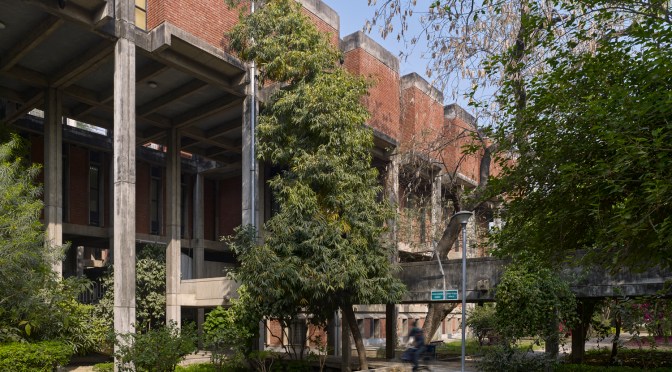
MODERN SOUTH ASIA | Indian Institute of Management Bangalore

MODERN SOUTH ASIA
A Visual Archive of South Asia’s Modernist Heritage


The Modern South Asia (MSA) series is dedicated to exploring modern architecture of historic importance in South Asia through photography-based books. The series will focus on architecture from the 20th century, designed and built by regional and international architects. Each book will provide the reader with an in-depth visual exploration of the architecture through contemporary photographs, architectural drawings, and newly commissioned writing by architects, thinkers, and academics. 

The MSA series is edited and photographed by Randhir Singh. The project is supported and published by Arthshila Trust.


The Campus as a Garden:
Doshi’s Indian Institute of Management Bangalore

Essay by Kazi Khaleed Ashraf
Photographs by Randhir Singh

Speaking to a group of students at the campus in 2014, Balkrishna Doshi characterised the Indian Institute of Management Bangalore (1983) as not a building. “Can you ‘see’ IIMB as a building?” he asked.[1] In saying this, Doshi was emphasising that not only is IIMB not a building, but the typical components of a building had also receded from view. “It is not visible because nature has taken over – so you see a wall here, a pillar there”. The project at IIMB sits against the predominant practices of producing spectacular or robust buildings, and ushers in the principles of what I describe as an architecture of complexity.

Continue reading MODERN SOUTH ASIA | Indian Institute of Management Bangalore

PRAXIS 25 | SOCIAL DESIGN COLLABORATIVE

An editorial project by Matter in partnership with Şişecam Flat Glass, PRAXIS investigates the work and positions of diverse contemporary architecture practices in India. In this episode, Swati Janu of Delhi-based Social Design Collaborative emphasises on their idea of design and collectives as prisms to multiply opportunities to make architecture and its responsibilities accessible as a conversation to all; especially to those outside the purview of planning processes. The practice engages with an integrated approach to arrive at meaningful enquiries and possible opportunities at a more localised level, in tandem with the governance and power structures, community networks and the city. Architecture is conceived as a sort of node in the broader system. Swati, and her colleagues, Shreya Rajmane and Anushritha Sunil reflect on their processes and values that guide and conciliate technical and narrative tools to translate ‘projects’ across spatial, planning, advocacy, academia, art, writing, research and other diverse forms.


Continue reading PRAXIS 25 | SOCIAL DESIGN COLLABORATIVE

CONSTRUCTING THE SACRED OUTSIDE TRADITION

A Srivathsan

A Recorded Lecture from FRAME Conclave 2019: Modern Heritage


In this lecture, A Srivathsan presents his view on the construction of Hindu Temples, and raises pertinent questions about the orientation of contemporary and modern architecture within this discourse. Using examples of temples built by young practitioners as a prism, he draws distinctions and similarities between what the sacred is and what is modern.

Continue reading CONSTRUCTING THE SACRED OUTSIDE TRADITION

[BOOK] THE MAKING OF A CAMPUS: IIM BANGALORE BY KIRAN KESWANI

Through archival material, and insights into practical and lived experiences, the book curates a deep understanding of the Indian Institute of Management, Bangalore‘s architectural evolution. This prose captures not solely spaces but the dynamic interactions it contains and engenders as an institution, emphasising on how it has shaped the campus over time. Thus, reinforcing what brings the architecture to life and that the true spirit of the campus lies in the experiences of its users.

Continue reading [BOOK] THE MAKING OF A CAMPUS: IIM BANGALORE BY KIRAN KESWANI

PRAXIS 24 | The Vernacular Modern

An editorial project by Matter in partnership with Şişecam Flat Glass, PRAXIS investigates the work and positions of diverse contemporary architecture practices in India. In the episode, Abhirup Dutta and Deeptashree Saha reflect on the intellectual roots of their work as The Vernacular Modern. While anchored in their emphatic thematics of material cultures, and engineering, the imagery of the vernacular and the modern eponymously makes for their repertoire of furniture, art, architecture and objects. The formidably functional range is deeply researched, as evidenced by the studio’s process that is simultaneously organic and directional, embedded in the idea of ‘slowness’ and ‘an artisan-led’ approach. The Vernacular Modern’s work places these objects as signifiers in a complicated context and legacy of craft heritage in India. Working consciously with old demolition timber and towards contemporary narratives born of relearning and exploring, it asks a more nuanced question of itself – about true sense of collaborations, and developing products with a purpose.


Continue reading PRAXIS 24 | The Vernacular Modern