Category Archives: Discourse

In Memoriam: Kamu Iyer; A Tribute by Mary N. Woods

A Tribute by Prof Mary Norman Woods


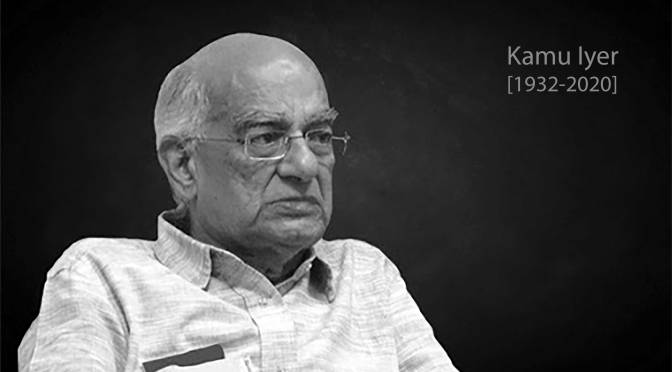
Mary Norman Woods pens a tribute to Kamu Iyer – one of Mumbai’s most cherished architects and a much respected member of the design community in India. With his passing, we lose one of the last few keepers of the conscience of our profession – a citizen-architect who loved Mumbai and was perpetually engaged with the fate of the city through his work, his writings and his activism.

The tribute is followed by a reproduced dialogue between Kamu Iyer, Brinda Somaya and Mary Woods titled ‘Working from Mumbai‘ originally published in Brinda Somaya’s monograph titled ‘Works & Continuities’. 


Kamu Iyer (1932-2020)
Mourning and Celebrating a Friend and Mentor

Albert Mayer, American architect and planner who worked in post-Independence India, wrote about his excitement at being present at the birth of a nation. Throughout his seven decades of practice, teaching, writing, and mentoring, Kamu Iyer sustained and nurtured the “tingling atmosphere of plans and expectation” envisioned by Indians of “ability, outlook, energy, and devotion” that so impressed and inspired Mayer. Kamu embodied the ideals of the Independence struggle and hopes for a free India in his life and work. He was a mahatma, a great soul who touched so many and whose like we will not see again. Continue reading In Memoriam: Kamu Iyer; A Tribute by Mary N. Woods
An Ephemeral Lab in a City of Fixity

In a series on archival texts, views, discussions and comments on the state of architecture and design education in India,  Architect and Academic Krishnapriya Rajshekar shares from her experience as Assistant Professor at Wadiyar Centre for Architecture (WCFA), the significance of context in a studio culture, ‘making’ of a campus experience, and the intrinsic pedagogical framework embedded in an architectural education. For the curated short series, a prologue by Suprio Bhattacharjee.


PROLOGUE

BY SUPRIO BHATTACHARJEE

When I had set out to write the first essay that in many ways I had thought of as an ‘anchor’ to this series – though not a definitive, dogmatic or instructive one – as points of view, definitions, what can be determined as radical or not, etc. – all of this tends to alter and transform over time – I had never thought it could be seen as a set of ‘implied’ questions or loosely framed inquiries to which one can directly respond.

In many ways, I am indebted to Krishnapriya Rajshekar, Assistant Professor at the Wadiyar Centre for Architecture [WCFA], Mysore, for breaking this aforementioned perception I have had of my one piece of text. Continue reading An Ephemeral Lab in a City of Fixity

Charles Correa: Trajectories and Contexts

Ranjit Hoskote

A Recorded Lecture from FRAME Conclave 2019: Modern Heritage


In this lecture, Ranjit Hoskote postulates a portrait of Charles Correa as a curator. He speaks about Correa’s contribution to culture at large and his preoccupation with societal institutions albeit being an architect.


Edited Transcript

Good Morning.

Since I have 35 minutes, I am not really going to try and engage with absolutely everything that Charles Correa built in the course of a magnificent career. I am going to try and focus on a very particular strand in his work, his preoccupation with cultural institutions, and through what I have to say, I am going to try and develop provisionally a portrait of the architect as not only a member of a particular profession but as a contributor to ‘culture’ at large.

Charles Correa’s architecture was really part of my growing up in Bombay. Whether it was the Salvacao Church or Kanchenjunga, these were part of the urban fabric, part of the way in which one experience the city and part of what one identified with one’s home city. But also in the course of my professional life, there are Correa buildings to which I have often returned, where I have sometimes done things and which again have been part of my consciousness in my being. I am thinking particularly here of the Crafts Museum in Delhi, indeed the Kala Academy, the Jawahar Kala Kendra in Jaipur, the British Council building in Delhi and Bharat Bhavan in Bhopal. Also, on a far more personal note, my wife and I spent for many years our New Year holidays in a Charles Correa house, a spare elegant home that Charles designed for his and our friend, the artist Mehlli Gobhai in a chikoo orchard in Gholvad. To be there around Christmas and the turn of the year, every year, was very special. It is still a visceral experience that remains with me. Last year as part of an exhibition called ‘The Sacred Everyday‘, which I curated for the Serendipity Arts Festival here at the Adil Shah Palace, I thought that it might not be out of place to have, so to speak, a shrine that honoured the way in which Correa dealt with these questions of the ‘Circulation of the Sacred in the Everyday’ and how one might by means, both mythic and material, invoke these larger contexts of being so. But I am not going to talk about this today, I am actually going to move on.

Continue reading Charles Correa: Trajectories and Contexts

Doshi: The Master of Elastic Time

Lecture and Text: Bijoy Ramachandran
Film: Cinematographed, Edited and Directed by Premjit Ramachandran; Conceived and Researched by Bijoy Ramachandran (© Hinterland Films)

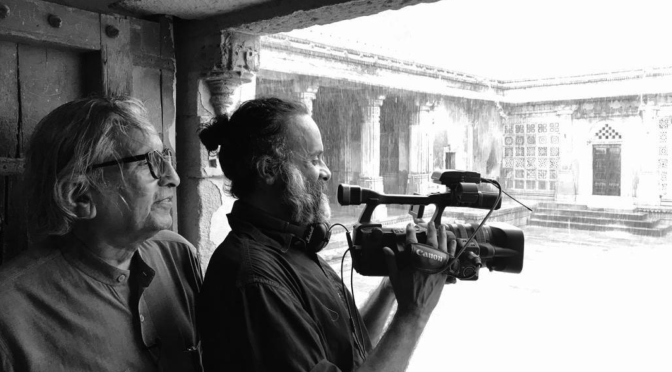
In this lecture, Bijoy Ramachandran articulates his reading of the works and thoughts of Pritzker Laureate Dr Balkrishna Doshi through the multiple encounters with his buildings that include the seminal IIM Bangalore, NIFT Delhi Campus and the Diamond Bourse. The talk also outlines the influence of the numerous interactions Bijoy has had with Doshi over the years.


In 2009, Bijoy collaborated with his brother and filmmaker Premjit Ramachandran to author and produce Doshi – a film on the celebrated indian architect. In 2019, and with a gap of ten years, they collaborated again to script and produce the second film ‘Doshi: Return to Formlessness‘ – an intimate portrait of the architect with immersive and enduring glimpses of some of his celebrated buildings.

Images and Film: Courtesy Bijoy Ramachandran and Premjit Ramachandran. The talk and the film were presented at the FRAME 2019 conclave ‘Modern Heritage’. 

Continue reading Doshi: The Master of Elastic Time

History: Narratives for Meaning and Operation

In a curated series on archival texts, views, discussions and comments on the state of architecture and design education in India, Kiran Kumar & Madhuri Rao review the significance of ‘History’ in architectural education and practice of contemporary architecture as a “…..tool to operate rather than a static and canonic body of knowledge.”

The facts are really not at all like fish on the fishmonger’s slab. They are like fish swimming about in a vast and sometimes inaccessible ocean; and what the historian catches will depend, partly on chance, but mainly on what part of the ocean he chooses to fish in and what tackle he chooses to use – these two factors being, of course, determined by the kind of fish he wants to catch. By and large, the historian will get the kind of facts he wants. History means interpretation.

E.H. Carr, What is History?


Premise

It is necessary at crucial junctures such as our present, to come to terms with change and to re-direct and accommodate shifting practices. This will ensure that architecture and history will continue to be sponsored by and for the collective. The process of evolution of the past is an engaging construct to reflect on themes – generic and those that have been susceptible to modifications. The past can become relevant and meaningful only if it becomes an anchor to our conscience, diffusing into our politics, economics and our daily mundane, not as a characteristic or stylistic manifestation but as a reflection to what has always remained relevant. Continue reading History: Narratives for Meaning and Operation