Category Archives: Discourse

History: Narratives for Meaning and Operation

In a curated series on archival texts, views, discussions and comments on the state of architecture and design education in India, Kiran Kumar & Madhuri Rao review the significance of ‘History’ in architectural education and practice of contemporary architecture as a “…..tool to operate rather than a static and canonic body of knowledge.”

The facts are really not at all like fish on the fishmonger’s slab. They are like fish swimming about in a vast and sometimes inaccessible ocean; and what the historian catches will depend, partly on chance, but mainly on what part of the ocean he chooses to fish in and what tackle he chooses to use – these two factors being, of course, determined by the kind of fish he wants to catch. By and large, the historian will get the kind of facts he wants. History means interpretation.

–E.H. Carr, What is History?


Premise

It is necessary at crucial junctures such as our present, to come to terms with change and to re-direct and accommodate shifting practices. This will ensure that architecture and history will continue to be sponsored by and for the collective. The process of evolution of the past is an engaging construct to reflect on themes – generic and those that have been susceptible to modifications. The past can become relevant and meaningful only if it becomes an anchor to our conscience, diffusing into our politics, economics and our daily mundane, not as a characteristic or stylistic manifestation but as a reflection to what has always remained relevant. Continue reading History: Narratives for Meaning and Operation →

Crafting Metal Roofs

With R Ravindrakumar & Suhasini Ayer, Auroville


In a world of tremendously paced technological advancements, technique often supersedes skill as technology replaces craft. While alternate modes of construction and production with higher efficiency and precision levels continue to influence the building industry, there exists a sustained effort to renew processes rooted in intuition and the idea of endurance. Suhasini Ayer, Principal Architect, Auroville Design Consultants and R Ravindrakumar, Principal, Ravindrakumar Roofing Technology, shed light on aspects of sustainability and construction methodology deployed in crafting the metal, respectively.

Continue reading Crafting Metal Roofs →

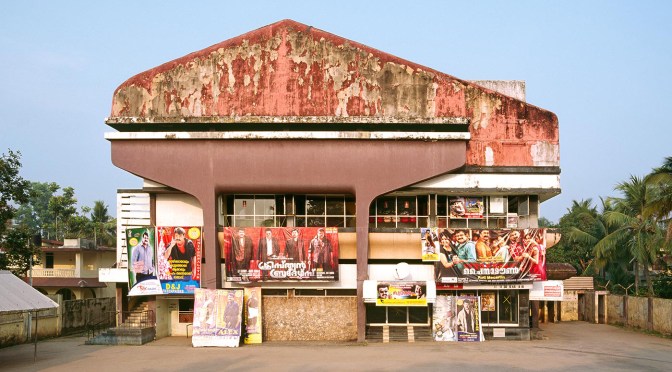
Portraiture: ‘Movie Theaters’ and ‘Churches’

By reading into the cultural environment of the sixties and seventies, and the rise of a range of affinities in architecture that emerged in the wake of Independence in India, two pictorial essays by Stefanie Zoche and Sabine Haubitz document a part of a larger cultural zeitgeist. The essays focusing on the essentialised photographs of facades of single screen movie theatres and churches in South India propose a common ground – an enquiry into what they refer to as ‘Hybrid Modernism’. 


In India, architecture evolves in a palimpsestic disposition, especially in the rurban areas. Historical, provincial, aspirational layers exist in this pluralistic built landscape. The development of modern architecture in India succeeding the influences of international style made a gradual headway from 1920s and -30s and pronouncedly was acknowledged with Le Corbusier’s vision for Chandigarh. While post-independence architecture in India is largely attributed to modern architecture, it belongs to perhaps only a fraction of the built landscape. Architecture in the remaining paradigm is countered by a gentler transition, more self-conscious and self-referential, consolidated socially and culturally. Familiar and immediate frames of references are appropriated and contextualised at a local level. Moreover, it is not homogeneous across the country but exists in complex crossovers.

Continue reading Portraiture: ‘Movie Theaters’ and ‘Churches’ →

In Focus: The Architecture of Didi Contractor

Resonating with the mindfulness of architect Didi Contractor’s approach to her work and life, Joginder Singh’s book ‘An Adobe Revival – Didi Contractor’s Architecture’ and the documentary ‘Didi Contractor – Marrying the Earth to the Building’ by Steffi Giaracuni, together encapsulate the unique sensibility with which Didi diligently continues to pursue an architecture that is embedded in a holistic sensorial experience.

The film unassumingly opens with the architect seated at her drawing board, sketching while deep in thought in the comfort of her warm mud abode amidst the stunning views of the Kangra Valley. Born to Expressionist Painters associated with the Bauhaus group of the 1920s, Didi pursued an education in art although keenly drawn towards architecture and design. Having moved to the hills, she set up a practice much later in life with a core ideology rooted in the understanding of local material and construction techniques. Continue reading In Focus: The Architecture of Didi Contractor →

MODERN HERITAGE: In Retrospection: Shivdatt Sharma

CURATED BY SANGEET SHARMA

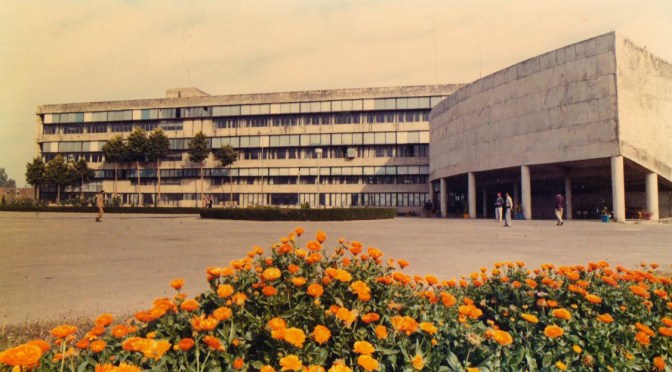
The Capital Project of Chandigarh is among the most widely discussed and debated projects in the history of Modern Architecture in India. Under the trusteeship of Prime Minister Nehru, several young Indian architects joined hands to contribute to the mammoth task of nation-building, working across diverse sectors such as buildings for Space Research & Technology, Administrative Infrastructure, Cultural & Educational Institutions and Housing. At the forefront alongside his better-known contemporaries, was Architect Shivdatt Sharma [SD Sharma], a silent but powerful contributor to the ‘modernist’ landscape of a young India. In this piece, curated and assimilated by his son and architect Sangeet Sharma, SD Sharma writes about his time working alongside Le Corbusier and as an apprentice under Pierre Jeanneret. 

In an intimate note that follows, Sangeet Sharma shares instances of growing up in the newly built city of Chandigarh and working under Shivdatt Sharma as an apprentice for almost two decades. He reflects on the many relationships that he has nurtured with his father, over the years – one of a friend, philosopher and guide.


LEARNING FROM LEGENDS
Authored by Shivdatt Sharma

Le Corbusier and his associates, all being the members of CIAM, processed the pure architecture that was to be followed in the making of Chandigarh. They believed that geometry was a timeless factor in the whole universe, and was, therefore, to be followed to create purity. Continue reading MODERN HERITAGE: In Retrospection: Shivdatt Sharma →