Book: ‘Plastic Emotions’ reviewed by David Robson

David Robson pens a critical review of a recent book by Shiromi Pinto that creates a fictional story based on a relationship between celebrated Sri Lankan architect Minnette De Silva and global architectural icon Le Corbusier.


Book by Shiromi Pinto
Reviewed by David Robson

PLASTIC TRUTHS

The writer Shiromi Pinto has recently published her own fictionalised account of the life of Sri Lankan architect Minnette de Silva under the bizarre and inexplicable title ‘Plastic Emotions’. Apparently, in this Trumpian world of fake news and casual lies, it has become acceptable for writers to take the lives of real people and re-cast them to suit their own purposes. But can such cavalier distortions ever be justified if, along the way, the personality of the protagonist is distorted beyond recognition, if the people who surrounded her are pilloried, if her achievements devalued and her ideas misrepresented?

Continue reading Book: ‘Plastic Emotions’ reviewed by David Robson

Portraiture: ‘Movie Theaters’ and ‘Churches’

By reading into the cultural environment of the sixties and seventies, and the rise of a range of affinities in architecture that emerged in the wake of Independence in India, two pictorial essays by Stefanie Zoche and Sabine Haubitz document a part of a larger cultural zeitgeist. The essays focusing on the essentialised photographs of facades of single screen movie theatres and churches in South India propose a common ground – an enquiry into what they refer to as ‘Hybrid Modernism’. 


In India, architecture evolves in a palimpsestic disposition, especially in the rurban areas. Historical, provincial, aspirational layers exist in this pluralistic built landscape. The development of modern architecture in India succeeding the influences of international style made a gradual headway from 1920s and -30s and pronouncedly was acknowledged with Le Corbusier’s vision for Chandigarh. While post-independence architecture in India is largely attributed to modern architecture, it belongs to perhaps only a fraction of the built landscape. Architecture in the remaining paradigm is countered by a gentler transition, more self-conscious and self-referential, consolidated socially and culturally. Familiar and immediate frames of references are appropriated and contextualised at a local level. Moreover, it is not homogeneous across the country but exists in complex crossovers.

Continue reading Portraiture: ‘Movie Theaters’ and ‘Churches’

Material Immaterial Studio

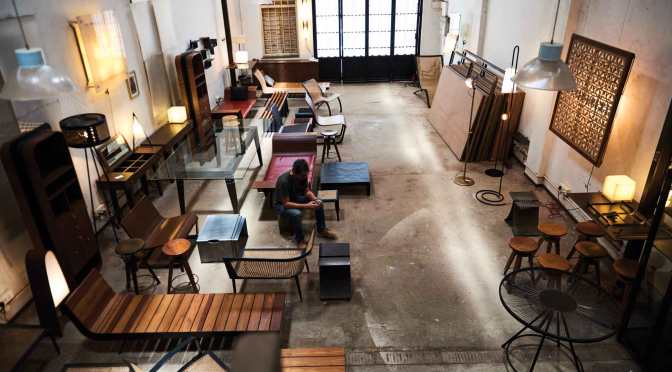
Founded by Nitin Barchha and Disney Davis with their shared passion for design, the Mumbai-based practice ‘Material Immaterial Studio’ indulges in the sheer joy of crafting and the process of experimenting with the character of materials. The studio forges unconventional handmade curiosities which appeal to the architectural intellect as reductions of spatial scale by “exploring the bare beauty of materials”.


Every once in a while, one entertains an idea of a peculiar venture; the grounds of which tend to be less pragmatic and more whimsical. While these ideas end before they take off, Nitin and Disney fostered their fascination with materials into a unique endeavour which celebrates craftsmanship. Continue reading Material Immaterial Studio

SITE VISIT: House in Assagao by Field Atelier

Inserted into the topography with forethought, House in Assagao designed by the Goa-based Field Atelier, is a home open to programme while evolving an identity borrowing from the historical context.

Positioned in between the lush valleys of the Western Ghats coursed with streams and scattered coconut palms is a village rich in Goan cultural heritage; Assagao. In the last decade, a number of new and relatively grand country homes have been built in the village. Continue reading SITE VISIT: House in Assagao by Field Atelier

STUDIO: Pratyush Shankar

Studio culture – as with all manifestations of the human intellect – is the embodiment of a pattern of work that nurtures the craft of building. Architecture workspaces are especially readable in this context as architects are, in this case, designing for themselves. With every workplace as distinct and specific as the work it produces, the people who design and work in these environments reveal their ideas about space-making.

In this edition of the STUDIO series, we enquire about the processes, approaches, work ethics, and the trajectory of a Baroda-based multi-disciplinary practice led by academician and architect Pratyush Shankar.


Q: Tell us a little about the initial years of your practice. Continue reading STUDIO: Pratyush Shankar