Tag Archives: Design

CONSTRUCTING THE SACRED OUTSIDE TRADITION

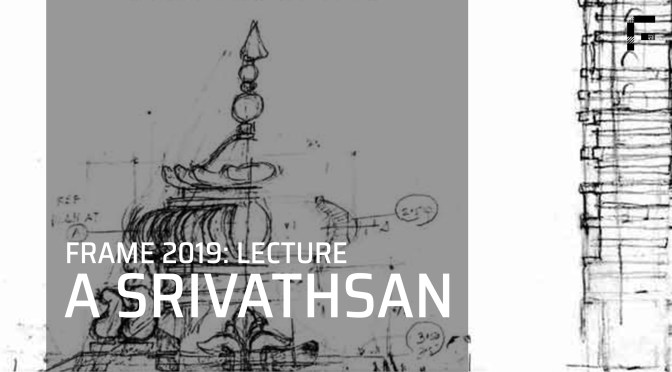
A Srivathsan

A Recorded Lecture from FRAME Conclave 2019: Modern Heritage


In this lecture, A Srivathsan presents his view on the construction of Hindu Temples, and raises pertinent questions about the orientation of contemporary and modern architecture within this discourse. Using examples of temples built by young practitioners as a prism, he draws distinctions and similarities between what the sacred is and what is modern.

Continue reading CONSTRUCTING THE SACRED OUTSIDE TRADITION

NID’s Early Years: An Indian Experiment of Global Relevance

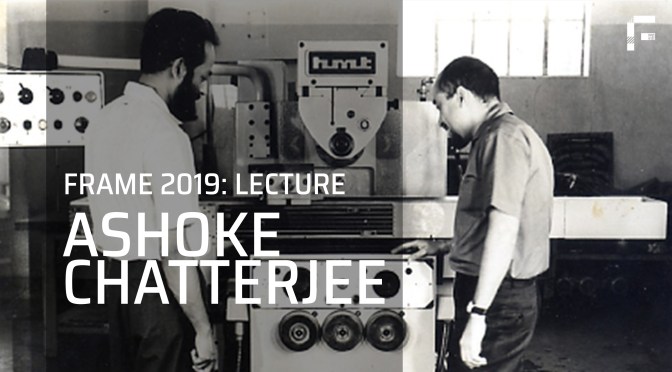
Ashoke Chatterjee

A Recorded Lecture from FRAME Conclave 2019: Modern Heritage


In this lecture, Ashoke Chatterjee talks about the inception of the National Institute of Design in Ahmedabad, its formative years, the pedagogy provided to the students, the experiments with the curriculum, the challenges, successes, and failures it faced in becoming the ‘world-class’ institute it sought out to be today.

Edited Transcript

I am delighted to have this opportunity to be back in Goa after forty-one years. The last time I came here, it was to assist the Government of Goa with a study of its ‘carrying capacity’ for tourism: how would Goa manage the growth of tourism in coming years? This might mean tough decisions of planning and control. I need not tell you that my report was trashed long before the Hall of Nations. Goa is clearly still struggling with those issues, but it is good to be back. I am grateful to the organizers, to FRAME Conclave for inviting me.

Let me start by indicating that this talk will be a very personal view of one part of contemporary Indian design history. It will focus on the experience of one institution, the National Institute of Design, its educators, and those who studied there. It will cover some years of a larger institutional history as well as design in modern India. Yet NID has been a catalyst, so it is valid to draw on an experience which has been unique not only in India but in a global context.

Continue reading NID’s Early Years: An Indian Experiment of Global Relevance

GANDHI OF SPATIAL DELIGHT: THE CRITICAL PRACTICE OF LAURIE BAKER

Himanshu Burte

A Recorded Lecture from FRAME Conclave 2019: Modern Heritage


In this lecture, Dr Himanshu Burte speaks on the nature of Laurie Baker’s human-centric architectural practice; as an empiricist, environmentalist and extremely critical and creative practitioner.

Edited Transcript

So it is going to take a while for me to recover from one hour of Geoffrey Bawa and after this lush serenity, especially because I have to follow it up with an argument. But, I will go ahead and I am going to be talking about Laurie Baker. I have kept what I am saying fairly narrow and it is mainly in the form of a straight-on argument I am offering, and I am hoping that we can have a discussion afterwards, whenever we are scheduled. I have actually changed the title from what is published or what was originally given to it, because I actually took the title of my obituary for Baker, written just after he passed away and because of the resonance with yesterday’s discussion around Gandhi and Architecture.

I will begin by looking at the context, the objectives and the premises of what I have to say. To begin with, since this is about heritage and we are talking about Modern Heritage particularly, I approach heritage with the understanding that every map is really a plan. It just does not show you what is there, but it is a project. Heritage in that sense, I see as an exercise in constructing the future. By constructing the past in certain ways, by preserving certain memories and ascribing certain meanings to it, we are really constructing and doing the work of creating a future that we want. That I think extends to some extent to Prem‘s point, though I am sure he would not necessarily disagree with this. So, given that this is what is involved in thinking about heritage, it becomes very important to be conscious of our value positions and especially about the ethic of architecture, its politics, economics, the aesthetics and of course, the actual processes and practices that go into making the practice or the product itself. 

Continue reading GANDHI OF SPATIAL DELIGHT: THE CRITICAL PRACTICE OF LAURIE BAKER

Martand Khosla: Experiments of Urban Enquiry

Through his art and architecture, Martand Khosla has created a niche that lies at the intersection of the two fields. His installations embody philosophies from this undefinable space, as he extracts questions using art as a voice, and architecture as principles, to raise concerns about humanitarian aspects of societal and political systems.


The practice of Martand Khosla inhabits a transitional space between art and architecture, which enables him a platform to address concerns that transgress architecture as independent habitable spaces. He co-founded, and is a partner of the architectural practice RKDS (Romi Khosla Design Associates), which has obtained both national and international recognition through its award-winning designs.

Continue reading Martand Khosla: Experiments of Urban Enquiry

CONTRAPUNTAL MODERNISM: THE ARCHITECTURE OF MUZHARUL ISLAM AND LOUIS KAHN

Kazi Khaleed Ashraf

A Recorded Lecture from FRAME Conclave 2019: Modern Heritage


In this lecture, Kazi Khaleed Ashraf discusses the works of two prominent contemporary architects – Muzharul Islam and Louis Kahn as counterpoints to modernism in the Indian subcontinent. He also speaks about understanding modernity, modernism and the positions either took in the way they practised architecture.

Edited Transcript

In the pursuit of framing and reframing modernism, perhaps we might have to rethink the various ways we described modernism, tropical modernism, we might have to call it – monsoon modernism. Monsoon in the subcontinent is what sank European modernism; that is something to think about. I have been tasked to talk about two architects – Muzharul Islam and Louis Kahn. Muzharul Islam is from Bangladesh. He is what one could describe as the kind of a father figure of modern architecture. That term, ‘father figure’, is how Ranjit Hoskote described Charles Correa. If you replace Charles Correa with Muzharul Islam and other specific details, that is Muzharul Islam in Bangladesh. He was an architect, teacher, activist and most importantly, he was openly engaged in politics. He was a hardcore Marxist, a politically engaged persona. So I think among all the pioneering architects we are discussing here today, this is an interesting moment to think about an architect, who is both – an architect professionally engaged with the larger cultural milieu, and also devotedly engaged in politics. And the other person whom you are more familiar with, especially I am thinking about the younger architects and students. I am not sure how much you are familiar with Muzharul Islam so I will be taking up the task of talking about him in the next fifteen-twenty minutes, but you are surely familiar with the other person, Louis Kahn, who was invited to Bangladesh, and Muzharul Islam was involved in that invitation.

Continue reading CONTRAPUNTAL MODERNISM: THE ARCHITECTURE OF MUZHARUL ISLAM AND LOUIS KAHN