MODERN SOUTH ASIA A Visual Archive of South Asia’s Modernist Heritage
The Modern South Asia (MSA) series is dedicated to exploring modern architecture of historic importance in South Asia through photography-based books. The series will focus on architecture from the 20th century, designed and built by regional and international architects. Each book will provide the reader with an in-depth visual exploration of the architecture through contemporary photographs, architectural drawings, and newly commissioned writing by architects, thinkers, and academics.
The MSA series is edited and photographed by Randhir Singh. The project is supported and published by Arthshila Trust.
NATIONAL COOPERATIVE DEVELOPMENT CORPORATION (NCDC) Kuldip Singh, Mahendra Raj
COLLABORATIVE INVENTION AND THE ETHIC OF FRUGALITY: National Cooperative Development Corporation
Essay by Amit Srivastava & Peter Scriver Photographs by Randhir Singh
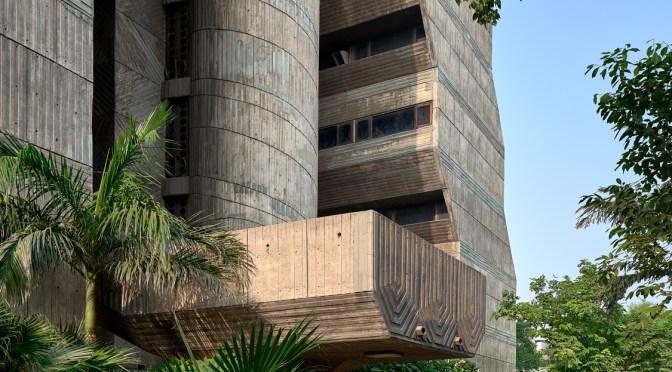
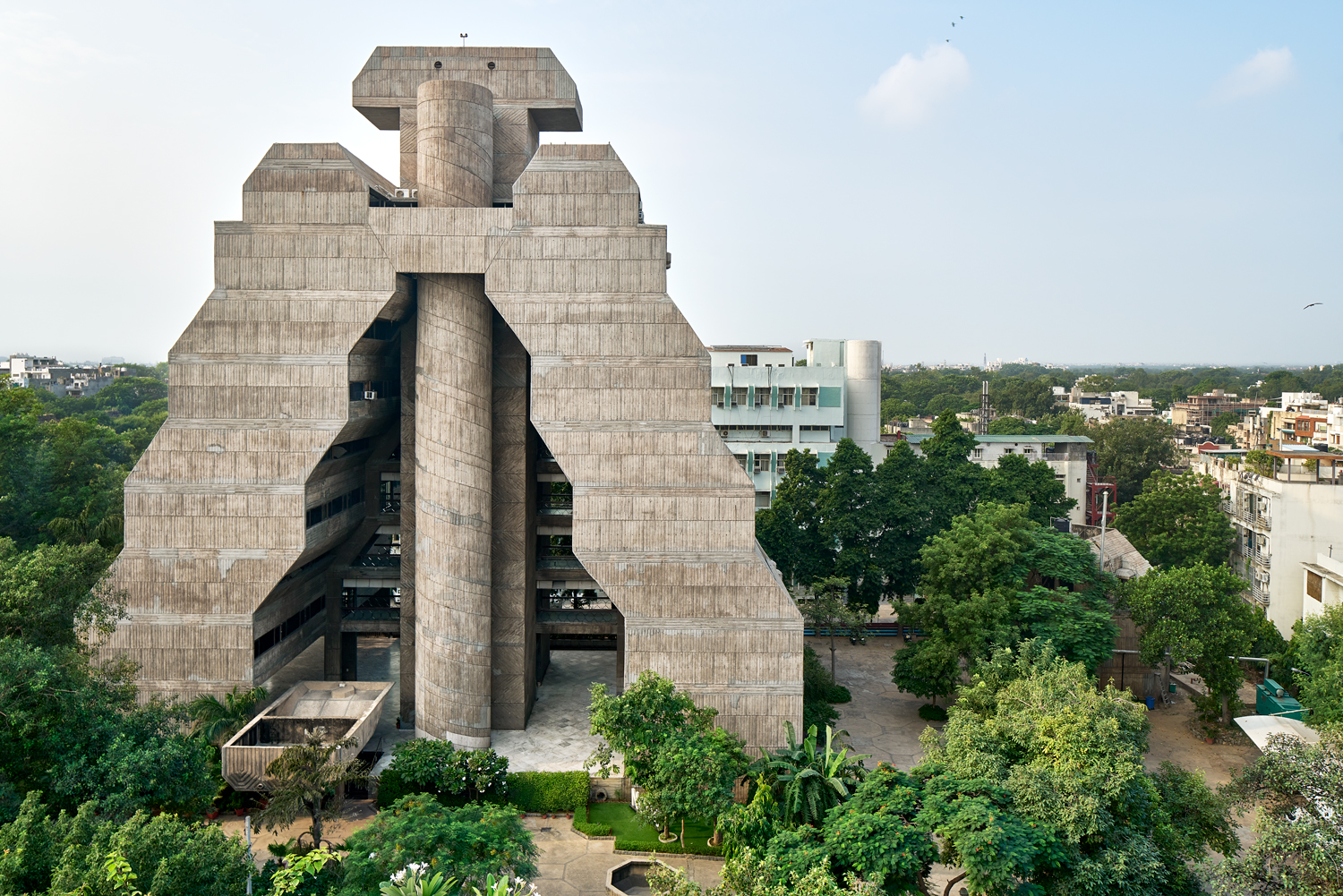
When it was built in the southern outskirts of metropolitan Delhi in the late 1970s, the National Cooperative Development Corporation (NCDC) headquarters was one of the relatively few new buildings that stood out, or even above, the sea of low-rise residential development that was then just beginning to expand the national capital beyond its first ring of post-colonial suburbs. But this was not just a taller structure and far from a merely generic modern office block. ‘Architecture’, modern or not, was still a relatively unfamiliar concept that few of the uninitiated public understood to apply to anything less exalted than the monumental tombs and ruined historic forts and palaces that dotted Delhi’s urban hinterland, such as in the neighbouring Siri Fort area. If ‘engineering’ had any better grip on the popular imagination, it was understood to be the equally heavy but more utilitarian stuff of infrastructure and industry that was progressing and building the young Indian nation’s economic capacity. Yet there was something about this strange, almost ungainly concrete edifice that defied categorisation; it was both monumental and ingeniously light-footed at the same time. Growing up in South Delhi in the 1990s, where the NCDC offices stood opposite the gates of the housing colony in which one of the present authors lived, it was the first and most conspicuous example to which an untutored prospective student of architecture could look with both awe and fascination.
MODERN SOUTH ASIA A Visual Archive of South Asia’s Modernist Heritage
The Modern South Asia (MSA) series is dedicated to exploring modern architecture of historic importance in South Asia through photography-based books. The series will focus on architecture from the 20th century, designed and built by regional and international architects. Each book will provide the reader with an in-depth visual exploration of the architecture through contemporary photographs, architectural drawings, and newly commissioned writing by architects, thinkers, and academics.
The MSA series is edited and photographed by Randhir Singh. The project is supported and published by Arthshila Trust.
The Campus as a Garden: Doshi’s Indian Institute of Management Bangalore
Essay by Kazi Khaleed Ashraf Photographs by Randhir Singh
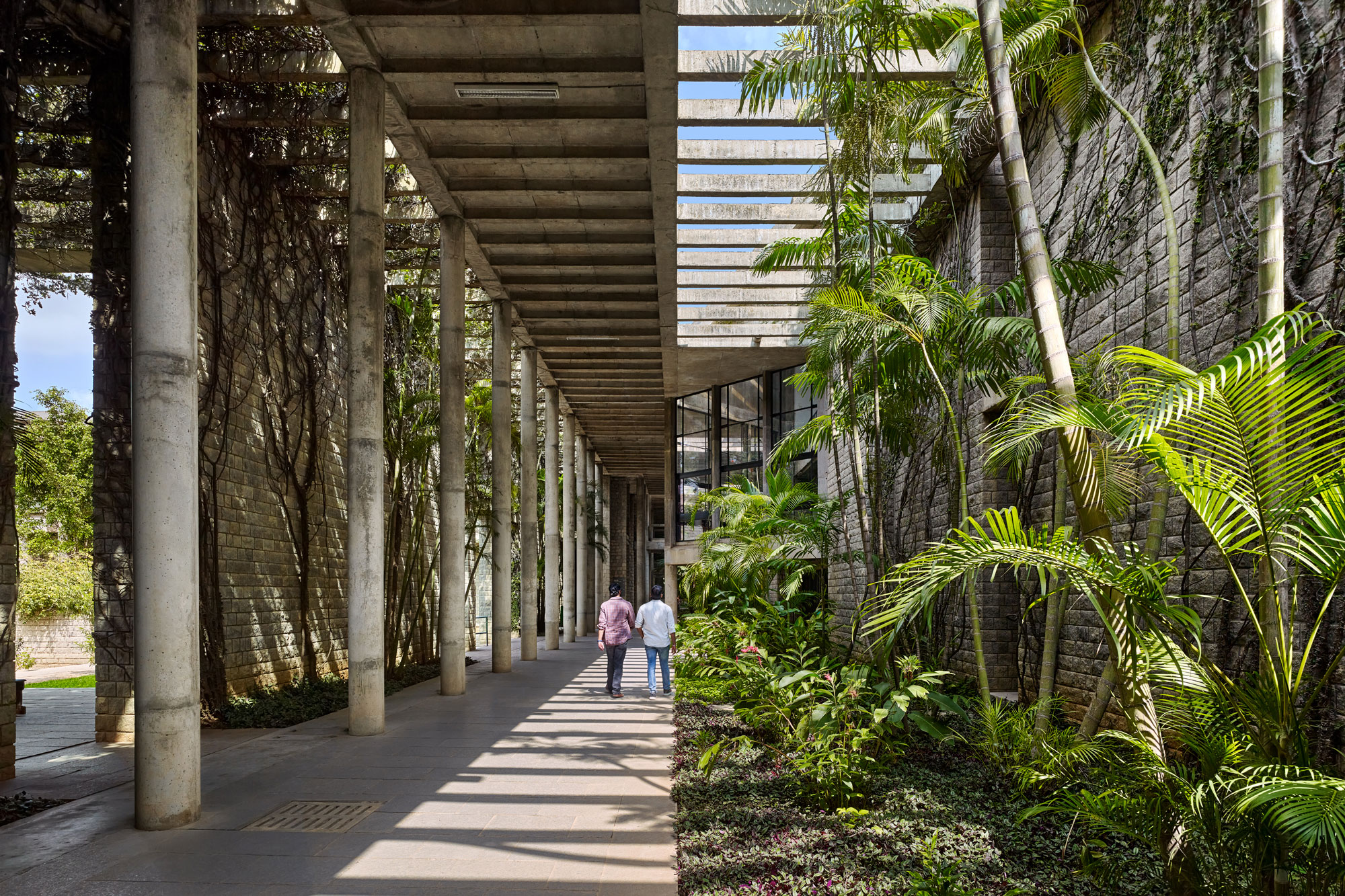
Speaking to a group of students at the campus in 2014, Balkrishna Doshi characterised the Indian Institute of Management Bangalore (1983) as not a building. “Can you ‘see’ IIMB as a building?” he asked.[1] In saying this, Doshi was emphasising that not only is IIMB not a building, but the typical components of a building had also receded from view. “It is not visible because nature has taken over – so you see a wall here, a pillar there”. The project at IIMB sits against the predominant practices of producing spectacular or robust buildings, and ushers in the principles of what I describe as an architecture of complexity.
At IIMB, Doshi has disaggregated the volumetric potential of a singular building into its components, rearranging them to generate new values and complexity, and overcoming the monolithic presence as demonstrated by Tagore Hall (Ahmedabad, 1961), a counter-example from his own work. This disaggregative approach was demonstrated earlier in Charles Correa’s Gandhi Ashram (Ahmedabad, 1964). Correa would continue with that organisational trope in a rambling manner at the National Craft Museum (New Delhi, 1975) and in a compact and mandalic geometry at the Jawahar Kala Kendra (Jaipur, 1986). In one stroke, the Gandhi Ashram evoked an Indianness that was irrefutable, heralding a new proposition and finding alignment with Gandhi’s oracular pronouncement: “I do not want my house to be walled in on all sides and my windows to be stuffed. I want the cultures of all lands to be blown about my house as freely as possible. But I refuse to be blown off my feet by any”.[2] The rawness of the construction, the typology of its pitched roof, the modularity of the grid, the degree of enclosure and porosity, and an inevitable concord with the surroundings, created a sprawled-out character where ambulation was not a necessity, but a virtue.
What I see in Correa and Doshi’s disaggregated building parti as a new proposition in Indian architecture, has been critiqued by others as evidence of a “postmodern architectural orientation”, a paradigm of regionalist architecture, or, in a nationalistic rhetoric, as “essentially Indian”. The diversity of the critique or claim is, in any case, evidence of a new pathway in Indian architecture.
While the disaggregated parti resolved better with the requirements of site, environment and habitability, its evolution and application had more to do with post-war debates amongst modern architects in Europe, and a growing predilection for what came to be known from the 1970s as “mat-building”.[3] I want to discuss IIMB within the discourse of mat-building and also argue how it is distinctive within that typology.
It is important to recall the new values that were being debated in the post-war period, particularly in the conferences of the International Congress of Modern Architecture (CIAM).[4] Modern architects of the time were exploring ways to wean themselves away from the regime of singular, sculptural structures, towards a family or complex of buildings. This shift in thinking came about as architects searched for ways to bring about greater social and communitarian relevance to their work. While the singular volumes provided opportunities to architects for displays of artistic brilliance, complexes enabled community organisation, along with novel spatial relationships and connections. The nature of complexes was a natural ground, so to speak, to define, articulate, and heighten relationships with the landscape.
In her 1974 essay, Alison Smithson emphasised the value of mat-buildings as they provided “new freedoms of action” made possible through “interconnections, close-knit patterns of association, and possibilities for growth, diminution, and change”.[5] In their 2002 case study of mat-buildings, Hashim Sarkis and colleagues described them as a field, ground, carpet or matrix. They note the following aspects of mat-buildings: close-knit formation, play on scale, efficiency in land use (although there is the question of sprawl), indeterminacy in size and shape, flexibility in building use, and a precursor to landscape urbanism.[6] To that, I would add, a fluid exchange between building and landscape.
Despite being unbuilt, plans for Corbusier’s Venice Hospital (1964) attained an iconic status among mat-buildings and captured the imaginations of architects searching for new values. The Hospital is a classic case in the modernist oeuvre in which Le Corbusier himself deviates from his own stand-out volumes in favour of a low-profile dispersed formation. Designed earlier than the Venice Hospital, the monastery at La Tourette (Éveux, 1960) conveyed a model of interconnected volumes organised through the decisive use of a corridor as more than a connector. These new ideas of a modern building as a ground-scraper, or a reified movement system, would not have been lost on Doshi in his years working closely with the Swiss-French master.
In the early 1960s, two projects – the Indian Institute of Technology Kanpur (IITK) by Achyut Kanvinde and the Indian Institute of Management Ahmedabad (IIMA) by Louis Kahn[8] – invited new possibilities in Indian architecture in the arrangement of complexes. These two projects represented the national policy on advancing higher education and emphasised the building up of a robust nation, both in the technological and managerial areas, as India prepared to take off as a sovereign nation. While the practices and spaces of education are an ancient topic in India, starting from the 1950s, the design of educational campuses encouraged a renewed culture of building, and an opportunity to rethink models of education and its practiced spaces. The programmatic blueprints – the curricula of the institutions – were billed as charting a course towards India’s future. Concurrently, their physical design and planning led to breakthroughs in the orientation of Indian architecture.
“You cannot isolate architecture from the age, from the social conditions, from the thinking, from the objectives and the ideals of that particular age”, so declared the prime minister, Jawaharlal Nehru, at a conference of architects in 1959. At that same meeting, on behalf of the architects present, Achyut Kanvinde appealed to the prime minister: “Our problems concerning architecture have changed entirely from the past age because of our changing cultural outlook, namely the political institutions, scientific and technological development, our knowledge about human sciences, and our new ideas of aesthetics developed as a result of visual arts. Almost all past periods of architecture came into being as a result of a desire for glorification, as an expression of the vanity of the ruling class and the dominant religious sentiments. Thus the architecture of the past was essentially feudalistic in approach. Contrary to this, the present political institutions are democratic in their approach where the stress is on the economic and social values related to the common man.”[9]
Architecture thus played a crucial part in the nation-building enterprise. Writing about the work of Kanvinde in India and Muzharul Islam in Bangladesh, James Belluardo and I commented: “The (Modern) Movement offered India the possibility of meeting its needs and participating along with the industrialised nations in a common future that would restore India’s greatness throughout the industrialised world.”[10]
IITK (1960-67) provided one of the earliest examples of a modern campus, designed in India in light of the new political ideal and techno-scientific ideology.[11] Kanvinde had been sent to Harvard University by the Nehru government to study architecture so that the architect could participate directly in the project of nation-building upon his return. It is not coincidental that Kanvinde’s first major project would be an educational institute, highlighting the significance of institutions of learning as the backbone of the nation. While the overall layout of the campus makes reference to Bauhaus planning principles, and in particular to the Graduate Center at Harvard University (Boston, 1950), the buildings themselves represent a significant departure. Kanvinde’s masterful handling of local red brick within a concrete frame acknowledges Le Corbusier and Kahn’s work at that time, the first buildings of the New Brutalists in England, and also St. Stephen’s College (New Delhi, 1938) designed by Walter Sykes George.[12]
Kanvinde’s new campus, as well as the book he wrote with H. James Miller, Campus Design in India(1969), provided decisive examples of how a large-scale architectural plan could embody modernist principles and Indian aspirations. The book provided an “instructive guide” for employing institutional campus design for a modernising country. What is notable about IITK is how pre-modern models were eschewed (certainly the notion of an ashram), to embrace a techno-intellectual utopia, or what Gropius saw as a “technical civilisation”.[13]Campus Design in India also included Kahn’s IIMA as a model in Kanvinde’s map for the future of India.
While Kanvinde’s project presented the free-standing disposition of buildings on a green field (of foliage and orchards) in a Bauhaus manner, Kahn’s IIIMA recalls Jefferson’s Virginia campus, but in a tightened disposition. IIMA appears as a monastic enclave for an aspiring managerial class. With a central court as a hub and the library as a fulcrum, building volumes radiate out with decreasing concentricity creating a regulated matrix of volumes and open spaces. The spaces invoke ancient cloisters and courtyards.
How much does Doshi’s IIMB constitute a breakthrough? While it is a continuation of the educational policy framed by the national government in the 1960s, and it echoes the architectural and spatial models evolved by Kanvinde and Kahn, it also develops a new language in the morphological and relational disposition of a campus. IIMB responds to the requirements of a modern campus – the diversity of departments and activities, and the continuous process of growth, change, and adaptability – but presents a condition in which the volumetricity of a building recedes within a landscape strategy. The latter includes deliberate planting, porosity in the fabric, and opening up to the ambient world. The campus proposes a language of informality in which the conditions of hierarchy and classification are reconsidered for an environment of diffusion and impromptuness.
IIMB sits on a hilly site of sixty hectares south of the city of Bangalore. Here, an inescapable reference to Bangalore as the so-called “city of gardens” is apparent. Although Doshi claims that he found the site a barren land upon his first visit – “without hardly a tree” – forty years of “nurturing” has made it blossom as a garden. Buildings barely peep out from among the lush foliage, students saunter between structures and trees as they navigate the campus, classrooms often feel like a gathering in a park, and the sun becomes “part of the architecture here”. The ground of IIMB now participates in the garden mythology of the city.
The reference to a garden setting for the campus also alludes to an ancient Indian venue for education and enlightenment – the ashram. Here, Doshi takes up an older model perhaps not attended to in the projects in Kanpur and Ahmedabad. Ashrams and gurukuls, mentioned frequently by Doshi in the context of IIMB, always have a tree reference, whether the guru sitting under a tree as one would imagine the Buddha in his asrama in Sravasti, or teachers and students gathering for a class in the amrakunja of Santiniketan. Although barely researched as a topic in modern architectural history, the asrama as an ancient Indian landscape of erudition and enlightenment is certainly a lush, picturesque setting of flora and fauna, amidst which were the occasional kutis for the rishis and the munis. Perhaps this is what made Rabindranath Tagore claim that civilisation in India began in the forest.[14]
At IIMB, the usual hyperbolic imagery of learning under the tree is translated into an idyllic campus with a complex modern program in which a very tectonic assemblage of frames and modularity (especially apparent in the models of the campus) weaves in and around miniature forests creating mutuality. This description may seem unconvincing without the intense interlocking of architecture and landscape demonstrating that the campus is a veritable garden. IIMB is as much landscape design as building construction.
Built in phases, in stone and concrete, the slow progression of the campus allowed for experiments in new construction. The tectonic language of the buildings is defined by an architecture of walls and columns, in a jugalbandi, as Doshi would say, in which the enclosures, as well as the passages, are decisively modulated in a dialogical manner. The complex is a weave of volumes and planes, heavy and light, orthogonal and diagonal, and with both stereotomic and tectonic configurations. The character of the buildings and their projected openings (increasingly projected up) resemble wooden architecture, certainly evidenced by the modularity and framework language of the openings.
Although not truly accretional – the scope of construction and development over the years was carried out by the same architect – the complex invokes that quality. To Doshi, the principal characters of a campus as IIMB are freedom, choice, and interaction. Abiding by the need of modern universities for flexibility and adaptation for change, the overall plan of the campus is a “loose grid,” in which growth as well as insertion and clustering of buildings is allowed. The modern institute with its diverse disciplines also needs groupings, a clustering without becoming tribal. IIMB’s interlocking buildings, courts, gardens and galleries create an ensemble of clusters. The idea of such a “loose grid” with the attachment of distinctive volumes recalls the temple at Madurai and the palace complex at Fatehpur Sikri. The density of buildings and paths woven through them make a reference to Kahn’s IIMA.
What makes IIMB distinctive is the articulated path in the forest. Where Kahn implies hierarchy (such as the honorific position of the library), Doshi adopts informality, and where Kahn foregrounds density (the academic building, the dormitories, and the faculty housing each have their distinctive density), Doshi prefers porosity.
IIMB’s grid is animated by an articulated passage, the promenade architecturale. There are multiple ways to navigate the campus at IIMB: along corridors and across courts and gardens, and walking up open staircases. The procession is often disciplined, on occasion diagonal, and often also meandering. In the video from 2014, as Doshi takes a group of students on a walk through the campus, he points to a construction detail here or the termination of the vista there, saying, “when you walk long distances, you have time to ponder, and interact and meet people by chance.”[15]
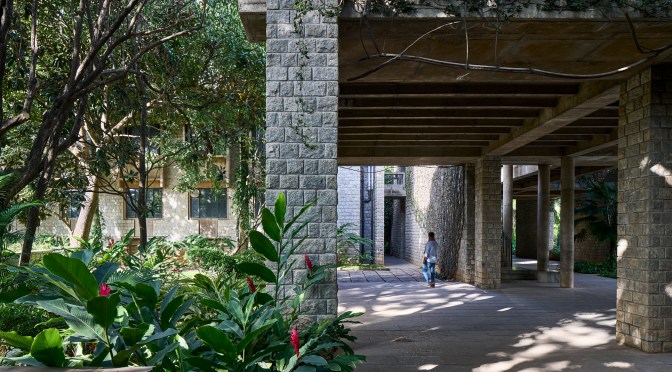
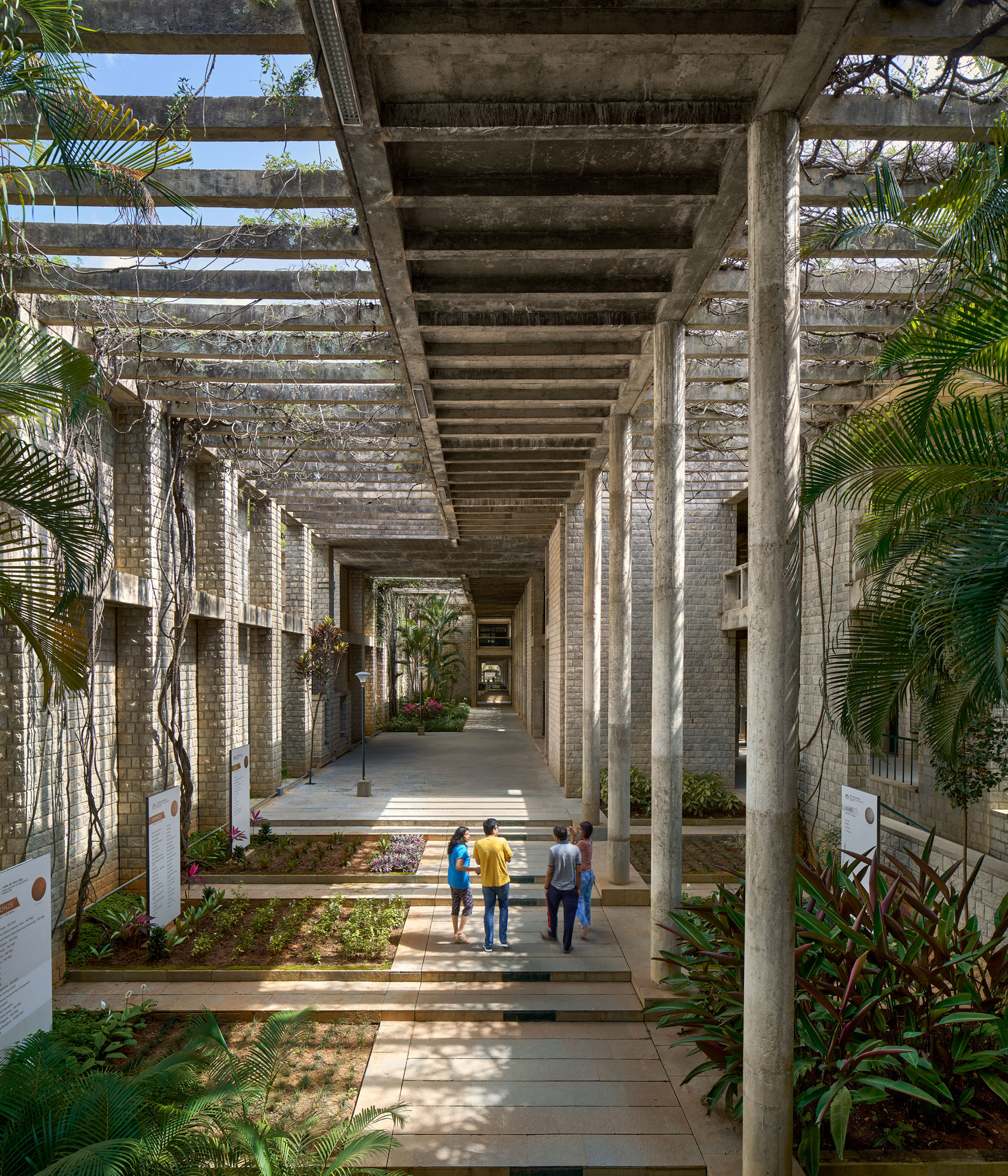
A street, in its truest sense, and analogically summoning the bustle of an Indian city, the walk is the raison d’être of the Institute. Any representative photograph of the project, including those here by Randhir Singh, is decisively of the passage in the garden. The passage receives many names: corridor, colonnade, pathway, or pergola. More than a corridor, as pragmatic infrastructure for walking, the “pathway-as-street” generates encounters and sociability. It is more experiential than purely visual.
Such pathways also link the ground, as I have written elsewhere, in the context of Louis Kahn’s arcade at the ground level of Exeter Library (1972), that such a pathway belongs to the ground and defines the grounding of a building.[16] Also, when the vault of the Kimbell Art Museum (Fort Worth, 1972) billows up, it opens to let the sun and air in. I have described such deliberate conditions in an architectural configuration, in which the air, ground, and sun are invited in, as a “landscape event.” Doshi’s architectural passages constitute such a landscape event, which necessarily positions the project as landscape architecture.
Such a celebration of the passage dissolves the dominance of volumetric presences. A horizon or destination is unclear in most framed images of the campus. While in Madurai, passages are obedient to constructed volumes, or even at IIMA, where the centrality of the main court or the library is always present, the overriding experience at IIMB is one of paths taken amidst non-deliberate volumetric presences. In such an architecture of passages, walls, columns and shadows are architectural protagonists. Staircases provide an additional rhythm to the columns and vistas – an upward diagonal passage.
In the promenade architecturale, in which one finds movement, the experience is one of cadence, connection and choreography. The relationships between buildings, or buildings and open spaces, are heightened. And all of that is experienced by humans in motion. Such an architecture of connections is an integral aspect of a disaggregated condition. Once disaggregated, connections become a critical aspect of the architectural parti. Connections are between buildings to buildings, and buildings to open spaces or gardens. The classic modulator of that connection in warm climates is the veranda. In that sense, the connectors at IIMB are also like tropical verandas that have become unmoored from some main volume and have become their own typology.
“Campus must be a place of discovery,” Doshi implores. “A place of not knowing and then knowing”. In such a campus, one “must have pauses”, as in moments of resolution in a process of dialogue and reaction. It is not ensured that such epiphanies will happen inside the disciplined classroom or the hermetically organised building. Such experiences are more likely in the liminality of “outside” spaces nestling along the hard edges of architecture. Doshi’s bet is on his street, the super-corridor, or the unmoored veranda, as the venue for such experiences. IIMB eschews the controlled knowability emblematised by a panopticon. It instead presents a landscape of spontaneity and spread, in which openings and light change in each corridor. All views are partial and, as in a Japanese garden walk, pathways shift to reveal new contours. ▪
CITATIONS
[1] Naveen Bharathi, Walk the talk with Dr. BV Doshi, YouTube video, 29:16, IIM Bangalore, August 25, 2014, https://youtu.be/7AuZ1cebqGU
[3] Alison Smithson, How to Recognise and Read Mat-Building. Mainstream Architecture as it has Developed Towards the Mat-Building, Architectural Design, September 1974.
[4]Congrès Internationaux d’Architecture Moderne. Active from 1928 to 1959, this organisation was influential in spreading the principles of the Modern Movement with a focus on architecture.
[6] Hasim Sarkis, Pablo Allard and Timothy Hyde, Le Corbusier’s Venice Hospital and the Mat Building Revival, Prestel, 2002.
[7] It is perhaps relevant to note Smithson’s familiarity with India because of her, and her partner Peter’s, association with Le Corbusier in Chandigarh.
[8] Doshi worked with Kahn, as an associate, on the design and construction of IIMA, eventually collaborating with him for a decade.
[9]Seminar on Architecture, Lalit Kala Akademi, New Delhi, March 1959
[10] Kazi Khaleed Ashraf and James Belluardo, Building the Nation: The Architecture of Achyut Kanvinde and Muzharul Islam, India International Center Quarterly, Volume 24, Monsoon 1997.
[11] Although Santiniketan, built by the poet Rabindranath Tagore in Bengal in the 1901, is an example of a deliberately planned campus, it is not taken up in a discourse on planning. Nonetheless, Santiniketan as a unique campus “wrapped in nature” may have provided to Doshi one notion of the campus as a garden.
[13] The paper argues that Kanvinde’s book presented progressive concepts of campus planning but filtered them through the lens of nation-building ideology and history. Maryam Gusheh and Prajakta Sane, “Form and Design for India: Achyut Kanvinde’s Reflection on Louis Kahn”, SAHANZ 2017 Annual Conference Proceedings.
[16] Kazi Khaleed Ashraf, Taking Place: Landscape in the Architecture of Louis Kahn, Journal of Architectural Education, November 2007.
KAZI KHALEED ASHRAF
Architect, Professor, Urbanist, Architectural Historian, Director-General of the Bengal Institute for Architecture, Landscapes and Settlements.
As one of the notable architectural critics of South Asia, Kazi Khaleed Ashraf works at the intersection of architecture, landscape and the city. He has authored books and essays on architecture in Bangladesh and India, the work of Louis Kahn, and on the city of Dhaka.
Ashraf has taught at the University of Hawaii at Manoa, University of Pennsylvania, Temple University and Pratt Institute in the USA, and lectured internationally. He is the author of numerous publications including The Hermit’s Hut: Architecture and Asceticism in India (2012), An Architect in Bangladesh: Conversations with Muzharul Islam (2014), Designing Dhaka: A Manifesto for a Better City (2012), and The Great Padma: The Epic River that made the Bengal Delta (2023). His essays and articles have appeared in the Architectural Review, Architectural Design, Topos, Economic and Political Weekly, and many other periodicals. Ashraf and his contributing team received the Pierre Vago Journalism Award from the International Committee of Architectural Critics for the architectural design publication “Made in India” (2007).
At the Bengal Institute for Architecture, Landscapes and Settlements, Ashraf directs a unique program involving academic, research and public activities around the topic of habitats in a hydrological milieu.
BALKRISHNA V. DOSHI 1927 – 2023
Architect, planner and teacher.
Born in Pune to an extended Hindu family of furniture manufacturers, Balkrishna Vithaldas Doshi, is one of India’s most celebrated practitioners of architecture. He is known for his extensive contributions towards the evolution of architectural discourse and as the first Indian architect to be awarded the Pritzker Architecture Prize (2018). Through his lengthy career, his projects adapted principles that he mastered while working with Le Corbusier and Louis Kahn, while expanding on them to create timeless spaces that reflect the environmental and sociocultural aspects of the country.
After completing his initial architectural studies at the J.J. School of Architecture in Bombay, Professor Doshi worked as a Senior Designer (1951-54) with Le Corbusier in Paris before returning to India to oversee his projects in Ahmedabad. He also worked with Louis Kahn on the Indian Institute of Management, Ahmedabad and continued to collaborate with Kahn for over a decade.
In 1956, he started his own office in Ahmedabad – Vastushilpa, with two architects. In a career spanning almost seven decades and over 100 projects, his work has included large institutional buildings along side projects that cater to the economically weaker sections of society. Some of his most notable projects are – Sangath (his workspace), Kamala House (his home), Institute of Indology, Shreyas Comprehensive School, School of Architecture CEPT, Kanoria Centre for Arts, Premabhai Hall, Tagore Hall, LIC Housing, Aranya Low-Cost Housing, Indian Institute of Management Bangalore and Amdavad ni Gufa.
Deeply interested in environment, sustainability and education, Professor Doshi established the Vastu-Shilpa Foundation for Studies and Research in Environmental Design in Ahmedabad (1978). He was the founder and Director of the School of Architecture (1962-72) and the School of Planning (1972-79), the Dean of the Centre for Environmental Planning and Technology (1972-81), a founding member of Visual Arts Centre, and the Director of Kanoria Centre for Arts in Ahmedabad.
In recognition of his distinguished contributions, Professor Doshi was posthumously awarded the Padma Vibhushan (2023). His numerous awards include, the RIBA Royal Gold Medal (2022), Foreign Honorary Member – American Academy of Arts and Letters (2021), Padma Bhushan (2020), Pritzker Architecture Prize (2018), Officer of the Order of Arts and Letters, France (2011), Global Award for Lifetime Achievement for Sustainable Architecture – IFA (2007), Prime Minister’s National Award for Excellence in Urban Planning and Design (2000), Aga Khan Award for Architecture (1995), Gold Medal – Academy of Architecture, France (1988), Gold Medal – Indian Institute of Architects (1988), and the Padma Shree (1976).
Two retrospectives of his work, Celebrating Habitat: The Real, the Virtual and the Imaginary and Balkrishna Doshi: Architecture for the People were shown at numerous galleries internationally and in India. A comprehensive book on his work, Balkrishna Doshi – Architecture for the People was published by the Vitra Design Museum in 2019 in collaboration with the Vastu Shilpa Foundation.
Over the last decade, Professor Doshi reinvented himself as an artist. Anand Karo (celebrate life), as he would always say, was reflected in his work and allowed for a timelessness that is present in his projects. He held a profound desire to link people to their memories and created spaces that strengthen this association. His architecture, as spaces of memory, remains something that people celebrate even today.
RANDHIR SINGH
Randhir Singh is an architectural photographer based in New Delhi and Barcelona. He has a Bachelor of Architecture from Rensselaer Polytechnic Institute in New York and fifteen years of work experience as an architect. Over the it last decade, his photography practice has focused on issues related to architecture, modernism and the urban landscape. Singh was commissioned by the Museum of Modern Art, New York to photograph an extensive collection of architecture in South Asia for the exhibition The Project of Independence: Architectures of Decolonization in South Asia, 1947-1985 (New York, 2022). A selection of these photographs were acquired by MoMA for their permanent collection. Photographs from this body of work have been included in Tropical Modernism at the V&A Kensington (London, 2024) and Photo City at the V&A Dundee (Dundee, 2024). His 1 photographs of modernist campus of the Indian Institute of e Technology Delhi were included in a two person exhibition, with Madan Mahatta, at Photoink (New Delhi, 2020) and Arthshila (Ahmedabad, 2022).
He has collaborated with the artist Seher Shah on Studies in Form, a project exploring the overlaps between photography, architecture and drawing. This work was shown as a part of Bearing Points at the Dhaka Art Summit (Dhaka, 2018), the Jameel Arts Centre (Dubai, 2019), the Kiran Nadar Museum of Art (New Delhi, 2022) and the SCAD Museum of Art (Savannah, 2022). Singh’s extensive documentation of social housing projects in New Delhi, titled CPWD, was shown as a part of When is Space? at the Jawahar Kala Kendra (Jaipur, 2018).
His Water Towers series, exploring industrial architecture and urban landscape, was shown at the Pondy Photo Festival (Pondicherry, 2016) and as a part of the Body Building exhibition at the Ishara Art Foundation (Dubai, 2019). Continuing his interest in the urban landscape, a selection of his photographs examining waterways and hydraulic architecture were included in the award winning Yamuna River Project publication and exhibition (New Delhi, 2017). Singh is the photographer and editor of the Modern South Asia series. His photographs have been included multiple publications and magazines worldwide.
An editorial project by Matter in partnership with Şişecam Flat Glass, PRAXIS investigates the work and positions of diverse contemporary architecture practices in India.In this episode, Swati Janu of Delhi-based Social Design Collaborative emphasises on their idea of design and collectives as prisms to multiply opportunities to make architecture and its responsibilities accessible as a conversation to all; especially to those outside the purview of planning processes. The practice engages with an integrated approach to arrive at meaningful enquiries and possible opportunities at a more localised level, in tandem with the governance and power structures, community networks and the city. Architecture is conceived as a sort of node in the broader system. Swati, and her colleagues, Shreya Rajmane and Anushritha Sunil reflect on their processes and values that guide and conciliate technical and narrative tools to translate ‘projects’ across spatial, planning, advocacy, academia, art, writing, research and other diverse forms.

A Recorded Lecture from FRAME Conclave 2019: Modern Heritage
In this lecture, A Srivathsan presents his view on the construction of Hindu Temples, and raises pertinent questions about the orientation of contemporary and modern architecture within this discourse. Using examples of temples built by young practitioners as a prism, he draws distinctions and similarities between what the sacred is and what is modern.
An editorial project by Matter in partnership with Şişecam Flat Glass, PRAXIS investigates the work and positions of diverse contemporary architecture practices in India.In the episode, Abhirup Duttaand Deeptashree Sahareflect on the intellectual roots of their work asThe Vernacular Modern. While anchored in their emphatic thematics of material cultures, and engineering, the imagery of the vernacular and the modern eponymously makes for their repertoire of furniture, art, architecture and objects. The formidably functional range is deeply researched, as evidenced by the studio’s process that is simultaneously organic and directional, embedded in the idea of ‘slowness’ and ‘an artisan-led’ approach. The Vernacular Modern’s work places these objects as signifiers in a complicated context and legacy of craft heritage in India. Working consciously with old demolition timber and towards contemporary narratives born of relearning and exploring, it asks a more nuanced question of itself – about true sense of collaborations, and developing products with a purpose.