The Takshila Lecture on Architecture and Society is delivered by an eminent professional / academician that addresses the growing disparity between the practice and pedagogy of Architecture in India, and the realities of our social, cultural and economic contexts. The lecture and the following dialogue aim to challenge the status- quo with a conviction that an open and honest conversation on the state of practice will instigate positive change.
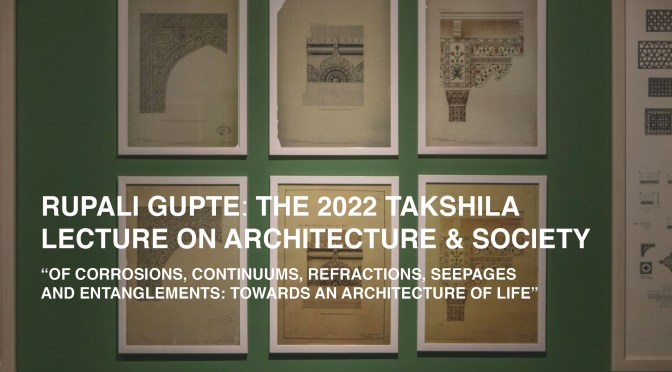
The 2022 Takshila Lecture on Architecture and Society was delivered by Rupali Gupte at Arthshila Ahmedabad on October 16th, 2022.
Category Archives: Architecture
PRAXIS: A Panorama on Contemporary Architecture in India
PRAXIS is a curatorial project to chronicle contemporary architecture practice in India, with a particular emphasis on the principles, the structure, the challenges and the ideology. This film – a panorama of the first phase of the PRAXIS initiative – documents eleven studios from across India.

PRAXIS
A Panorama on Contemporary Architecture in India
Continue reading PRAXIS: A Panorama on Contemporary Architecture in India
The Potential of Glass
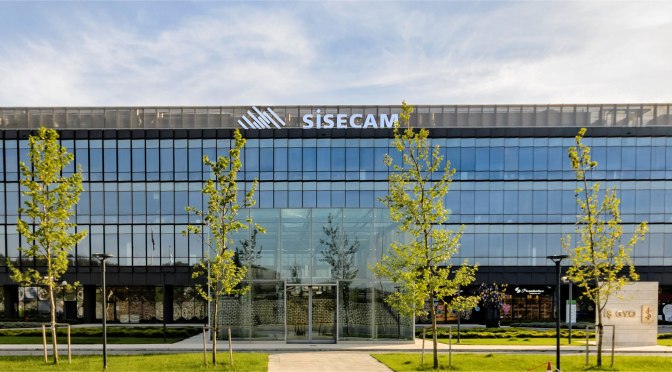
In the advancement of urban architecture, glass has played a key role and Şişecam Flat Glass has worked extensively to bring forth glass products catering to safety, functionality and aesthetics. Originating from Turkey, Şişecam Flat Glass is a multinational glass production company with manufacturing facilities in fourteen countries and a presence spanning 150 countries. With an experience of over 85 years, Şişecam Flat Glass has worked with the motto, ‘The world is our market’. Their values are grounded in building fair, transparent and mutually beneficial relationships through knowledge exchange with collaborators in all fields in the construction industry.
Glass can be perceived in two ways – through the lens of materiality and utility. In its innate properties, it offers control on several levels. With the right treatment and application one can modulate heat, light, noise, safety, visual connect, physical connect, ventilation, the feel of a space and aesthetic requirements of a space. Secondly, and more importantly, glass can be perceived as an idea.
How does this material extend as a means to an end to facilitate ideas?
Tracing the roots of its usage, an understanding emerges that historically, glass was used for smaller fenestrations or as fragmented parts of a whole such as in a stained-glass window. What was once a luxury material started to become more accessible during the industrial revolution. As iron and steel construction technologies developed in parallel, the glass and metal combination became key in the modern architecture movement. Glass started to appear in public spaces that demanded naturally well-lit large spaces. As towering glass-clad skyscrapers started rapidly dotting the horizons, developments in structural glass led to the material playing a critical role in today’s urban architecture. In a tropical climate like India, where heat is unavoidable, the usage and sourcing of this material evokes careful consideration. In this context, Şişecam Flat Glass is one of the world’s leading glass producers that is set apart by its brand values. As General Manager of Şişecam Flat Glass India, Mukesh Sharma articulates, Şişecam believes that glass is not a commodity, but a functional product that adds value to the user.
Continue reading The Potential of GlassMartand Khosla: Experiments of Urban Enquiry
Through his art and architecture, Martand Khosla has created a niche that lies at the intersection of the two fields. His installations embody philosophies from this undefinable space, as he extracts questions using art as a voice, and architecture as principles, to raise concerns about humanitarian aspects of societal and political systems.

The practice of Martand Khosla inhabits a transitional space between art and architecture, which enables him a platform to address concerns that transgress architecture as independent habitable spaces. He co-founded, and is a partner of the architectural practice RKDS (Romi Khosla Design Associates), which has obtained both national and international recognition through its award-winning designs.
Continue reading Martand Khosla: Experiments of Urban EnquiryPrem Nath: The Architect’s Performance
In conversation with Prem Nath of Mumbai-based Architect Prem Nath and Associates, we discuss the numerous obstacles traversed in his architectural journey, as well as some of the landmark projects that brought him to the forefront of contemporary architecture in India.
The following text is the edited transcript of the interview conducted with Prem Nath at his Mumbai office, on the 14th of October, 2021
I. Origins
Everybody always asks me this question – “Mister Prem Nath, how did you become an architect?” It seems almost like a miracle, that I became an architect.
Back in my time, in the 1950s, pre-independence – people did not know what an ‘architect’ was. Engineers, overseers and mistris (labourers), were common terms known to people, but they had never heard of the term, ‘architect’. I myself had no idea what architecture was. I became an architect by fluke, you may call it. Maybe fate had determined I was to become an architect through a series of random events, and I had no idea at the time.
Continue reading Prem Nath: The Architect’s Performance