
Subscribe to continue reading
Subscribe to get access to the rest of this post and other subscriber-only content.

Subscribe to get access to the rest of this post and other subscriber-only content.
In this lecture, Riyaz Tayyibji speaks about a fictional conversation between M K Gandhi and Le Corbusier. Through the dialogue, he discusses their relationship with work and lifestyle, and their intimate connection with the inside and the outside.
Before I get to the two gentlemen that I would like to talk about today, a short note about the method I have used of juxtaposing two seemingly unrelated people together; this was a method that was first introduced to us as students of Prof. A.D. Raje, who would give students an exercise to imagine a conversation between, say Louis Kahn and Mimar Sinan at a coffee shop in Istanbul. This is certainly not a historian’s method; it is an architect’s method. An approach that would not only require the rigours of research to imagine the content of the conversation but would allow you to play with these ‘facts’ and their interpretations. In Raje’s exercise, the hypothetical context, the coffee shop was important. You had to define the hypothetical time in which the conversation was taking place. Somewhere in the process, it would emerge that this ‘hypothetical time’ was really a mirror of our own time.
Often the narrative of the present in which our history is written remains covert. One of the things that I enjoy about this method is that it ensures that the preoccupations of our own time are integrated into the narrative while always remaining explicit. Given the formality of our gathering today, I have chosen the form of a dialogue between one, Mr. M.K. Gandhi and another, Le Corbusier rather than a causal chat in a Byzantine café.
In this lecture, Ram Rahman speaks about the works of his father, the noted architect Habib Rahman. He also speaks at length about Jawaharlal Nehru‘s vision for the new nation, the architecture and design in Delhi post-independence and its present-day state.
Basically, my approach to what I am talking about has come through photography. I am not really a historian. I am only here because my father, who you see there (referring to image 01), Habib Rahman was an architect and I grew up in the milieu of many of the architects whose work will be discussed today, but I will begin very quickly.

In a tribute to some of my Goan friends, these are pictures I did of Mario Miranda and Charles Correa at Dona Sylvia a number of years ago (referring to image 02). So, a tribute to them, tribute to these fantastic people who came out of Goa and did amazing work.

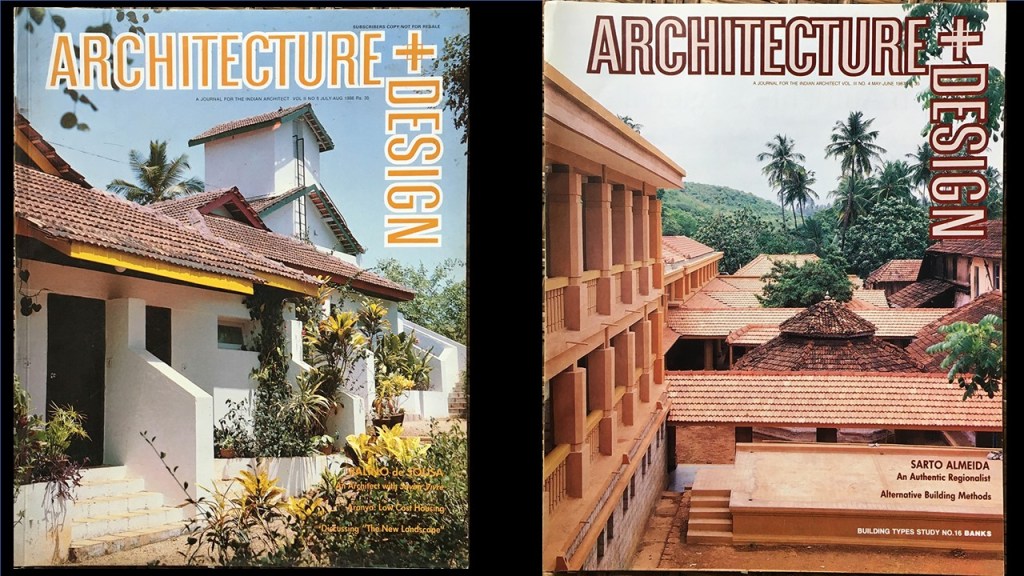
I first came here in 1986, it was for ‘Architecture + Design’ magazine (referring to image 03) at that time edited by Razia Grover. My introduction to Goa was actually Goan modernism in architecture. I came here to photograph the work of Ralino De Souza, Peter Scriver mentioned him earlier today, and I am happy he did. Also, Sarto Almeida and Lucio Miranda amongst many others. And these were wonderful issues at the time when much of this work had actually not been seen in the rest of India. So, salute to these architects too.
Continue reading Nehru and the Delhi Modern Movement: Architecture and Design in Delhi 1947-1980In this lecture, Dr Himanshu Burte speaks on the nature of Laurie Baker’s human-centric architectural practice; as an empiricist, environmentalist and extremely critical and creative practitioner.
So it is going to take a while for me to recover from one hour of Geoffrey Bawa and after this lush serenity, especially because I have to follow it up with an argument. But, I will go ahead and I am going to be talking about Laurie Baker. I have kept what I am saying fairly narrow and it is mainly in the form of a straight-on argument I am offering, and I am hoping that we can have a discussion afterwards, whenever we are scheduled. I have actually changed the title from what is published or what was originally given to it, because I actually took the title of my obituary for Baker, written just after he passed away and because of the resonance with yesterday’s discussion around Gandhi and Architecture.
I will begin by looking at the context, the objectives and the premises of what I have to say. To begin with, since this is about heritage and we are talking about Modern Heritage particularly, I approach heritage with the understanding that every map is really a plan. It just does not show you what is there, but it is a project. Heritage in that sense, I see as an exercise in constructing the future. By constructing the past in certain ways, by preserving certain memories and ascribing certain meanings to it, we are really constructing and doing the work of creating a future that we want. That I think extends to some extent to Prem‘s point, though I am sure he would not necessarily disagree with this. So, given that this is what is involved in thinking about heritage, it becomes very important to be conscious of our value positions and especially about the ethic of architecture, its politics, economics, the aesthetics and of course, the actual processes and practices that go into making the practice or the product itself.
Continue reading GANDHI OF SPATIAL DELIGHT: THE CRITICAL PRACTICE OF LAURIE BAKERIn this lecture, Kazi Khaleed Ashraf discusses the works of two prominent contemporary architects – Muzharul Islam and Louis Kahn as counterpoints to modernism in the Indian subcontinent. He also speaks about understanding modernity, modernism and the positions either took in the way they practised architecture.
In the pursuit of framing and reframing modernism, perhaps we might have to rethink the various ways we described modernism, tropical modernism, we might have to call it – monsoon modernism. Monsoon in the subcontinent is what sank European modernism; that is something to think about. I have been tasked to talk about two architects – Muzharul Islam and Louis Kahn. Muzharul Islam is from Bangladesh. He is what one could describe as the kind of a father figure of modern architecture. That term, ‘father figure’, is how Ranjit Hoskote described Charles Correa. If you replace Charles Correa with Muzharul Islam and other specific details, that is Muzharul Islam in Bangladesh. He was an architect, teacher, activist and most importantly, he was openly engaged in politics. He was a hardcore Marxist, a politically engaged persona. So I think among all the pioneering architects we are discussing here today, this is an interesting moment to think about an architect, who is both – an architect professionally engaged with the larger cultural milieu, and also devotedly engaged in politics. And the other person whom you are more familiar with, especially I am thinking about the younger architects and students. I am not sure how much you are familiar with Muzharul Islam so I will be taking up the task of talking about him in the next fifteen-twenty minutes, but you are surely familiar with the other person, Louis Kahn, who was invited to Bangladesh, and Muzharul Islam was involved in that invitation.
Continue reading CONTRAPUNTAL MODERNISM: THE ARCHITECTURE OF MUZHARUL ISLAM AND LOUIS KAHN