Tag Archives: Frame Conclave

The Architecture of Golconde

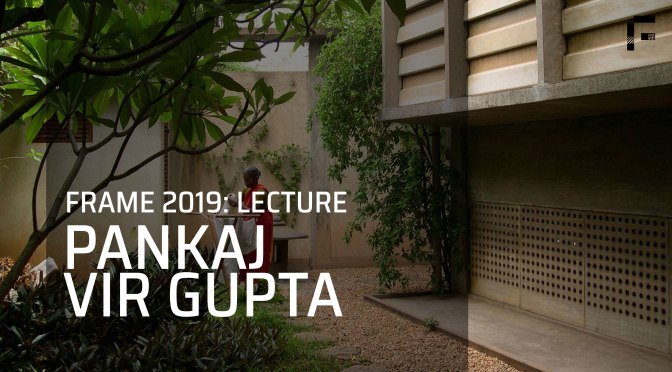
Pankaj Vir Gupta

A Recorded Lecture from FRAME Conclave 2019: Modern Heritage


In this lecture, Pankaj Vir Gupta discusses the conception of Sri Aurobindo Ashram in Pondicherry. Gupta delves into the architectural history of this structure, highlighting its pioneering use of concrete in India. He recounts his personal experiences at Golconde, sharing vivid details about the architecture and its unique features.

Edited Transcript

It is a particular privilege to be presenting a project with which we started our practice in 2003 and in the office archives, this is project 001 (referring to image 01). So, this morning to wake everyone up, I think it is important to understand why we are here to talk about this building and I will try and make it as energizing for you as possible.

My name is Pankaj Vir Gupta, and with my partner, Christine Mueller, I run a practice in New Delhi called Vir-Mueller Architects. I am also a professor of architecture at the University of Virginia, where I run what is called the Yamuna River Project, a multi-disciplinary research project, looking at ecology and urbanity in the megacities of the world. But to go back to how we started our practice, I was leading a study abroad program with some students from the University of Texas and we happened to be visiting Pondicherry, to look at the urban fabric of the city (referring to image 02), and we came across this extraordinary building (referring to image 02) and it was a surprise to me personally, because in several years of architectural education and research, I had never come across this building in any writing or any publication, at least not in the curricular work that we had been exposed to in our education.

Continue reading The Architecture of Golconde
NID’s Early Years: An Indian Experiment of Global Relevance

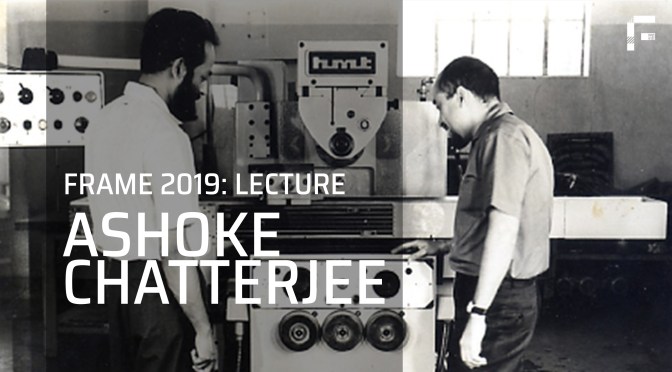
Ashoke Chatterjee

A Recorded Lecture from FRAME Conclave 2019: Modern Heritage


In this lecture, Ashoke Chatterjee talks about the inception of the National Institute of Design in Ahmedabad, its formative years, the pedagogy provided to the students, the experiments with the curriculum, the challenges, successes, and failures it faced in becoming the ‘world-class’ institute it sought out to be today.

Edited Transcript

I am delighted to have this opportunity to be back in Goa after forty-one years. The last time I came here, it was to assist the Government of Goa with a study of its ‘carrying capacity’ for tourism: how would Goa manage the growth of tourism in coming years? This might mean tough decisions of planning and control. I need not tell you that my report was trashed long before the Hall of Nations. Goa is clearly still struggling with those issues, but it is good to be back. I am grateful to the organizers, to FRAME Conclave for inviting me.

Let me start by indicating that this talk will be a very personal view of one part of contemporary Indian design history. It will focus on the experience of one institution, the National Institute of Design, its educators, and those who studied there. It will cover some years of a larger institutional history as well as design in modern India. Yet NID has been a catalyst, so it is valid to draw on an experience which has been unique not only in India but in a global context.

Continue reading NID’s Early Years: An Indian Experiment of Global Relevance

INDIA: MANY MODERNITIES – THE JOURNEY OF INDIAN RASAS

Subscribe to continue reading

Subscribe to get access to the rest of this post and other subscriber-only content.

LE CORBUSIER AND M K GANDHI: AN UNLIKELY DIALOGUE

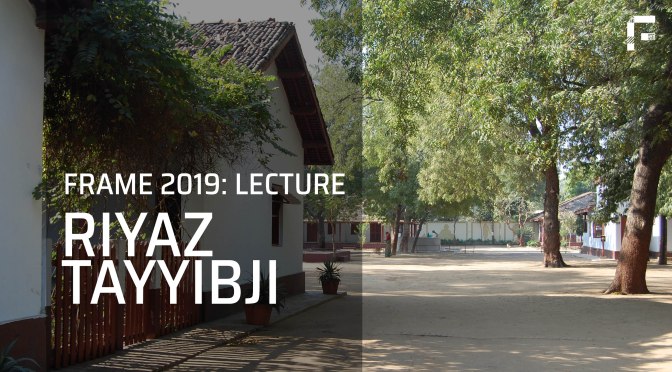
Riyaz Tayyibji

A Recorded Lecture from FRAME Conclave 2019: Modern Heritage


In this lecture, Riyaz Tayyibji speaks about a fictional conversation between M K Gandhi and Le Corbusier. Through the dialogue, he discusses their relationship with work and lifestyle, and their intimate connection with the inside and the outside.

Edited Transcript

Before I get to the two gentlemen that I would like to talk about today, a short note about the method I have used of juxtaposing two seemingly unrelated people together; this was a method that was first introduced to us as students of Prof. A.D. Raje, who would give students an exercise to imagine a conversation between, say Louis Kahn and Mimar Sinan at a coffee shop in Istanbul. This is certainly not a historian’s method; it is an architect’s method. An approach that would not only require the rigours of research to imagine the content of the conversation but would allow you to play with these ‘facts’ and their interpretations. In Raje’s exercise, the hypothetical context, the coffee shop was important. You had to define the hypothetical time in which the conversation was taking place. Somewhere in the process, it would emerge that this ‘hypothetical time’ was really a mirror of our own time.

Often the narrative of the present in which our history is written remains covert. One of the things that I enjoy about this method is that it ensures that the preoccupations of our own time are integrated into the narrative while always remaining explicit. Given the formality of our gathering today, I have chosen the form of a dialogue between one, Mr. M.K. Gandhi and another, Le Corbusier rather than a causal chat in a Byzantine café. 

Continue reading LE CORBUSIER AND M K GANDHI: AN UNLIKELY DIALOGUE

GANDHI OF SPATIAL DELIGHT: THE CRITICAL PRACTICE OF LAURIE BAKER

Himanshu Burte

A Recorded Lecture from FRAME Conclave 2019: Modern Heritage


In this lecture, Dr Himanshu Burte speaks on the nature of Laurie Baker’s human-centric architectural practice; as an empiricist, environmentalist and extremely critical and creative practitioner.

Edited Transcript

So it is going to take a while for me to recover from one hour of Geoffrey Bawa and after this lush serenity, especially because I have to follow it up with an argument. But, I will go ahead and I am going to be talking about Laurie Baker. I have kept what I am saying fairly narrow and it is mainly in the form of a straight-on argument I am offering, and I am hoping that we can have a discussion afterwards, whenever we are scheduled. I have actually changed the title from what is published or what was originally given to it, because I actually took the title of my obituary for Baker, written just after he passed away and because of the resonance with yesterday’s discussion around Gandhi and Architecture.

I will begin by looking at the context, the objectives and the premises of what I have to say. To begin with, since this is about heritage and we are talking about Modern Heritage particularly, I approach heritage with the understanding that every map is really a plan. It just does not show you what is there, but it is a project. Heritage in that sense, I see as an exercise in constructing the future. By constructing the past in certain ways, by preserving certain memories and ascribing certain meanings to it, we are really constructing and doing the work of creating a future that we want. That I think extends to some extent to Prem‘s point, though I am sure he would not necessarily disagree with this. So, given that this is what is involved in thinking about heritage, it becomes very important to be conscious of our value positions and especially about the ethic of architecture, its politics, economics, the aesthetics and of course, the actual processes and practices that go into making the practice or the product itself. 

Continue reading GANDHI OF SPATIAL DELIGHT: THE CRITICAL PRACTICE OF LAURIE BAKER