
AYAZ BASRAI
A Recorded Lecture from FRAME CONCLAVE 2025 —
[AUTHORING 01: TO DRAW]
In this lecture, Ayaz Basrai explores drawing as a way of thinking, not just a way of recording, tracing how the act itself can reveal how the mind constructs and misremembers what it sees. He sees drawing as a bridge into unfamiliar ways of perceiving, whether human, ecological, or computational, and concludes with a sense of cautious optimism speculating where emerging technologies might take the practice next.
The lecture series presents the full set of talks from the conclave. The published text is an edited transcript (adapted from spoken presentations) rather than a formal essay written by the author themselves. For complete documentation including visual material and video, please refer to the recording.
Edited Transcript
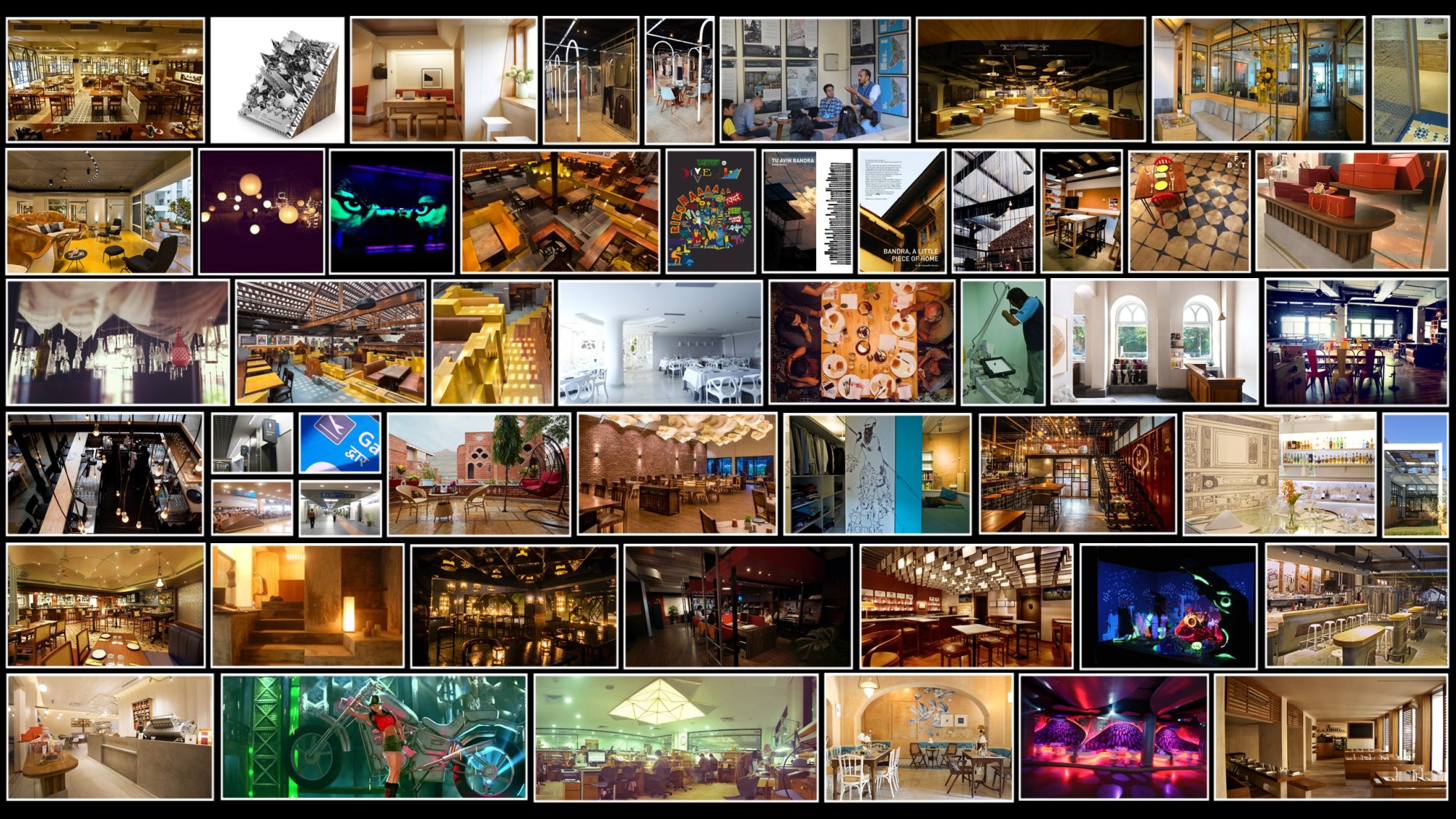
(referring to image 01) What I would like to talk a little bit about is to explore the contours of what we have been interested in doing within the studio, and it is loosely termed a pluriverse, so bear with some of the chaos that we will be sharing. As a studio, one thing that we have always tried to build in is a sense of polyvalence, trying to be excited about as many diverse things as possible.
Over the years, we have done a lot of hospitality projects. We have probably contributed to more cultural detritus than any other practice. A lot of the junk that you see around your cities probably has our signature on it – bars, restaurants, clubs, cafes, everything that starts today and shuts down in six months. Along the way, we have also worked on Bollywood films. We have done lots of work with immersive media and illustration. Drawing has been, I think, a fairly central part of that expression.
Processes and Work-flows
[02:45] What is continuously fascinating for us in the studio is to keep experimenting with processes and workflows. What we will see here is really a long, ongoing experiment with all kinds of different processes, technologies, ways of approaching drawing, and also things that we can glean from this process of engaging with drawing.
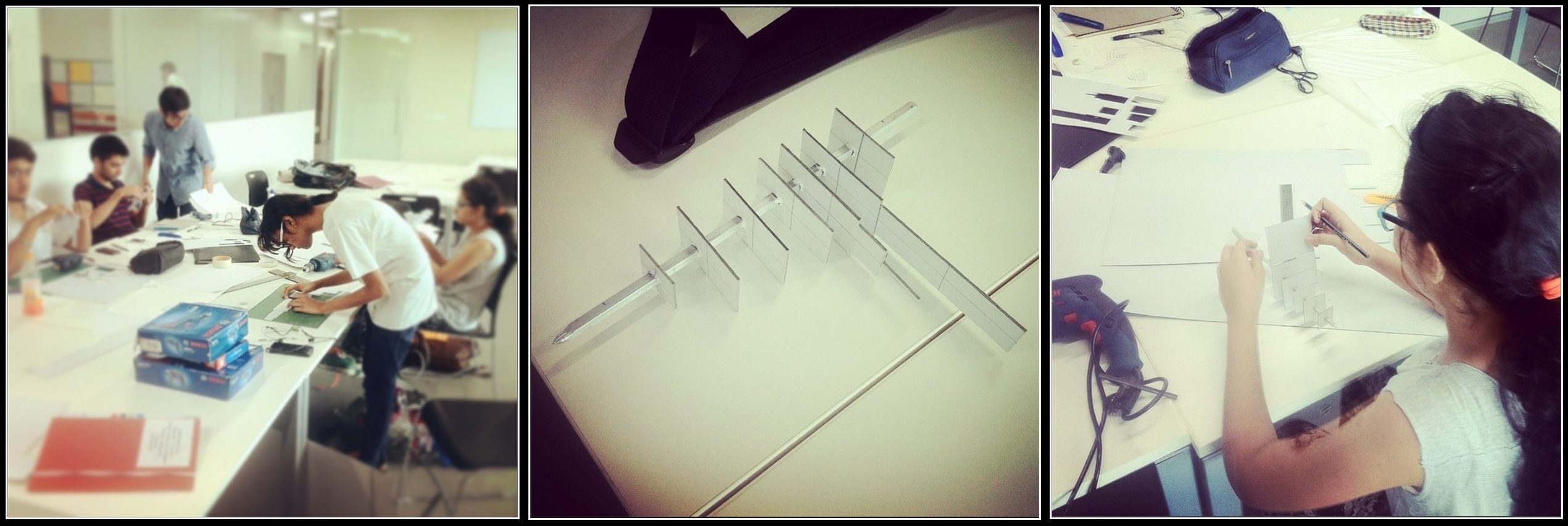
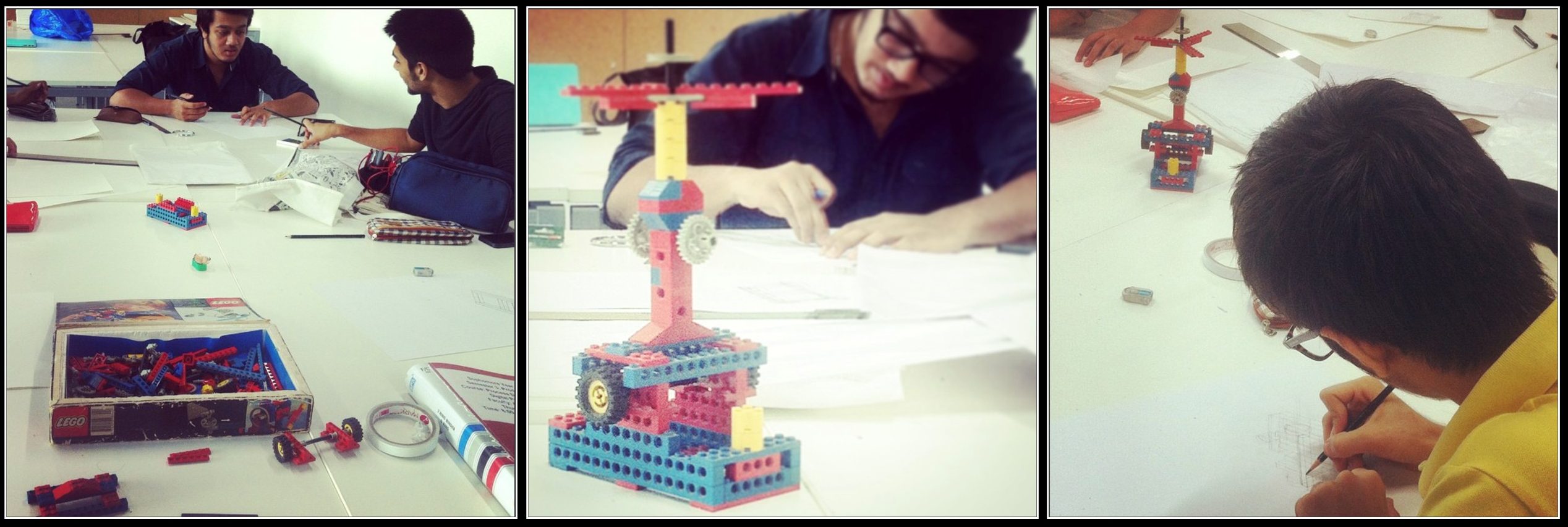
(referring to image 02, 03) I used to teach a process drawing course at the ISDI Institute in Mumbai and at Parsons School of Design, and we put students through weird experiments. We had a class where people would sit and draw a very rapidly changing slideshow of very dubious contents. On the top is a gun. They had to keep essentially drawing construction drawings as slides were changing really fast, in an effort to study how the mind works and how the mind processes these kinds of images.
We also realised one really interesting thing: when you are drawing, what you are doing is actually cheating a little bit. Your brain is seeing an image; the brain constructs that image inside your mind, and what you are drawing from is that mental image. You are actually not drawing what you are seeing. We used to find very simple mistakes in drawings, especially when drawing a construction drawing of a chair. You would see a perspective shift in the drawing which actually does not exist in front of you, and you realise that the student has imagined the chair already in their head, and they are drawing from that imagined image and not really looking at reality anymore. My continuous interest, and almost a bit like ragging these students, was to keep on experimenting and excavating where this drawing and cognition split is happening. We made them measure objects and we made them create vivisections of objects so that you are slowly drawing from reality as much as possible rather than this imagined image.
One really interesting and torturous exercise was to build a Lego drawing. You start with just a slice of Lego, and the student does not know where the next piece is going to be added. You have to construct it really accurately. The piece could come anywhere, and they have to add the next piece to the drawing they have already done. Even a small mistake in calculation at the base suddenly erupts into massive mistakes as the Lego tower grows.
A Neurological Symphony
[05:00] These kinds of insights have left me with a deep respect for drawing as almost a neurological symphony. There are so many things going on in the brain when we actually pick up a pencil and put it to paper. It is actually continuously fascinating. I thought some of what we will show today would be really these experiments with consciousness and seeing how our consciousness itself is actively creating the act of drawing.
One project that is fairly close to heart is something called the Smokehouse Deli. This was a series of restaurants that we worked on, I would say, ten to twelve years ago. This was a simple idea. At that point, Delhi was going through this extreme phase; Arjun Bahl would remember some of this, of mistaking opulence for serious restauranting. If you were not dropping eight or ten crores on a restaurant fit-out, that means you were not really a serious restaurateur. What we decided to do was use Smokehouse Deli as a parody of this entire thought process.
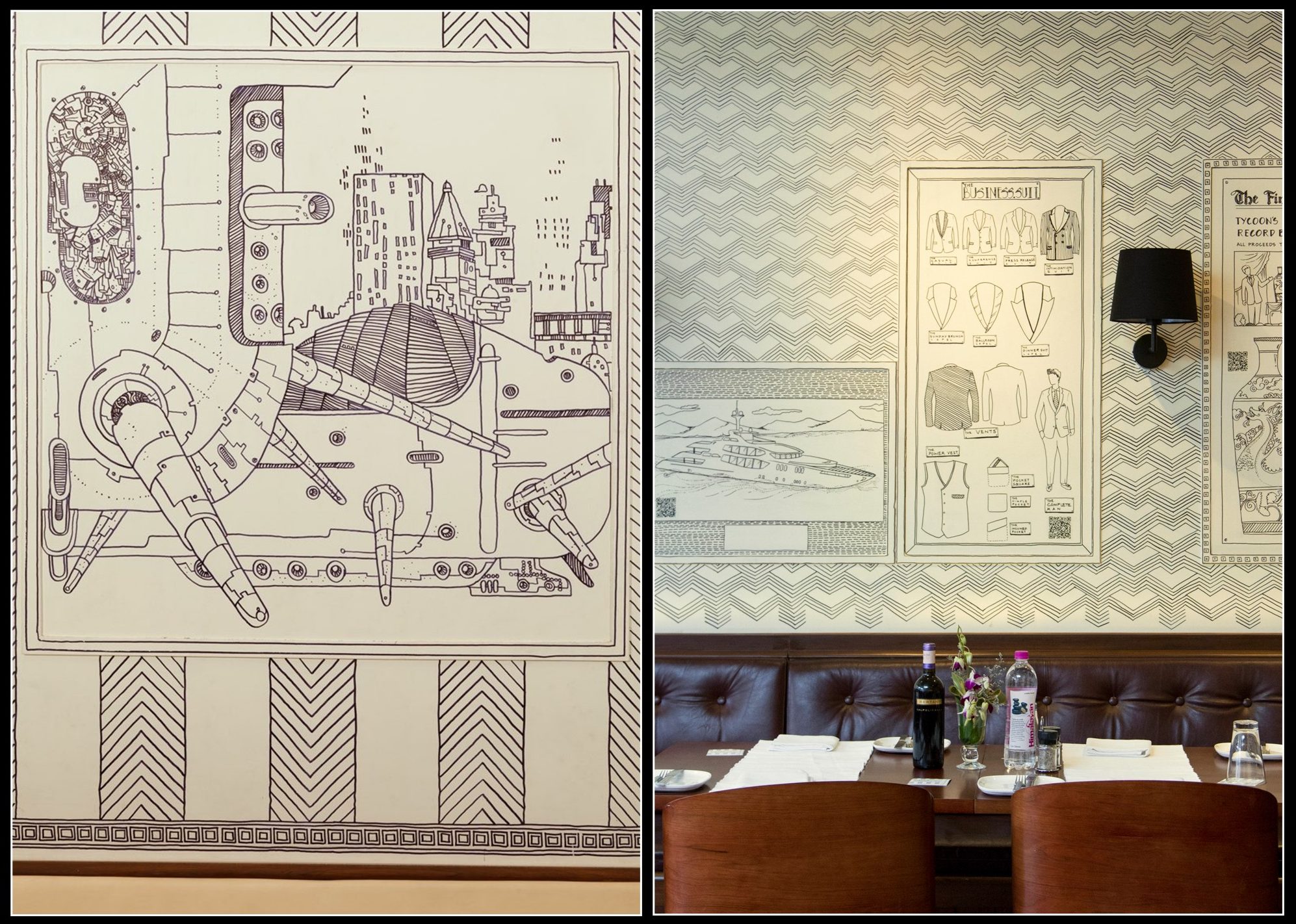
(referring to image 04) Over a period of 35 days, we painted this entire restaurant white, and I consumed a lot of Red Bull and drew for thirty five days straight. Every single surface actually started taking on a very, very intimate interaction with what was being said.
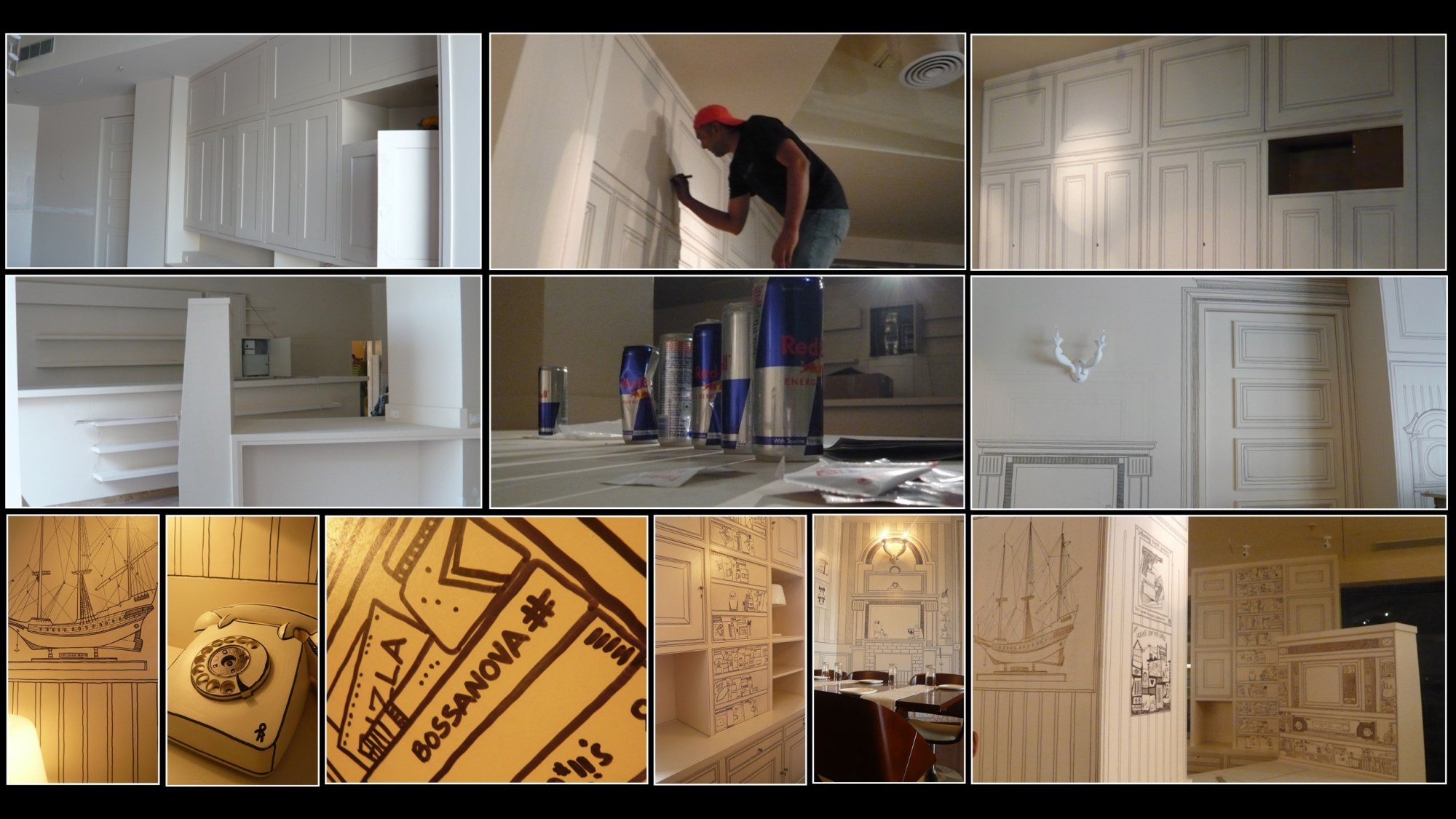
We realised halfway through this process that it is really the background research that is important; the act of drawing becomes almost secondary. For example, if you are drawing a series of audio cassettes – this is the time of audio cassettes – what the label of the artist on that audio cassette says is actually more important than drawing the cassette itself. We had to actually create a playlist that would play in Smokehouse Deli, and the artists on that playlist would be illustrated on the audio cassette that is on the wall. It is this kind of 360-degree understanding of space and how the space is going to behave for the next eight to ten years, and then that kind of nuance and detail is what really informs the space. Everything that you see is essentially hand-drawn on the wall. One really weird thing that used to happen was, if you see the alcohol logos on the top of the screen (referring to the screen), every time they changed an alcohol sponsor, we used to get flown down from Mumbai to Delhi to hand-draw that to keep the style consistent. Eventually, the expenses became too much, so one of the staff guys used to just take a black marker and do their number on it.
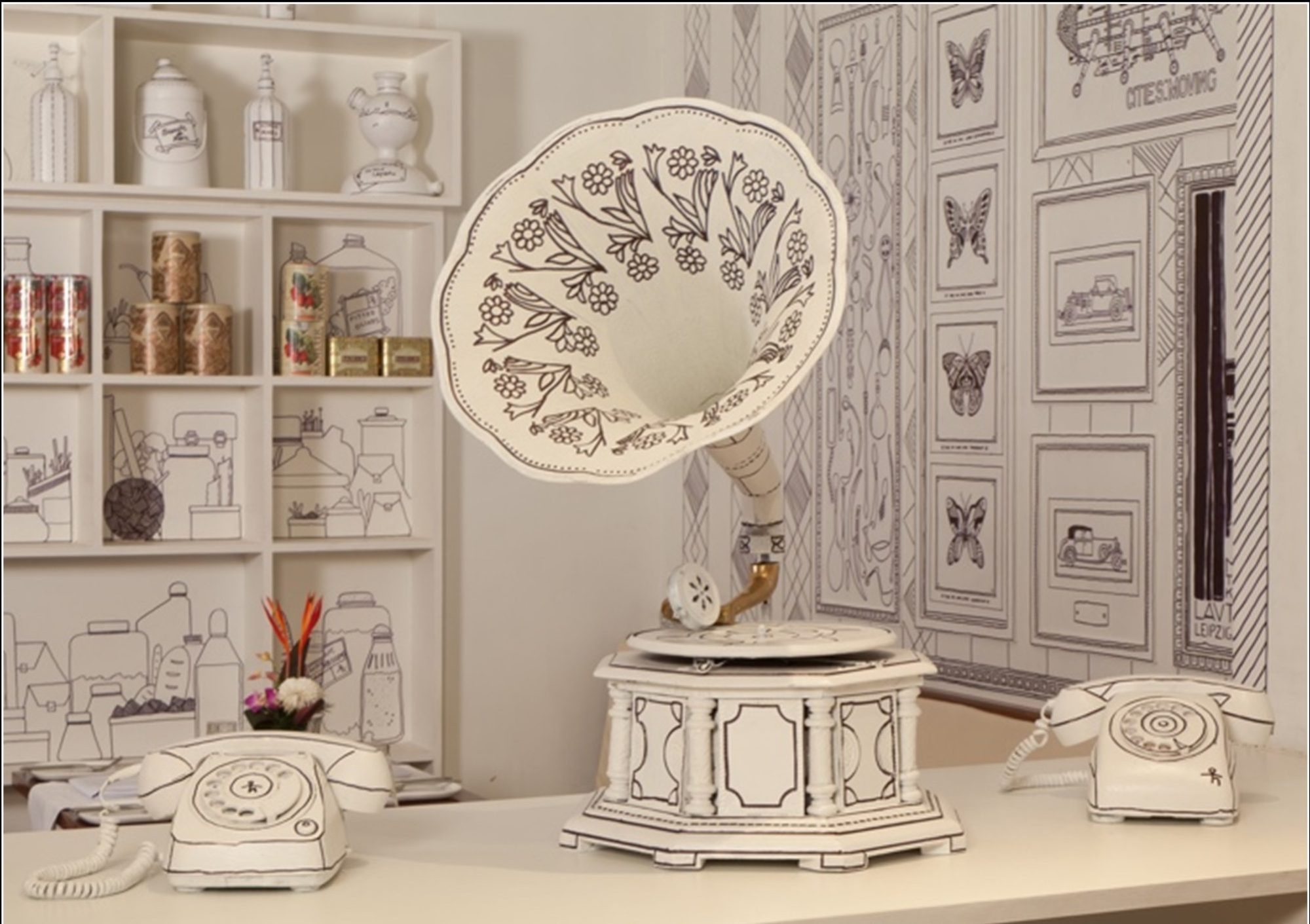
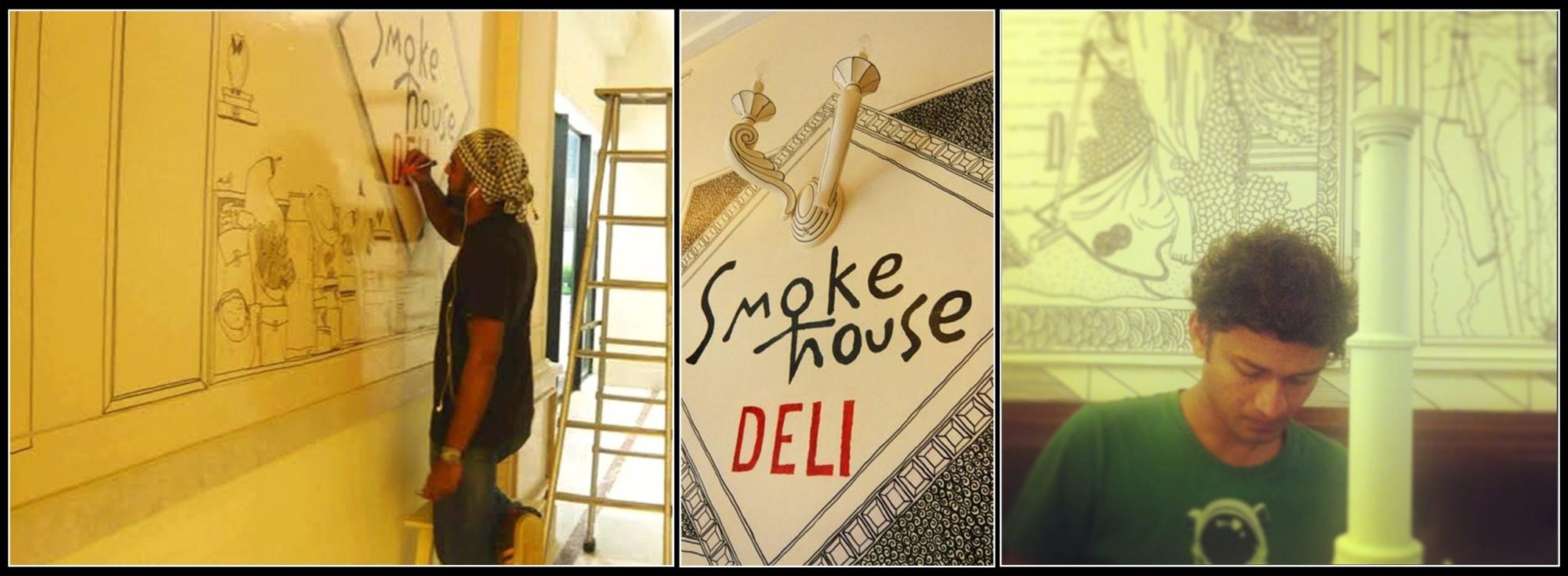
(referring to image 05) So that is Smokehouse Deli. We did ten of these. Even the thought of doing another one is daunting right now; my right shoulder starts aching even when you hear the word, Smokehouse Deli now. We did a whole bunch of these. (referring to image 06) I found this really interesting image last night of Hanif Kureshi, and we did a lot of work together. We worked very closely on all the Socials [a prominent Indian cafe, co-working and bar-restaurant chain], and this is the time when he had half an hour to kill before his flight back to Delhi and he came to Smokehouse Deli, without any prompt he picked up a pen and started drawing on something or the other, and I just found this last night. Smokehouse Deli became like a really intimate engagement with the site, and we could actually say a lot of things using illustration. Can you imagine drawing that wallpaper by hand? When you come up with an idea for an ornamental wallpaper, you are automatically kicking yourself in your head that you should think of something simpler because it is going to be a pain to measure and draw, but it was fun while it lasted.
We did around ten Smokehouse Delis. This is the one in Indira Nagar. (referring to image 07) Then we tried an experiment at Lavelle Road. Essentially, Lavelle Road became an experiment in how hyper-local we can go with our research. We decided that every single item of decoration that goes onto the wall of the Lavelle Road Smokehouse Deli will come from Lavelle Road. That opened up a rabbit hole of research. We realised that the person who owned the Kolar Gold Fields in the south of India lived on Lavelle Road, so that is a section of the Kolar gold mine there. All of them have hyperlinks to the history of that particular place. Essentially, it becomes like a small ode to the city. It becomes a space where you can come to these places and fall back in love with the city that we almost end up abusing on a daily basis when we are stuck in traffic or doing any of these kinds of urban things.
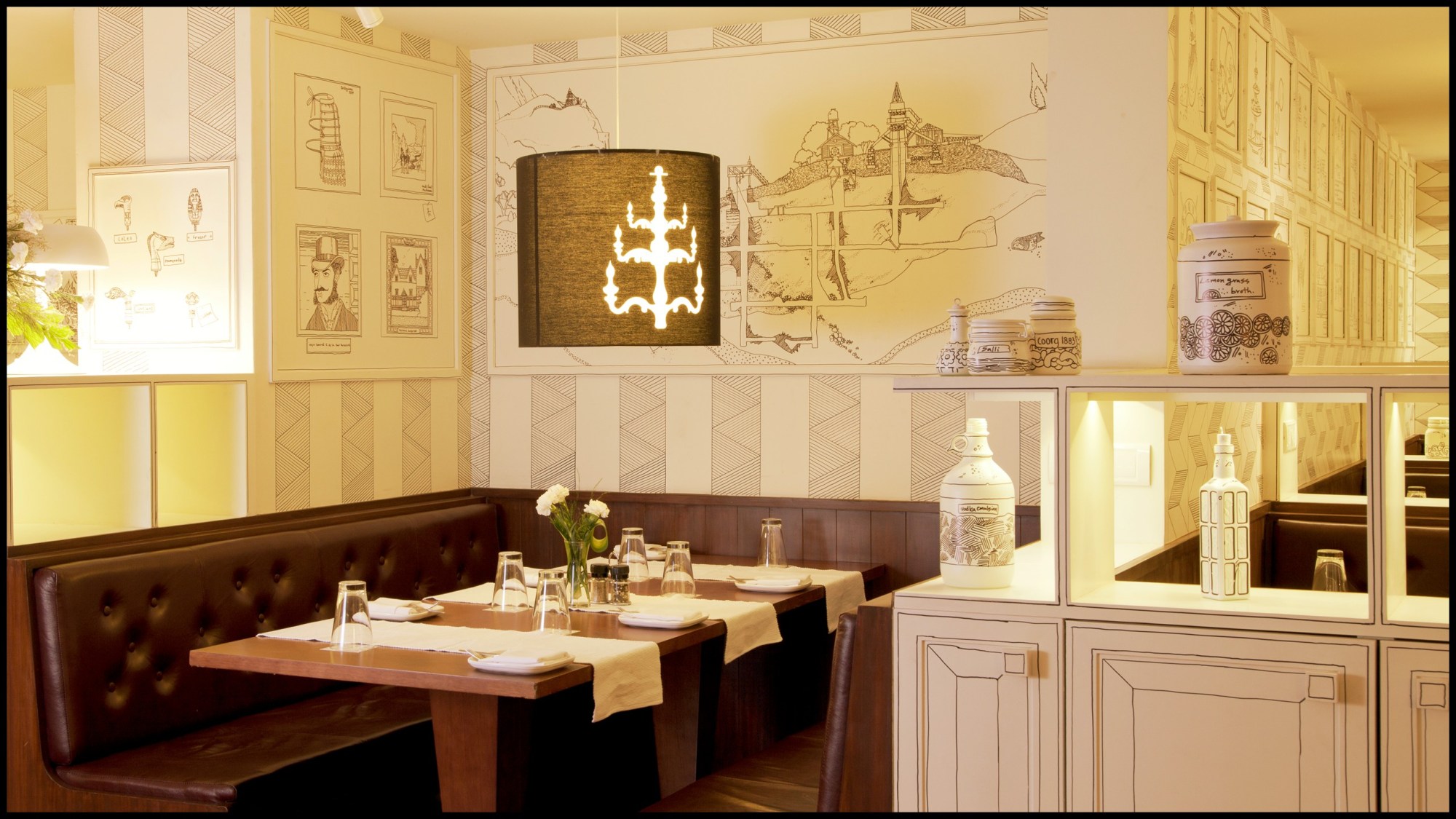
That is the one in the Bandra Kurla Complex, where we started doing something really interesting. This was in the same building as Citibank. We realised that Citibank has been involved, over the years, in all kinds of really, really shady deals. They have funded dictatorships; they have had their hands in all the wrong places. At the bottom of every illustration, there is a small QR code. If you zap that QR code, it takes you to that scam of Citibank. It is actually a link back to the scam that has happened in that same building. It is really kind of almost divine justice when you find Citibank managers coming to have a meal at Smokehouse Deli while their scams are right on the wall at the back. This is the one from Todi Mill. (referring to image 08) We realised that Todi Mill was actually being built at the same time that Archigram was happening in the UK, so we have a lot of Archigram references. We started drawing a lot of old Peter Cook drawings on the walls. That is a little bit about Smokehouse Deli.
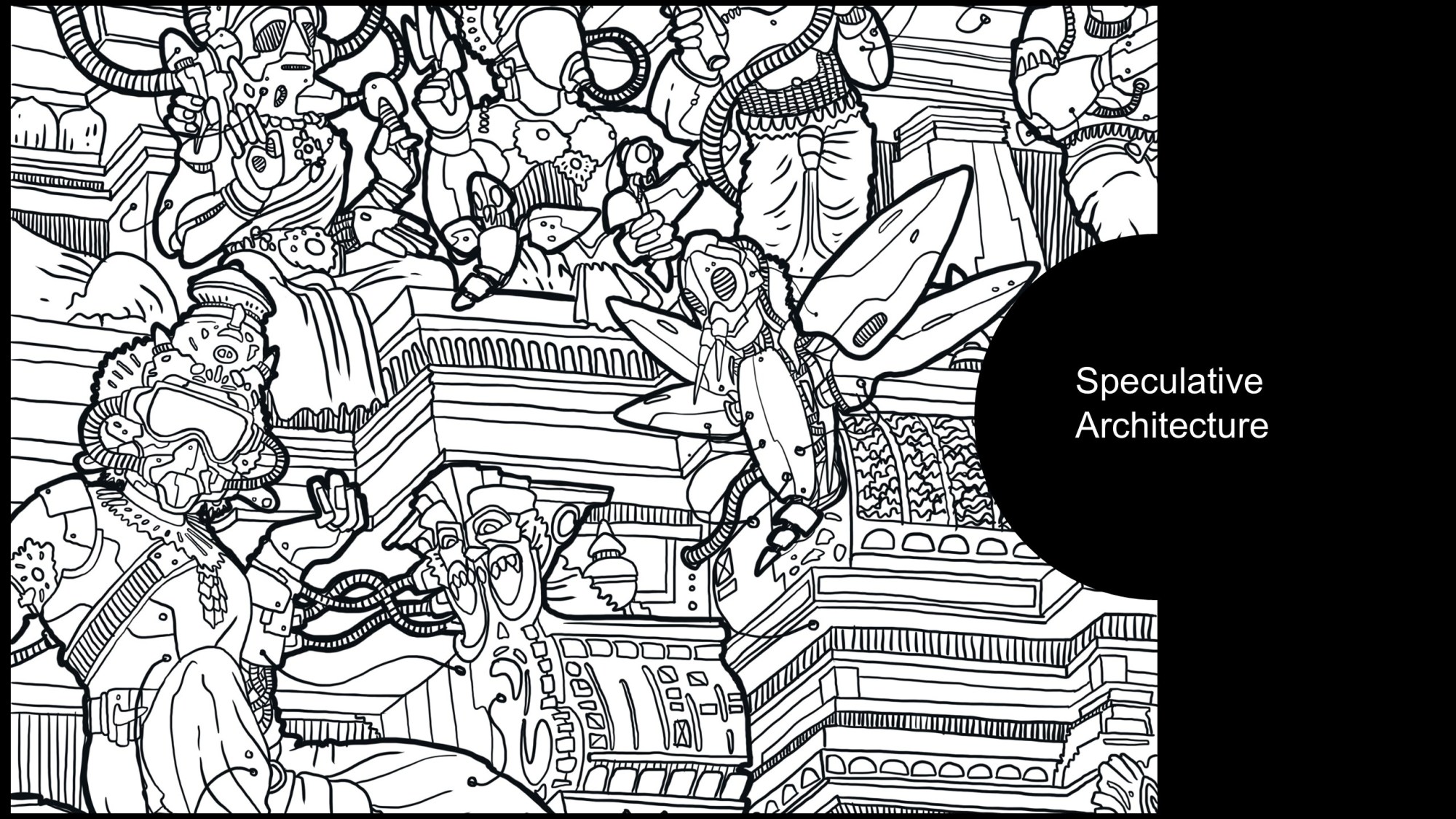
[10:20] I will just talk a little bit about speculative architecture (referring to image 09) because it is something that is very exciting for us right now. This is some concept art that we do with friends and partners. This is a video game called Antariksha Sanchar which actually posits a design movement called Tamil Punk. It is actually looking at Tamilian architecture mixed with this fascination with space travel. A lot of what you see here is just really study sketches of objects from the south of India married with this kind of steampunk aesthetic. We did a lot of rocket engines married with Madurai-style ornamentation. That is a tattoo that is revealed slowly in the game. (referring to image 10)
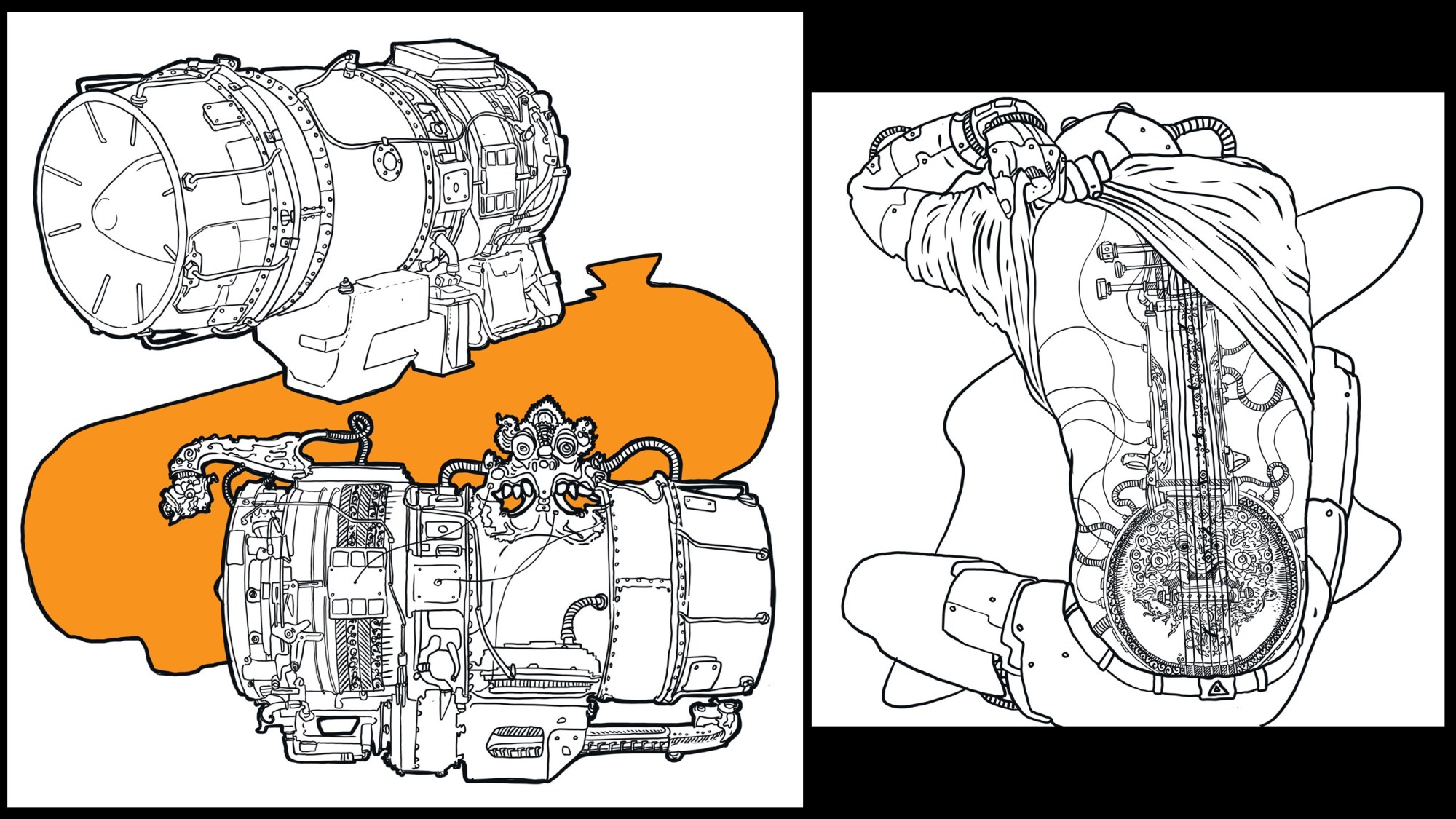
I think just the act of drawing these exquisitely detailed objects becomes almost meditative. It becomes something where you can actually almost walk your pen over the contours of the temple, and I think it is a lovely way of studying architecture just by redrawing it and drawing it again in almost this meditative fashion. There are some more artworks from that; I really enjoy drawing. That is actually the Burning Man temple superimposed into Hampi. This kind of speculative architecture, where you feel like there are two fractal forms separated by geography, could be really interesting to see what they could look like together. That sets down, again, a rabbit hole of illustration. Maybe at the end of two weeks, you come out and say, “Okay, let me stop here.”
We are also interested in exploring this idea of drawing as a record. We almost every day pick up the newspaper, see what is going on in the world around us, and try to use drawing as a way of engaging with that daily information. Some of you may remember the Statue of Unity that was put up at a fairly high taxpayer cost. We actually decided: what if I had 3,000 crores and someone told me to build a new statue for the country? It is interesting that we live in pretty much a minefield. It is a war zone out there. You will open the window, and you will see a hundred battles to pick.
#Scenario 1
India has emerged as the fifth largest E-waste producer in the world (2 million tonnes in 2016).
Mumbai tops the list of cities producing e-waste, while Maharashtra tops the state-list. 95% of the processing of the waste is carried out by the informal sector.
Slide A
[referring to Slide A at 12:30] One of the things you realise is that India, say, is the fifth largest e-waste producer in the world, and it produces almost two million tons every year. What if a statue could actually engage with this situation and create a small e-waste recycling mine in its basement, where all the gold rescued from old PCBs is then flecked back onto the statue? The statue itself is a data visualisation of the amount of e-waste that the city is producing. I think the general idea is that if the government has one bad idea, we can at least come up with a hundred good ideas. We are also running one of the largest and most ambitious renewable energy programmes. I think everyone in the room has fantasised about what is in Gandhi‘s dhoti. I think here the idea was to put turbines into Gandhi’s dhoti and use the dhoti to generate wind power. The base is also tidal energy. It is Gandhi’s birthday today; it is incredible. That is a tidal energy installation at the base of the statue, which essentially powers Mumbai with renewable energy. We are also going to very soon face a very dire water shortage, so I think the idea is to see what a statue could do. At ₹3,000 crores, we could easily set up a desalination plant within a statue. In this case, we favoured the seated Gandhi because of the volume of desalination that is possible, essentially cycling seawater and supplying Mumbai with a source of pure drinking water.
Then we obviously went crazy with this. We started doing statues for everything. This is a coral reef scaffolding. That is actually a very interesting one. This is when the BMC (Brihanmumbai Municipal Corporation) is replaced because they are so corrupt. They are replaced by an AI system, and there are two algorithms that are competing constantly to govern the city. How do you choose which algorithm is more efficient? You get them to play Pac-Man on the city skyline, and whichever algorithm wins the game of Pac-Man is then commissioned with managing the entire system. You have these kinds of interesting ideas. That is Kasturba Gandhi in the background. This is the Bhagat Singh sovereign grain silo. We are actually losing control of a lot of our sovereign grain, and the idea would be that in most cities, we can have a statewide sovereign grain farm which would store grain. What you have on the facade is these kinds of hydroponics which are keeping the grain going, and in the bays are underwater because it is cooler, so you can actually store a lot of these sovereign grains there.
[15:10] On the back of this, we have also set up something called the India Futures Lab. The India Futures Lab is a dedicated part of our practice which tries to build out speculative fiction as a curriculum. How do we teach this kind of thinking? How do we teach what it is like to be an intergenerational practice? What can we do today that would actually set the tone for things that are to come in the future? This is something we are setting up in Goa. Hopefully, we launch our curriculum in March 2026, so I will keep you posted on that.
As a return to a little bit of day-to-day work, we recently had a very prominent climate activist arrested and incarcerated in Jodhpur. This alternate history actually maps what would happen if you take a really productive scientist and give him one year in jail. Essentially, the amount of scientific patents that would come out of that period in jail is crazy, so we have just tried to visualise what a jail-driven drone workshop would be to supply high-end drones to the Government. That is actually one of the Tesla coils that is built. All these look at Indian futures. It is saying that if a climate activist and an extremely talented engineer are put behind bars for a long period of time, this is what happens. This is actually based on Donald Trump’s recent order putting a 50% tariff on upholstered furniture and kitchen vanity cabinets. The idea is: what if you could take kitchen vanity cabinets and build skyscrapers from them? A lot of that inventory is not going to go to the US anymore; it is going to have to be absorbed by a local market. Let us actually start visualising skyscrapers made completely out of kitchen vanity cabinets. That is the first upholstered skyscraper in Mumbai.
This is really interesting. In Vile Parle, what happened was the BMC created two staircases that do not join. It is like you walk up one, and then you walk back and go the other way. It is like this Escher [Maurits Cornelis Escher] kind of staircase. In our alternate future, what happened was this engineer was diagnosed with a very rare form of autism, so he is actually a genius and he is given lots of commissions to build staircases across the country. We have these kinds of crazy staircases all over Mumbai which are becoming these kinds of recreational art galleries. Inspired by that one small mistake, he has an entire practice of almost Escher-like, prolific output.
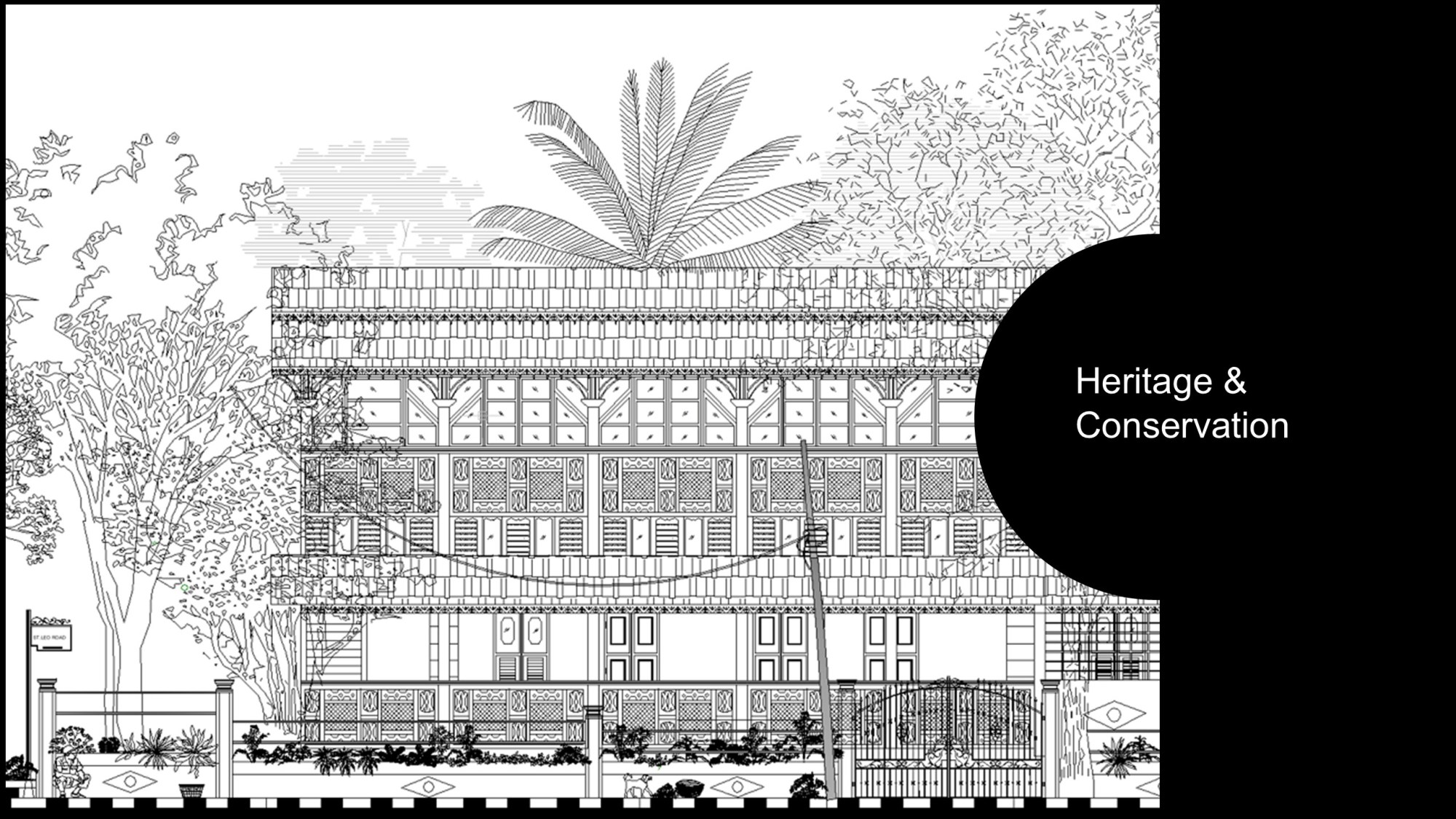
(referring to image 11) We also deploy drawing in slightly more respectable areas, such as heritage conservation work. These are some projects in Bandra. In Bandra, we are surrounded by objects of exquisite beauty. This is Priscilla Villa, which is one of the only timber residences, and we realised that the architectural record is fairly weak. We need to actually start actively going and drawing these things because they will aid future conservation projects; they will aid any kind of restoration or any kind of public engagement. This was something that we did under The Bandra Project banner a while ago. This was almost exclusively run by thesis students. People would come to the studio, we would not let them do any other commercial projects, and we would put them only on The Bandra Project. This was something that ran continuously.
This eventually became absorbed into something called the Bandra Collective, which is a small group of architects doing public-facing projects in Bandra. (referring to image 12) Again, there were a lot of interesting ripple effects from drawings. That is actually a measured drawing of the St. Andrew’s Church. These were actually the base drawings created by Vikas Dilawari’s office, and we inherited them through a range of dubious forwards from here and there. We thought we would just make a small kit, essentially visualising those drawings as a buildable kit that could then be sold or retailed to raise funds for church programmes. Essentially, drawing can become something that extends an ethos outside the structure itself and gets more and more people to engage with it. It is kind of interesting to also think of the afterlife of drawings, that once a drawing is there, what can you do with it, and what are the cool things that can actually happen and manifest? These are, again, some interesting drawings. That is The Cross of Santa Anna, which was drawn up to aid an INTACH conservation effort.
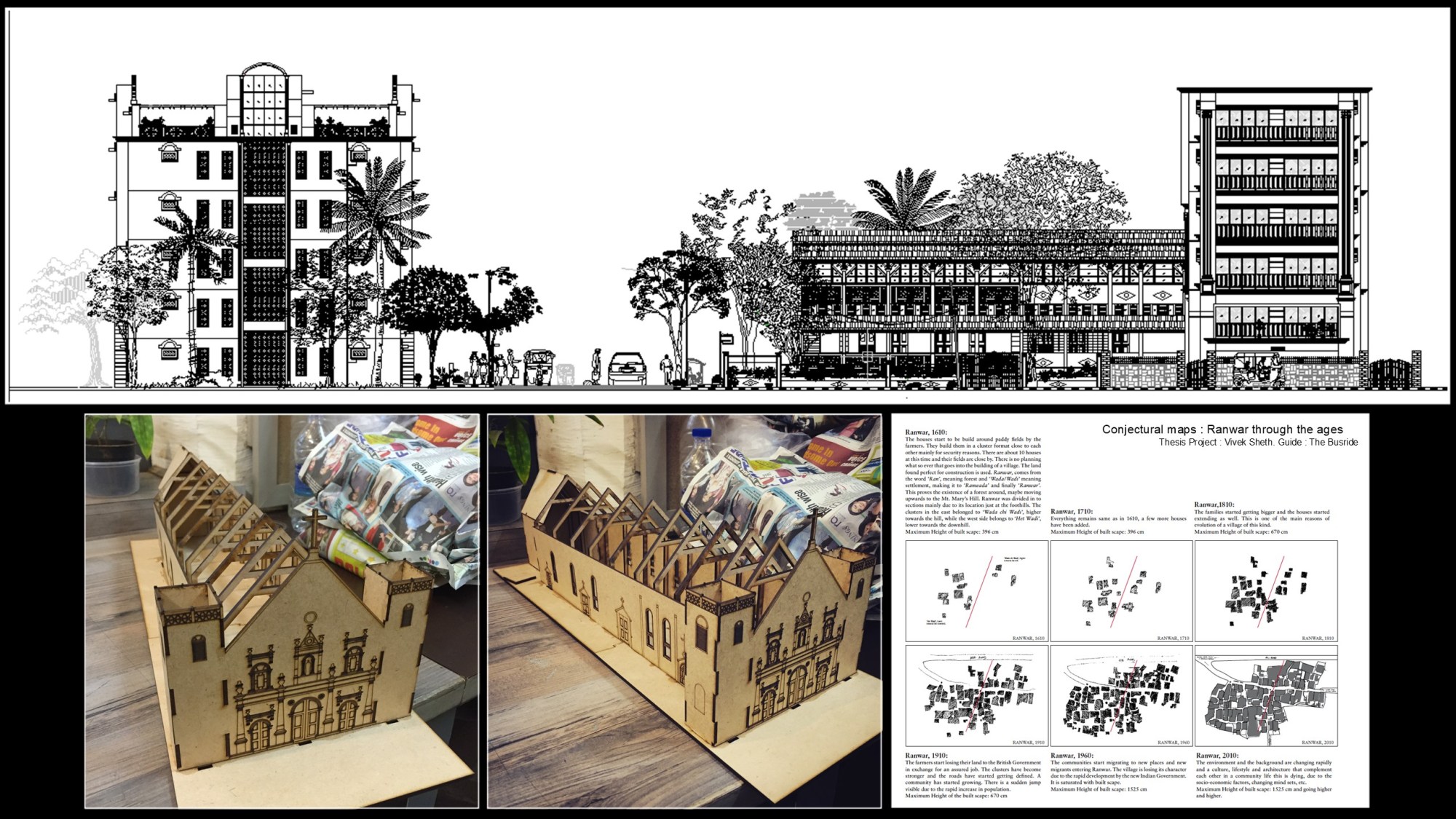
At the end of this bit, one thing that really stays with me personally in the act of drawing is this idea of flow, that there was a sense of meditative work that happened on the walls of, say, a Smokehouse Deli, where thirty five days pass and you have got to illustrate this entire space. You get into a space when you know that you have to do this for the next six hours. You have to just draw horizontal hatch lines to finish a wallpaper pattern. After a point, your brain switches off and you get into this kind of thing where you say, “Okay, let me just make sure that the next line accurately follows the next line.” There is a sense of repetition and a sense of mundanity when you look at it from an outside perspective, but from the act of doing it, there is a very, very felt sense of flow, which I feel is almost characteristic of this way of engaging with drawing.
Drawing with Altered Neurologies
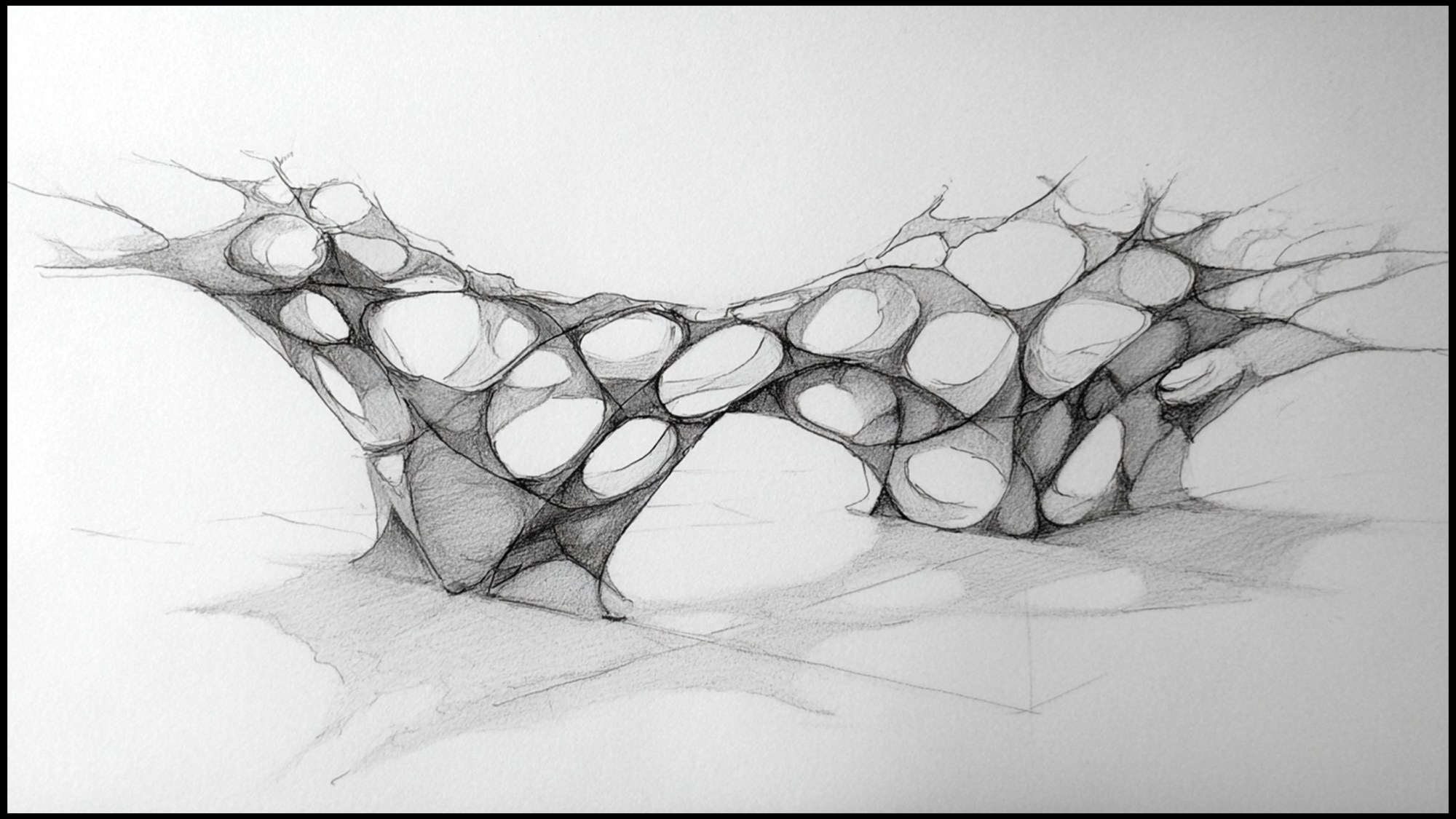
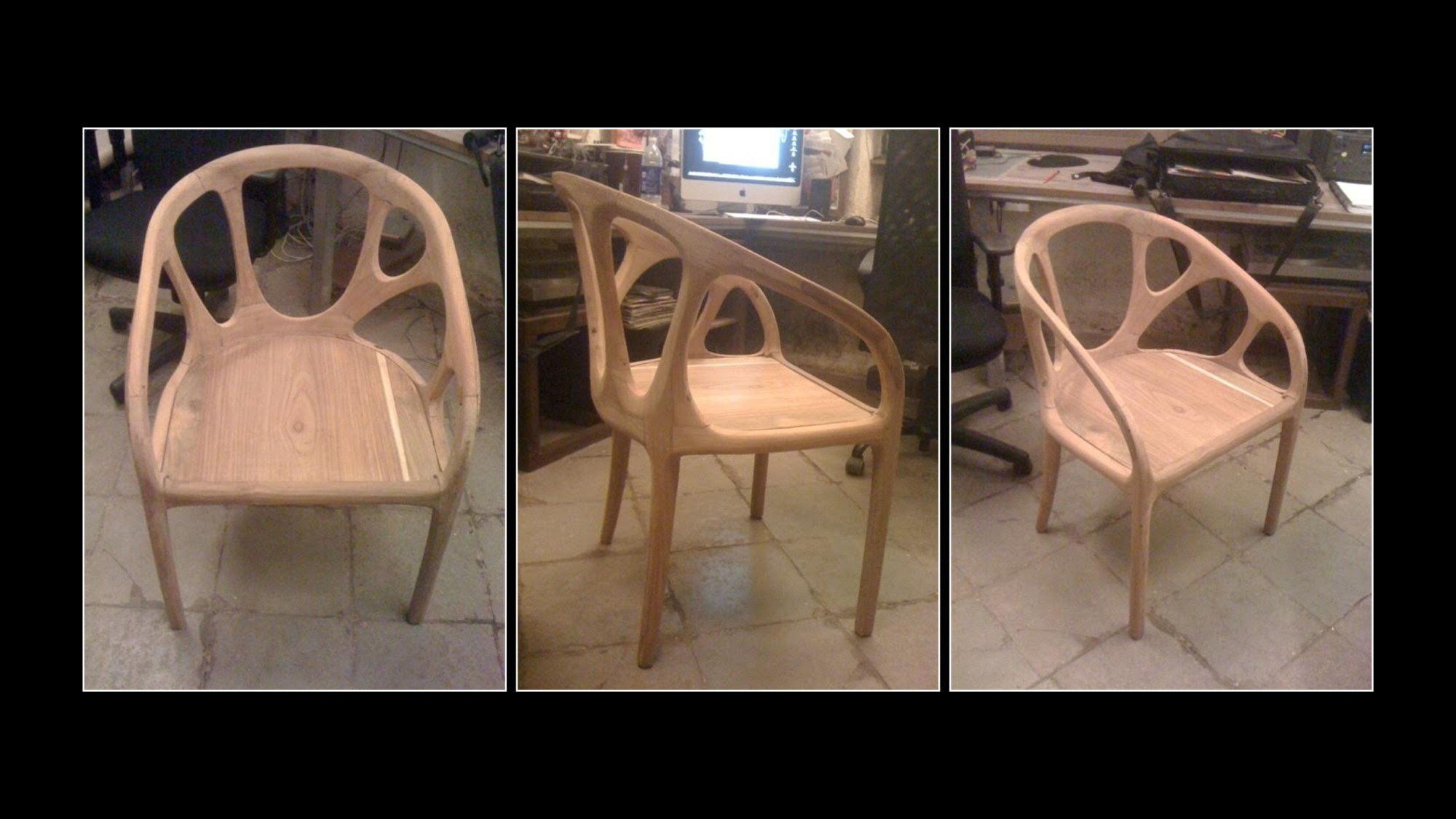
[20:18] I will maybe talk a little bit about altering that neurology. When you are in an unaltered space, there is a certain sense of flow and a certain sense of meditation that comes in. Through altering your neurology, either through the use of psychedelics or through deep meditative practices, you can actually get into really interesting mind spaces as well. This is a project we worked on called Shroom, around twelve years ago. It started with drawing. We started actually trying to visualise what the experience of psilocybin is, trying to actually understand what the effects of the mushroom are on the brain, and trying to draw them in an extremely gestural fashion. (referring to image 13) Some of the initial drawings for Shroom actually started turning out these Voronoi patterns repeatedly, and a certain design language emerged for the project. It resulted in the first chair that we built (referring to image 14). This was actually something we constructed in teak, using the same forms as a proof of concept, really. Those are some images as we started sculpting the space. This is something that we kept on developing as a language, and this is what results, essentially a practice of drawing repeatedly forms that we feel are emotionally, or in some sense viscerally, connected to the experience of the space. I feel somehow they also fuel the creation of that space in many ways. Those are some of the images from Shroom. This was actually something very intimate, a 40-cover tasting room attached to a nightclub. (referring to image 15) The same forms take on a very different avatar on both sides of the property, where one side is just really an elevated, minimal expression, and the other side is obviously a full-blown shroom experience. That is something that is interesting about working with altered neurologies.
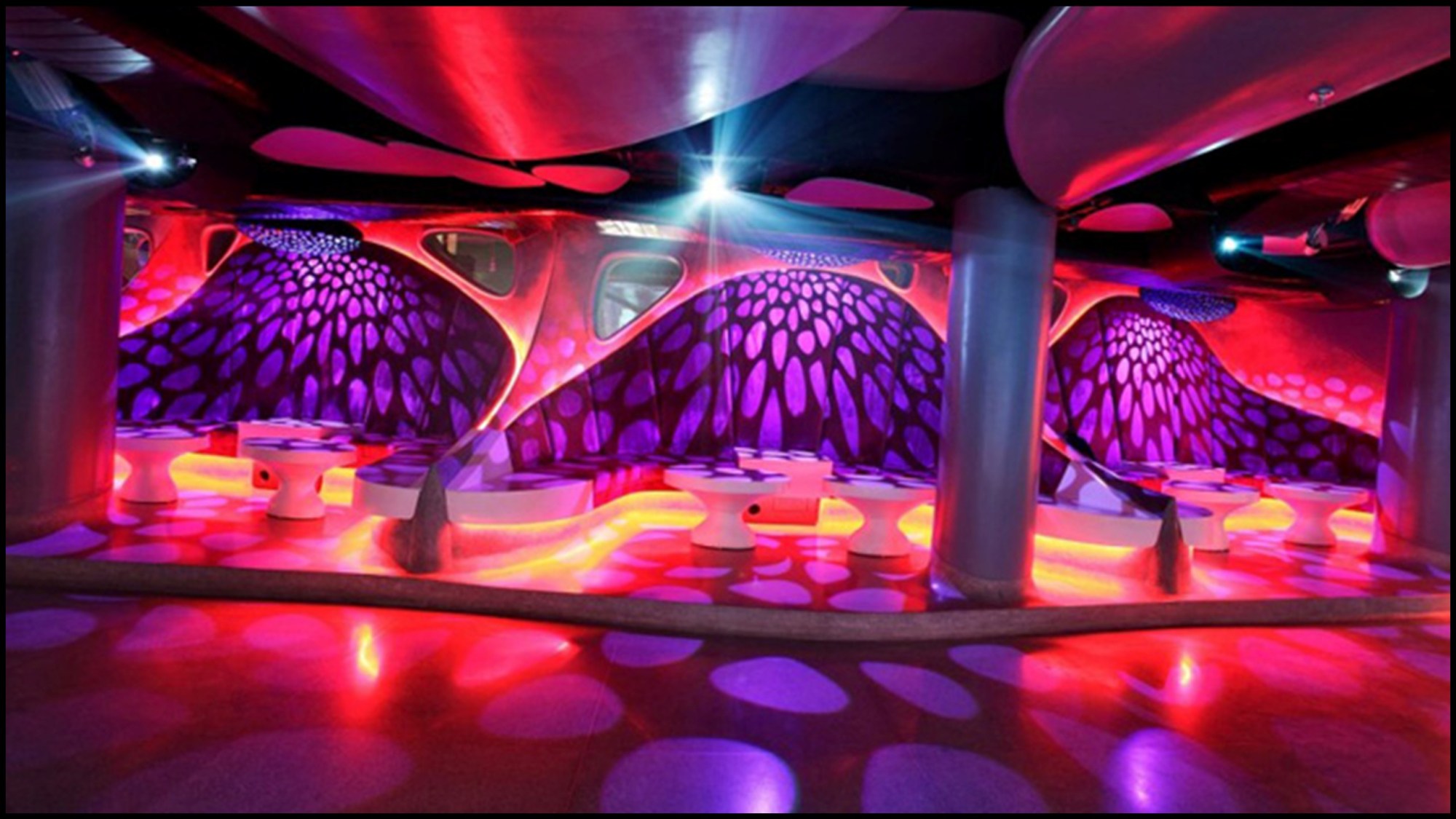
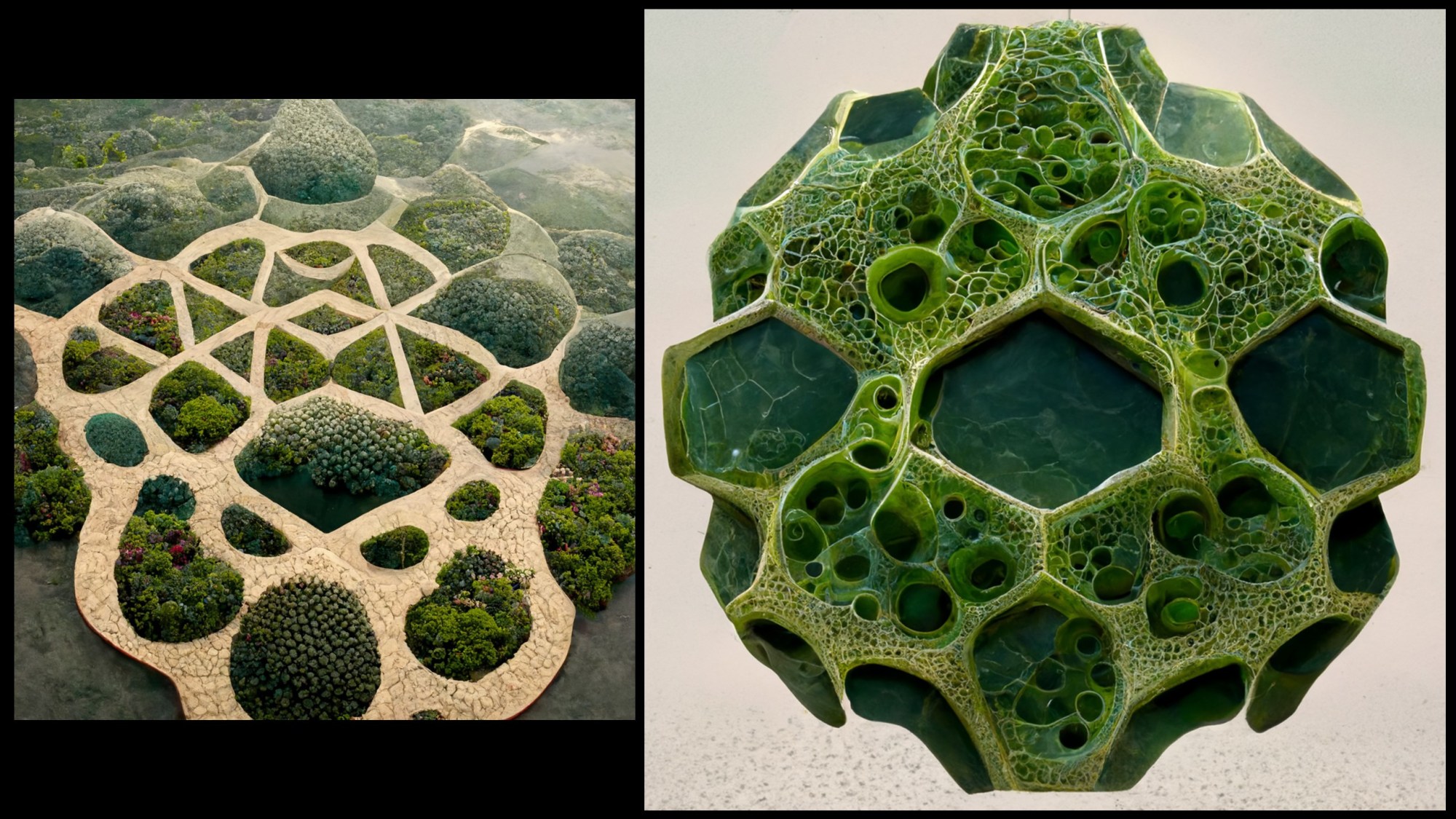
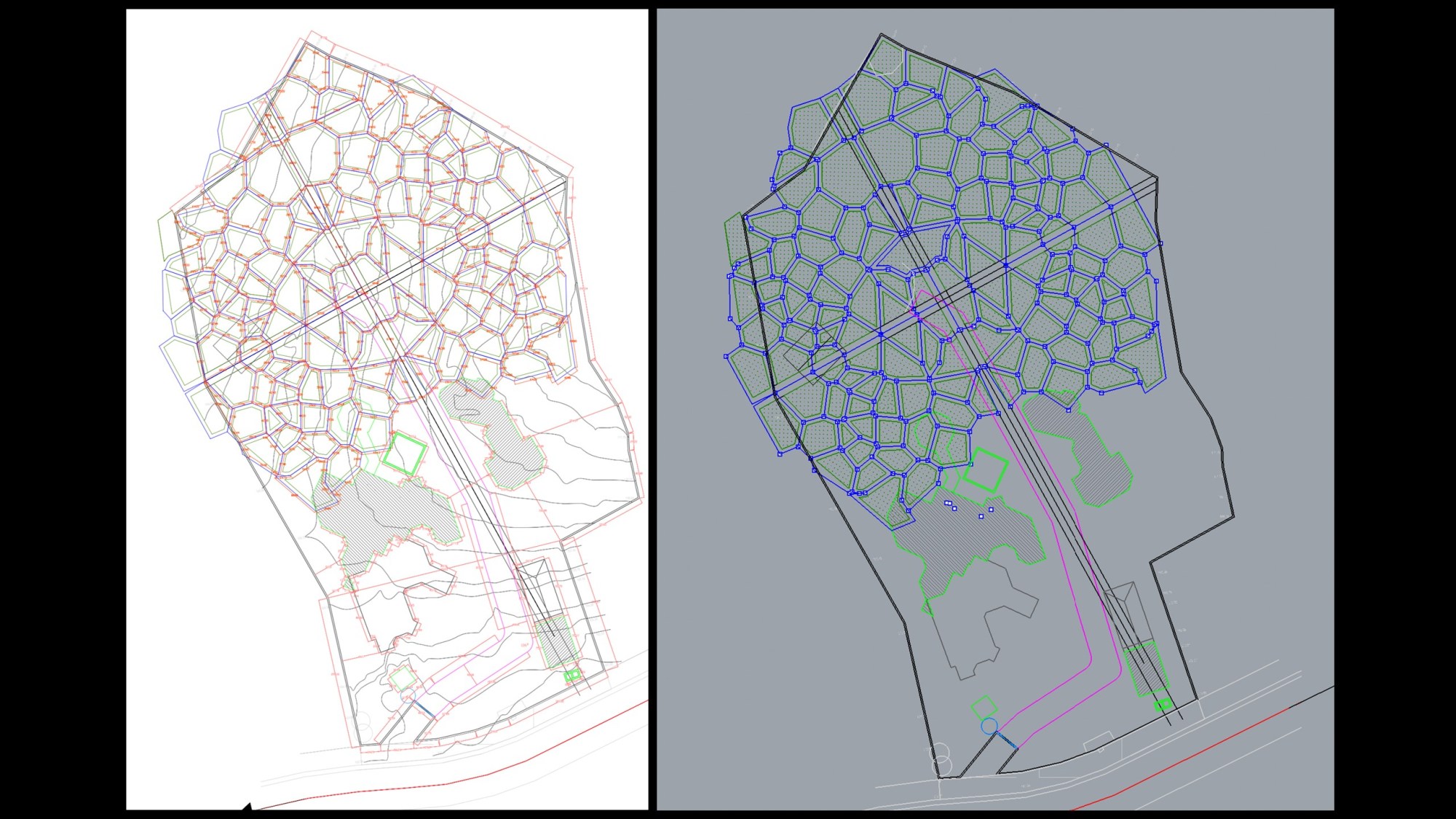
We have also been repeatedly fascinated by Voronoi patterns (referring to image 16). This is something that we are doing even now, using new illustration tools that keep getting tossed up by our ever-changing technological landscape. These are Voronoi patterns deployed for landscape. (referring to image 17) We are building our own Futures Campus in Calvim, Aldona. That is some of the master plan for the landscape, which is derived again from Voronoi patterns. What we are trying here is to look at a Renaissance garden meets neural network meets Voronoi patterns, and to see what that generates for us as an experiential thing. These are some works in progress, the things that we are building out slowly, budget permitting. These are the ways we are going to grow our vegetables in Voronoi patterns. I think this working with altered neurology is interesting because it introduces this idea of recursiveness, where a similar motif recurs, and one can create full spatial experiences using a recursive drawing process. I think a lot of us do this unconsciously, and it is very important to acknowledge the fact that our neurologies are getting altered as we do this as well.
Collaborating with Other Neurologies
[23:20] What is interesting about emerging tools is that we are surrounded in the world of AI and machine learning, surrounded by very, very unnatural, very emergent technological landscapes. I feel, at least internally, we try to engage with that with as much playful abandon as we would do with a pencil or a pen. I feel it is setting the stage for us to, as a species, collaborate with other neurologies. I feel like AI is a stepping stone in understanding what it is like to work with another neurology. For example, you can classify all of us in this room as carbon-based intelligence. What is it like to collaborate with a silicon-based intelligence, if we had to frame it in a single sentence?
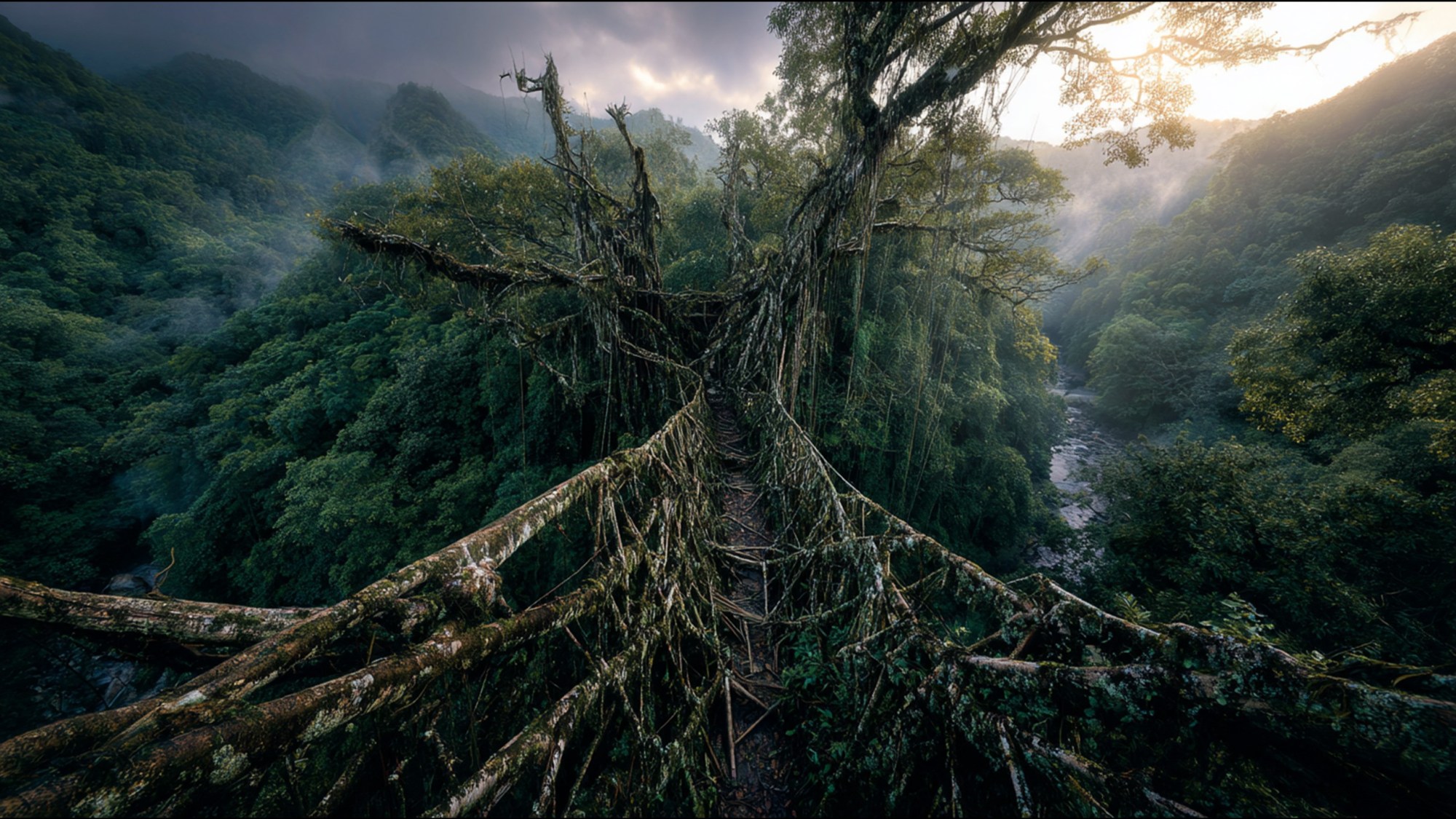
(referring to image 18) I will just go back to this because we have tried to use these tools, but balanced that on the other side with some very serious field research. We spent around 21 days in the cloud forests of Meghalaya, and we led a batch of Master of Architecture students in to describe this landscape through drawing. This is actually a close-up of a section of the root bridge. I am not sure how many people have been to this place, but I would highly recommend it; it is on everyone’s bucket list. It is a crazy place. We are walking across these 500-year-old root bridges which span across massive valleys and gorges, and what you are really walking on is a human craft. Every single root that you see in that tangled mess has been placed by human intention. Someone has actually guided each root through and almost woven this bridge across valleys.
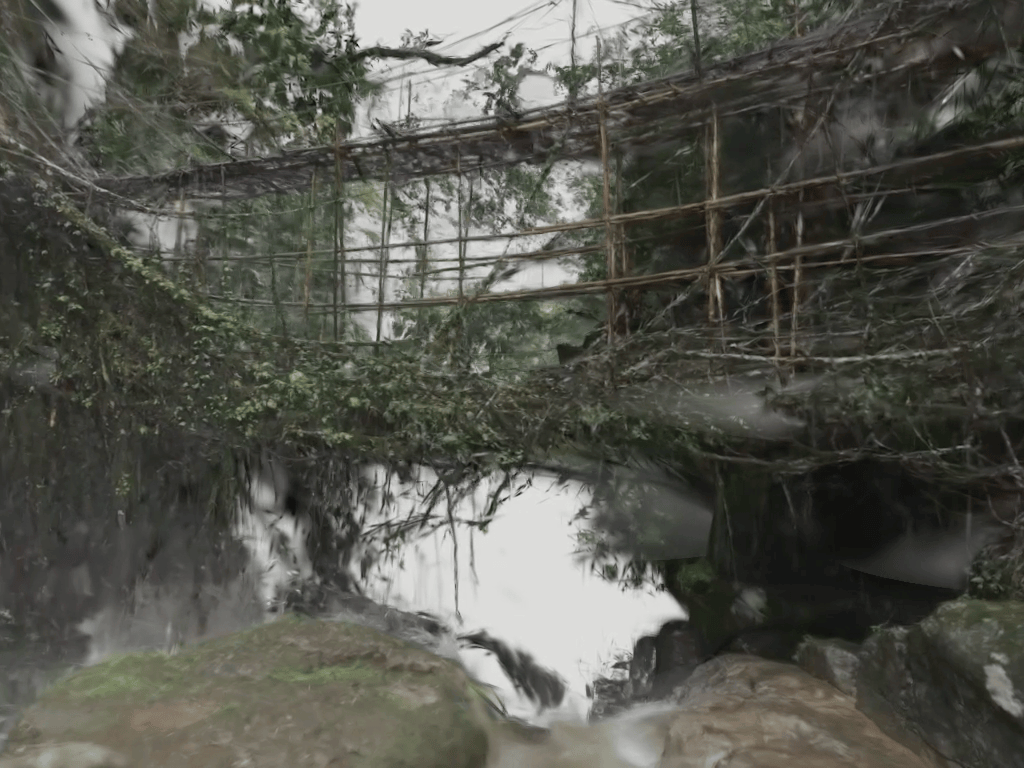
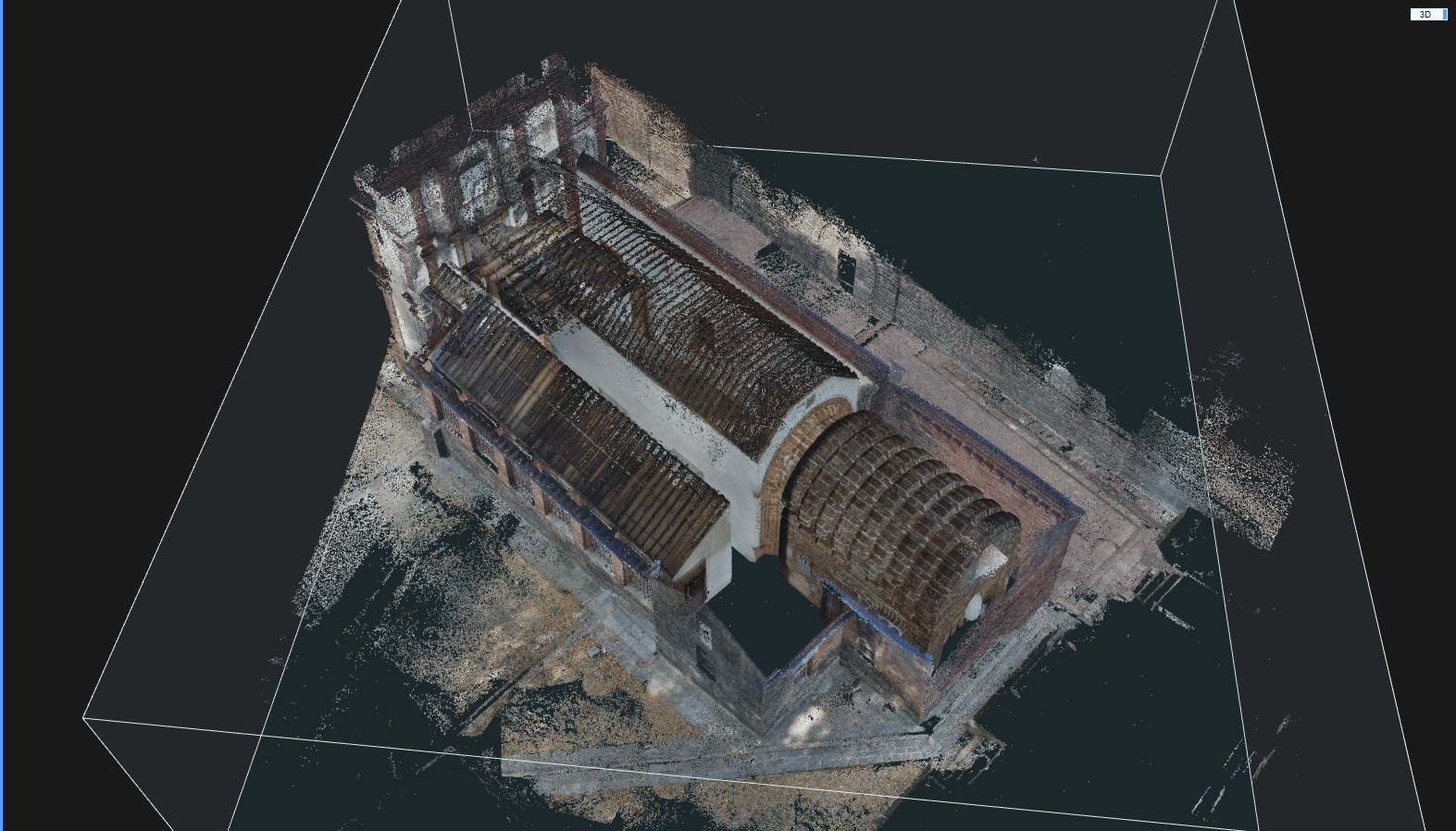
This is an image pulled from a LiDAR (Light Detection and Ranging or Laser Imaging, Detection, and Ranging) scan of the entire root bridge, and it gives you a sense of how intricate the structure is and how far it spans across. We are trying to use new ways of drawing and new ways of representation as well, and we try to actively integrate every single new part of the workflow that comes out in terms of tools and technologies. (referring to image 19) This is using LiDAR and importing it into 3D software. (referring to image 20) Once we have that database, you can actually start speculating and drawing many, many different kinds of speculative scenarios, and we try to use these scenarios more to describe the kind of conversations that we have had in the field. We closely collaborated with one of the bridge architects; his name is Morningstar Khongthaw. He is essentially the chief of the village, and he owns one of the trees, which is actually a very, very big honour, to own one of those Ficus elastica trees. With him, we were trying to talk about what it would be like to set up a school of living root architecture. Can you actually consider living root architecture as a curriculum to be taught, where people actually learn how to build with these natural materials which strengthen over the next 500 years? What would you build that you start today and that is only going to see fruition after 500 years? It actually is very interesting because it changes the whole conception of what we call a project, like a completion date or a handover date. We started thinking about what dwellings would look like built in the trees. We again put some of those LiDAR scans into TouchDesigner [node-based visual programming platform], so these become sound-responsive objects. The idea is to keep on experimenting with different processes and workflows and see what happens.
(referring to image 21) Something that Morningstar mentioned in one of his conversations was really, really interesting. He said that the single act of altruism, of taking care of one Ficus elastica, has a ripple effect throughout the forest because that tree is now a biodiversity haven. It is actually a home for countless species of squirrels, of rats, of plants, of birds, it is a biodiversity island in the middle of the forest. It has unintended consequences. Because of the nature of the tree and its root system, it essentially stabilises the banks of the river. You have little to no soil erosion in areas where the root bridges exist.
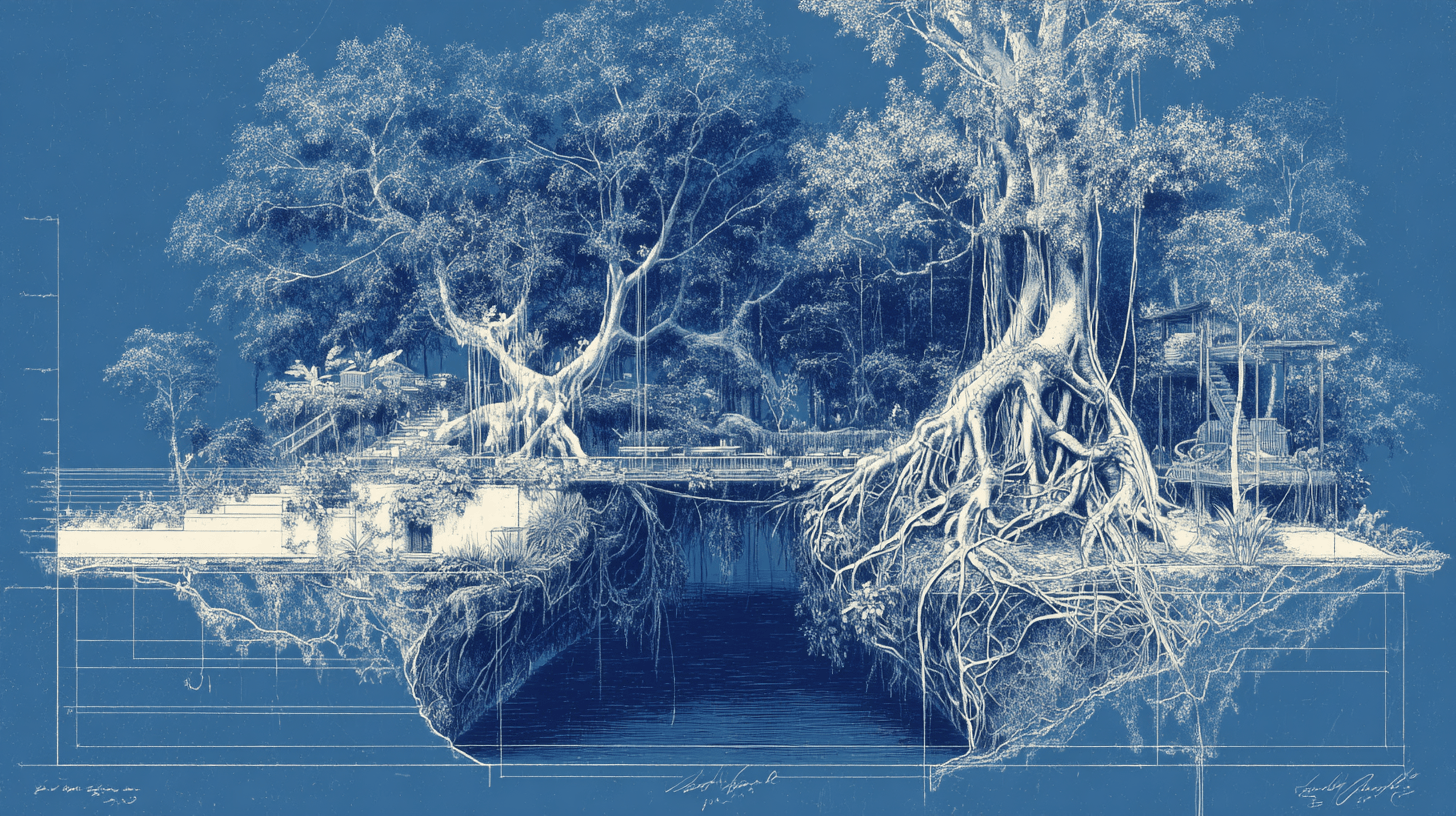
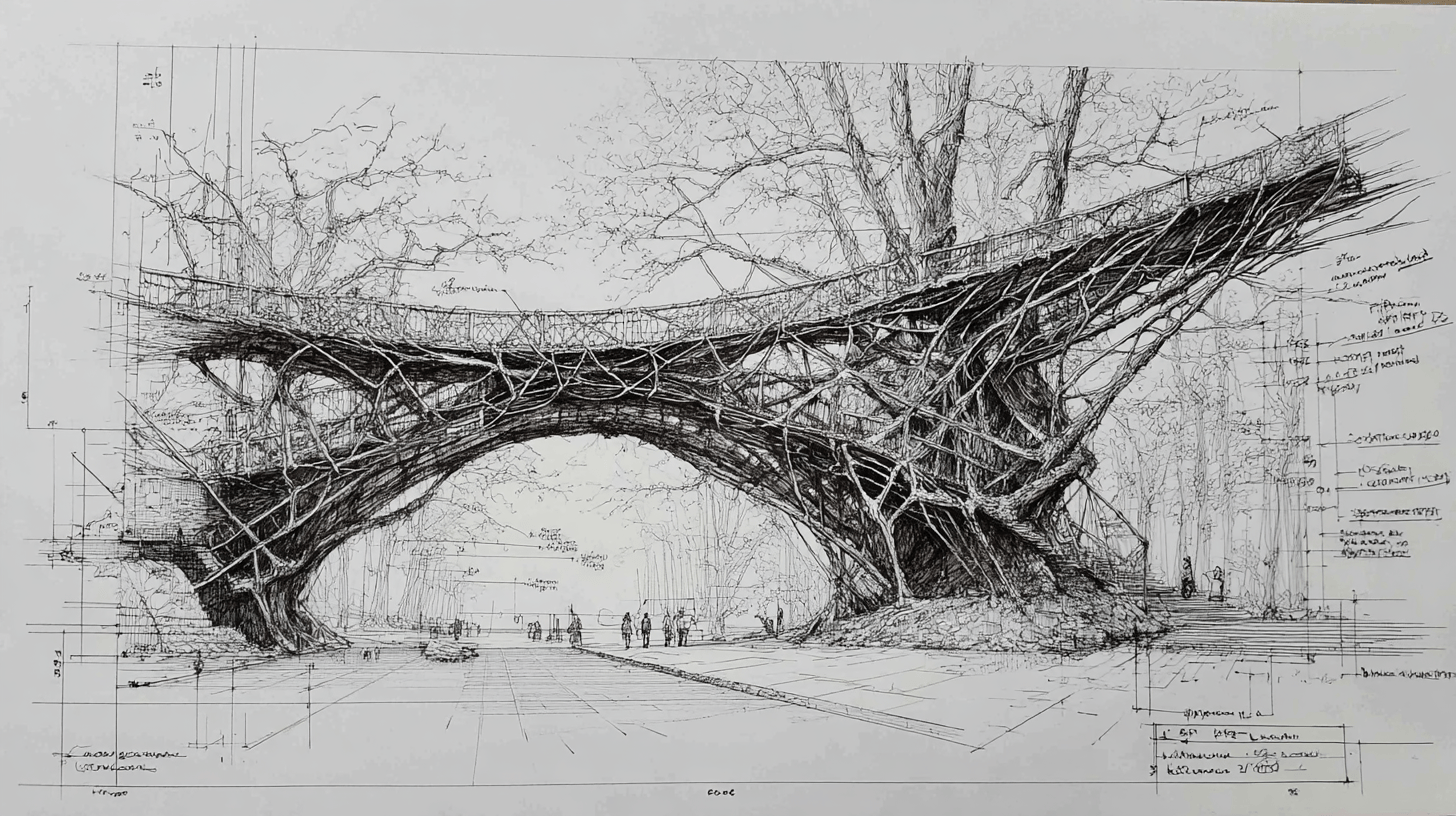
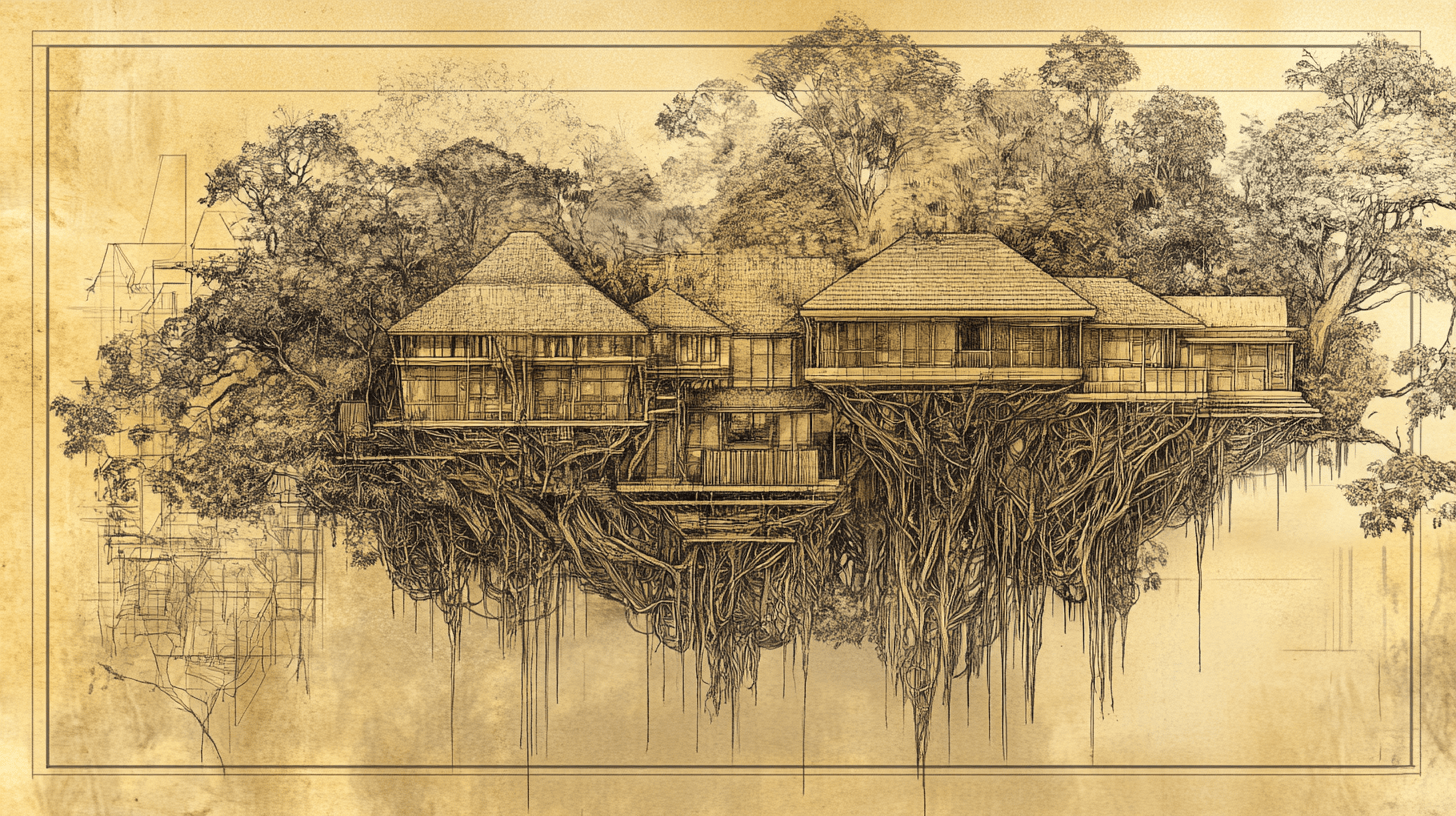
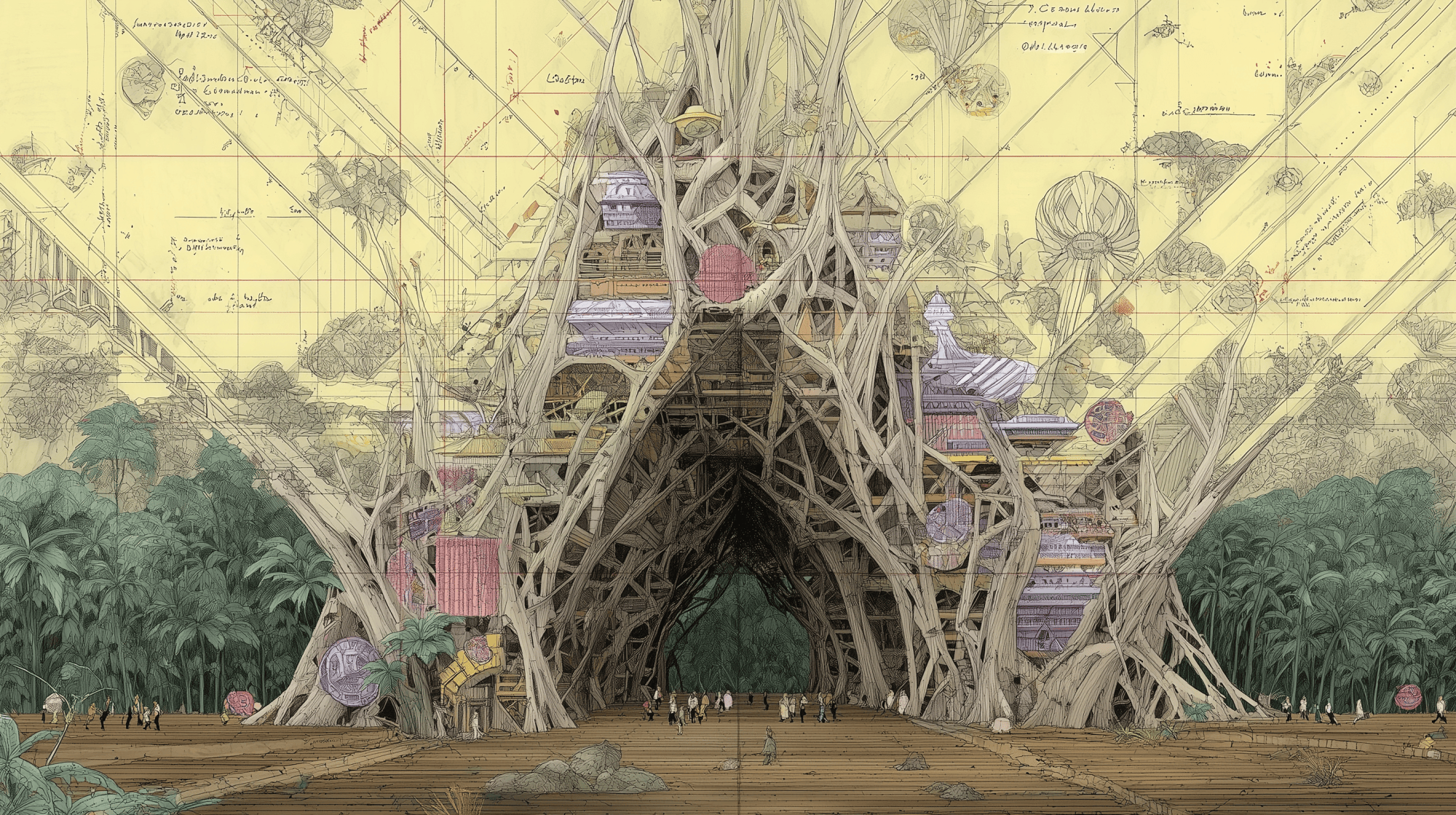
[27:27] We were thinking that in the future, once you have solved all your transportation needs, (referring to image 22) what if you could just plant Ficus elastica to protect against flash floods? This is something that we are increasingly going to face with climate change, specifically in the hills. What if Ficus elastica could be deployed across the built landscape? What is really interesting about these tools now is that you can actually walk through them. You can actually take a speculative drawing and create immersive environments very easily so that these can be shared with larger stakeholders. These can go back into communities, back into their own WhatsApp groups, and they can say, “Okay, what if we had to do something like this? How would it look? What would it be?” You can actually preempt a lot of problems in the early stages, before actually starting to commission this out. We have just been playing around a lot with different ways of drawing and different ways of engaging with this new tech; it is part of the fun of being in Goa and having time. I have just been enjoying different kinds of representation. (referring to image 23) This is a cathedral built in the forest, exploring whether you could actually train Ficus elastica to become a forest chapel, for example. A large part of the Khasis (Khasi tribe) have converted to Christianity, so it is an interesting, low-hanging fruit to build interesting structures in the jungle.
(referring to image 24) We have also flown drones in strange places. That was in the forest of Meghalaya, but this is through Riyaz Tayyibji, who is here. He opened up a lost stepwell for us, I think maybe eight years ago, and we sneaked into this place and flew a drone in to map it out from the inside for a project with National Institute of Design (NID). This is, again, with Fernando Velho; we documented a chapel in Old Goa through LiDAR.
In an extension of this workflow, we have done some extremely unethical things as well; I would like to share some of that. This is a programme called The Artist Does Not Exist. It is interesting that we can actually plagiarise work from the masters and do all kinds of blasphemy with it. This is actually a Midjourney (generative AI programme) output trained on the work of S.H. Raza. Raza never did any woodwork; he was mostly obsessed with the paintbrush and oils. What we are doing is a style transfer between Raza’s work and a set of carpentry output that he would have made if he had been alive for that long, or if he had access to really great woodworkers. Through the drawing process, we deconstruct that image and create a much larger engagement with understanding the output of that system, bring it back to traditional carpentry (referring to image 25), marquetry, and inlay work, and create objects that would actually have Raza turning in his grave if he saw this kind of stuff, right? (referring to image 26)
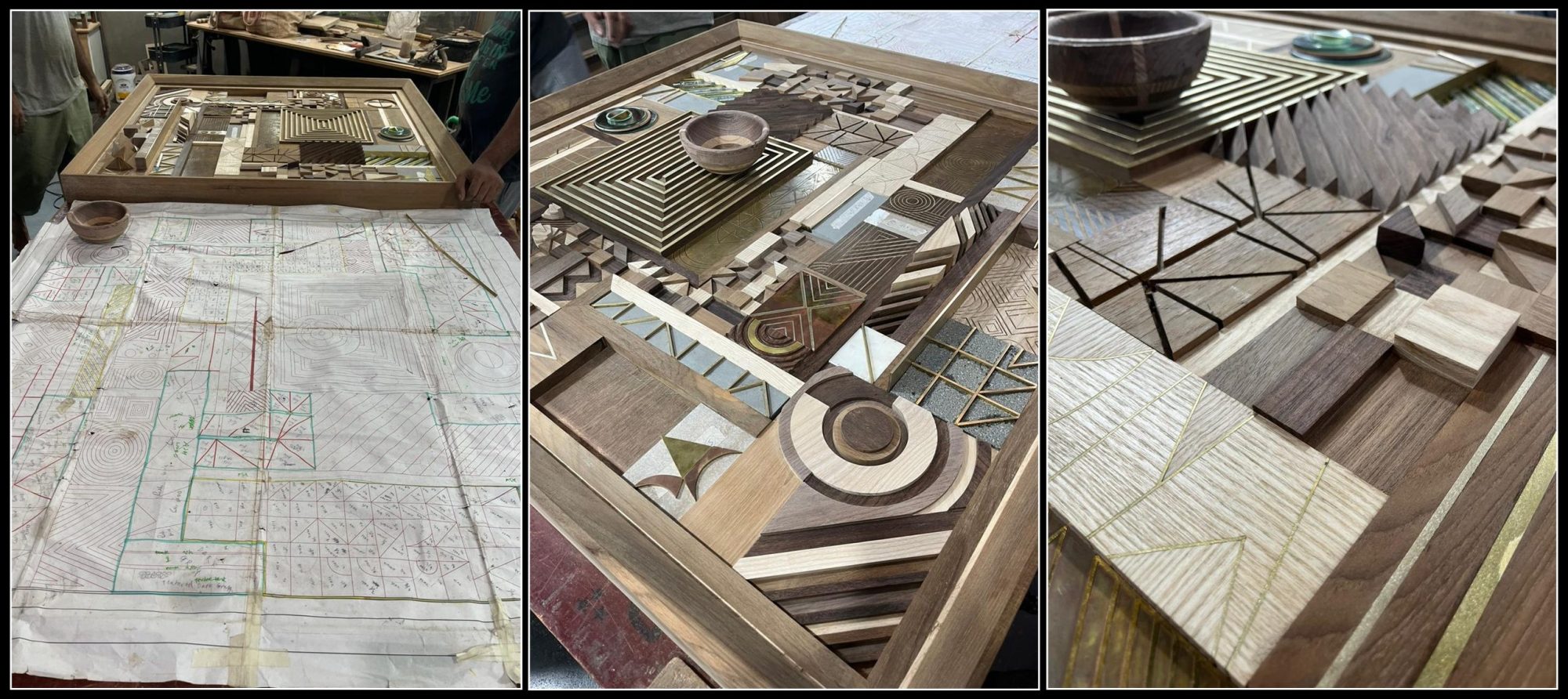
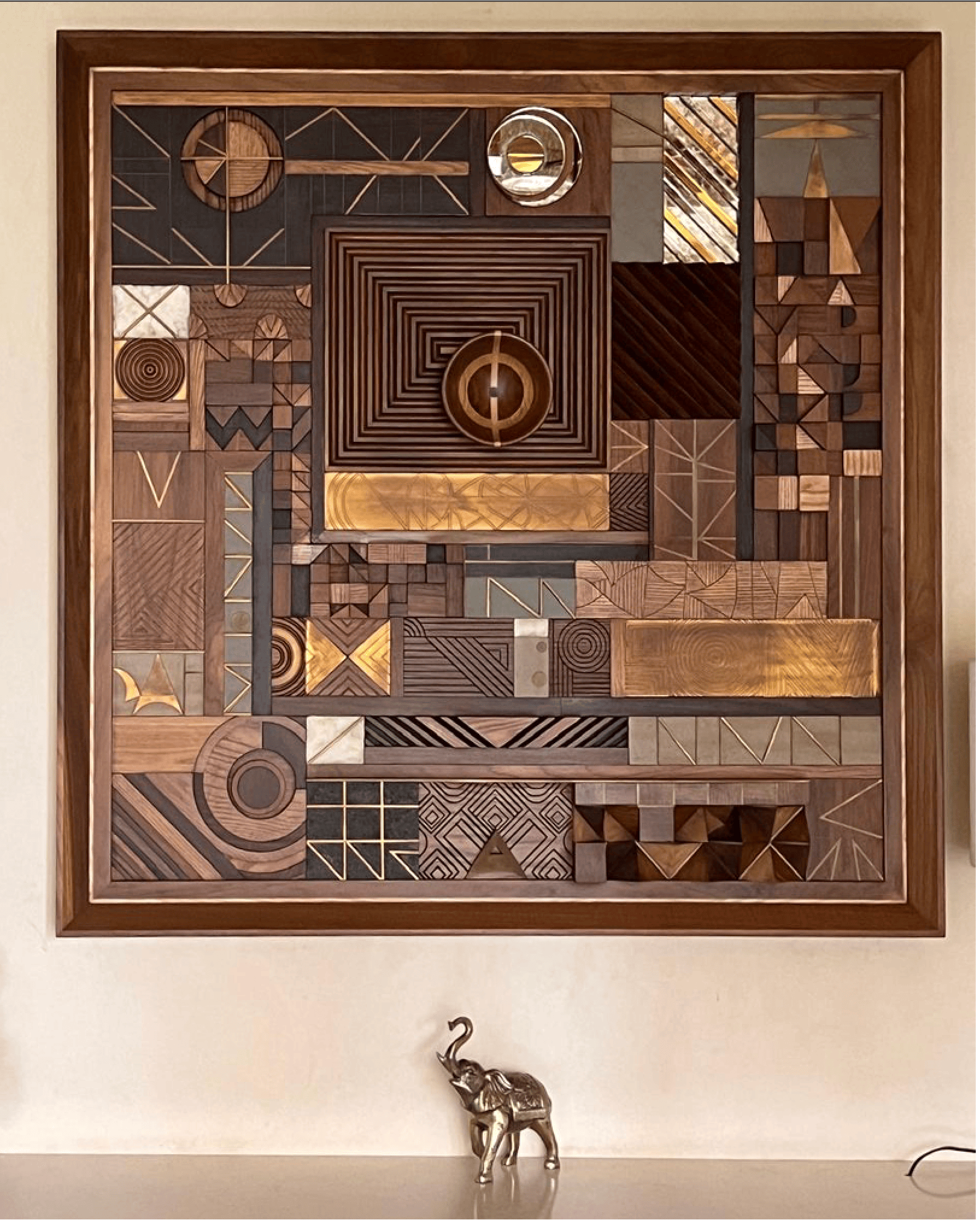
We are trying to set up something in Goa called the Slop Shop, which is essentially looking at “AI slop,” a derogatory term for the kind of, essentially, shit that AI spews out, and trying to sell it in a way that we can fund our drawing programmes. Essentially, you use the output of an AI system and the work that comes out of it to fund pen-and-paper drawing programmes for curious kids. Those are the kinds of projects that we want to do in Goa. An interesting way to look at AI systems is almost like a librarian on steroids. You imagine that the librarian has an unending library, and that person has to run through the library at lightning speed to pick up books and quickly read them, quickly regurgitate them, and spit them out to the person who is asking them. It is an interesting metaphor to imagine AI systems, and we keep this in mind as well.
The Future of Drawing
[31:13] I would like to talk a little bit about the future of drawing. Where do we feel this is going? It is interesting, I mean, and here you may have to bear with me a little bit because it gets a bit bizarre. I think what is happening today is we are essentially, we are not stuck, we are in a computational paradigm where most of our computation is happening through GPUs, essentially. It is big server farms and data centres which are processing all this information and spitting out imagery and novelty. It is interesting to see when that actually jumps by a magnitude, when we actually go down the paradigm of quantum computing, where you have completely bizarre rules. There are rules that nobody understands; even in quantum physics, they do not understand the reality that they are looking at.
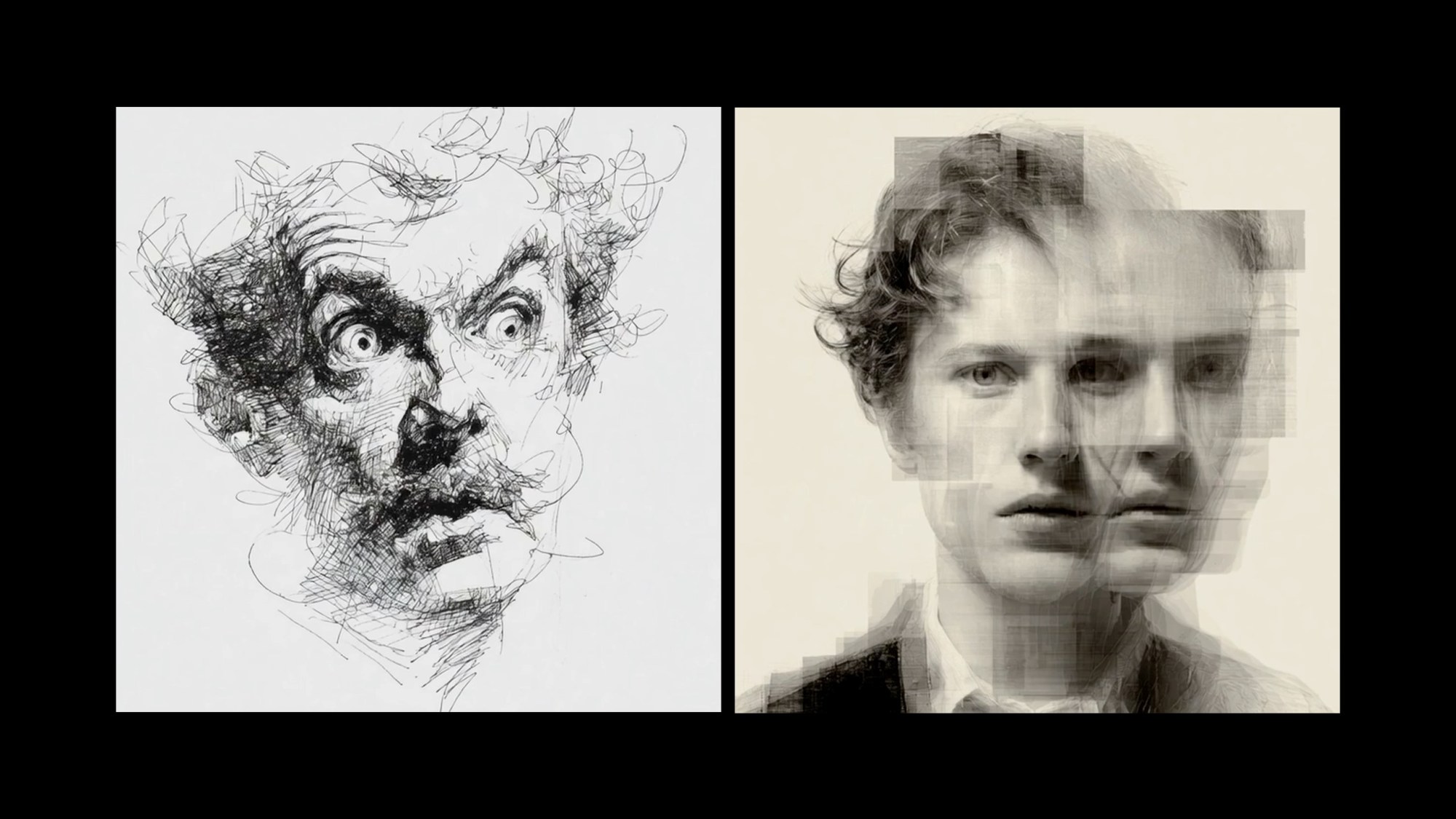
It is interesting to think about a drawing process that actually superimposes multiple different realities altogether. Imagine if you made a black box with an artwork inside it, but you can only see the artwork once you open the box (referring to image 27). It is a bit like Schrödinger’s cat, where you have multiple quantum states inside that box. It exists in this kind of magical orchestra inside the box, but when you open it, you actually see just a single artwork. We were trying to think about what it would be like to draw with a quantum computer. This is one of the things that we would like to offer as a curriculum as well. So, when quantum computing actually happens to us in the next ten to twelve years, the artists are the early adopters. It does not get deployed at the top of the pyramid to create more pyramidical structures. I feel that as designers, artists, and architects, we need to be adopting this technology at the bottom of the pyramid and dispersing it flat so that everyone knows how to do this. It is very important that a traditional carpenter knows how to use Midjourney rather than him or her being replaced by this technology, which essentially just solidifies power structures. I think we would like to be early explorers of these kinds of new domains of drawing as well.
(referring to image 28) It got me thinking about, you know, like for example, if flow for me is relaxation, and me sitting and taking a pen and drawing meditatively on the walls of a Smokehouse Deli is actually relaxing and you feel a sense of flow, what would relaxation feel like for a quantum computer? It is really interesting because if you imagine a quantum computer, it has every single note ever struck of every single orchestra ever played, but it will only play a single tune if you actually observe it. So, the act of non-observing it is actually relaxation for a quantum computer. Does that make any sense at all?
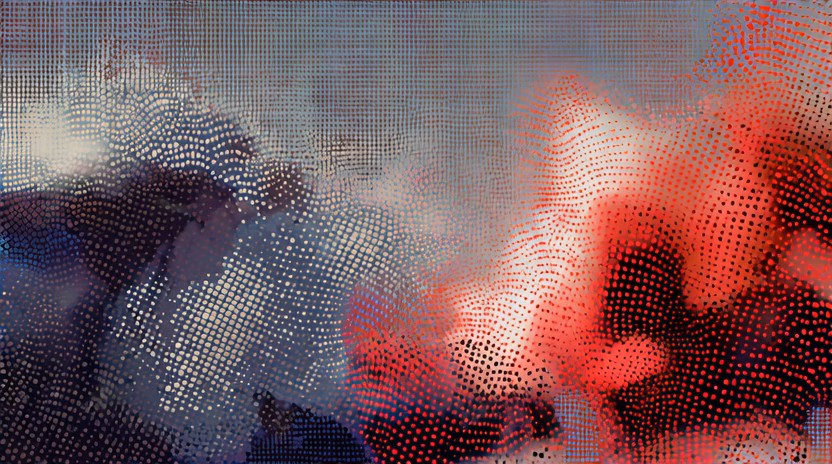
Anyway, we are trying to visualise that and see what it looks like in art. Essentially, you have this whole sense of pixelations and patterns that are constantly bubbling and blowing, but the image only erupts once you have actually engaged with this quantum system. We will watch this space for maybe fifteen years, and we will have some output to show by then. An interesting way, like the librarian was a good way of imagining the AI system, the magic orchestra is a great way of visualising quantum computing, because it essentially subsumes every single note ever played in all the universes around our universe, and the quantum potential only happens once an artist engages with the act of observation. So it is a very interesting inversion.
Where will Drawing take us?
[34:35] Maybe again, since I have seven more minutes, where will drawing take us in the future? What is it doing to us as a species, as a civilisation?
I think what drawing is at its core is a collaborative tool. I think all of us see it in a very pragmatic way on site when explaining a detail, explaining something that has to be quickly translated. I talk to my son using drawing because both of us enjoy it a lot, and we are able to talk about ideas and processes and things like that using drawing as a tool for collaboration. It fills in gaps where words do not do justice. I think if all of us start thinking about this as a collaborative tool, it also opens up possibilities of us collaborating with the extreme other. Once Neuralink technologies are finalised and made safe, what would it be like to talk to an octopus? It is very tough to imagine because it is a very different neurology. AI is actually giving us those training steps, that this is how you talk to a different neurology. Practice on me, I am a silicon-based emotionless kind of a thing, but when you actually talk to a fungi network or when you talk to a 500-year-old banyan tree, this is what you use. I feel drawing is a very important way of framing that collaboration very early on.
It leaves us with a sense of cautious optimism. We always approach things with cautious optimism. You are always problematising things first and then engaging with it wholeheartedly, hopefully the way a kid engages with a playground.
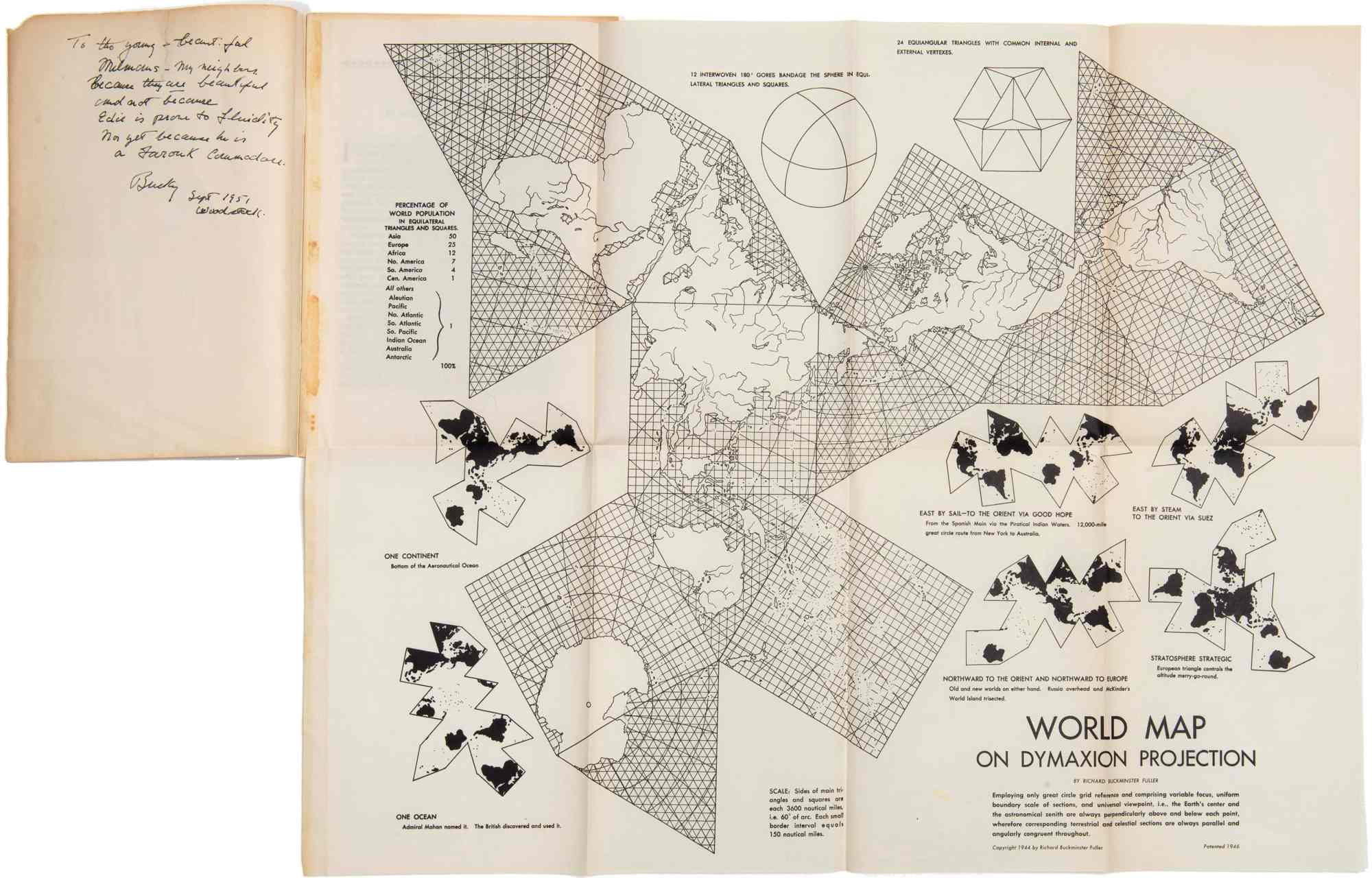
(referring to image 29) This is a revolutionary act of drawing. This is Buckminster Fuller’s Dymaxion map, and what he did in this act of redrawing the world map was to help us visualise the world in a non-colonial way. We see the map of the world that we grow up seeing in atlases, which essentially has the UK in the middle, and that is why terms like the “Middle East,” the “Far East,” and “Western” emerge. On a sphere, there is no Middle East. There is no Far East or Far West.
Buckminster Fuller’s genius was to visualise the earth as a single connected landmass, mapped onto an icosahedron, so it is actually more accurate dimensionally than the Mercator projection that we all use in school. If you look at the size of Greenland on our visualisation that we are all used to, it is almost the size of Africa, whereas Africa is four times the size of Greenland in terms of landmass. So, this map is actually a lot more accurate dimensionally, and it allows us to see how close the USA and Russia actually are. On our traditional maps, Russia is this side, USA is that side, and it feels like, “Oh man, there is so much conceptual distance between the two, there is communism and capitalism and how do we bridge this gap?” It is actually bullshit, because we are all on a connected landmass. You can actually cross from America to Russia on a very, very small land bridge. So, it is a very revolutionary way of drawing to actually show commonality between humanity. I feel drawing has this potential that if we engage with it wholeheartedly and with cautious optimism, many magical things can happen. He actually solved the Cold War using thumbtacks because he went into the UN and played something called Peace Games. I mean, I will not get into it right now, but it is a beautiful thing to read about. It is a really good one to read about what he did with Peace Games. He unrolled this massive Dymaxion map in the middle of the UN. He gave all the Soviet and US engineers and bureaucrats thumbtacks, and they were asked to pin their resources onto the world map, and this is the first time that a Russian hydro engineer said, “I didn’t realise that our rivers are so close to your solar power and we can do this. We can put a dam here. We can export energy here. We can do this. We can do that.” They were talking about setting up solar farms in Africa because they realised that these colonial divides do not actually exist on the planet the way we inhabit it today. So, drawing is a fairly revolutionary act at its core.
I also feel, I mean, since we are on this fantasy journey, let us also talk about something way out, planetary intelligence. If we had to engage with every single intelligence on our planet, my guess is that drawing is going to be the tool we use. If you remember this, this is the disk (referring to image 30) that was sent from Earth on the Voyager, and this is currently the furthest man-made object from Earth. It is almost on the outer edges of the mapped solar system, and they used drawing to tell alien species how to use this disk. So there are drawings. That is actually a pulsar map, which is the closest pulsar to Earth, and that pulsar is actually a way of signalling our location in the cosmos. So, if they can decode this drawing, they will actually be able to communicate with us as an alien intelligence.
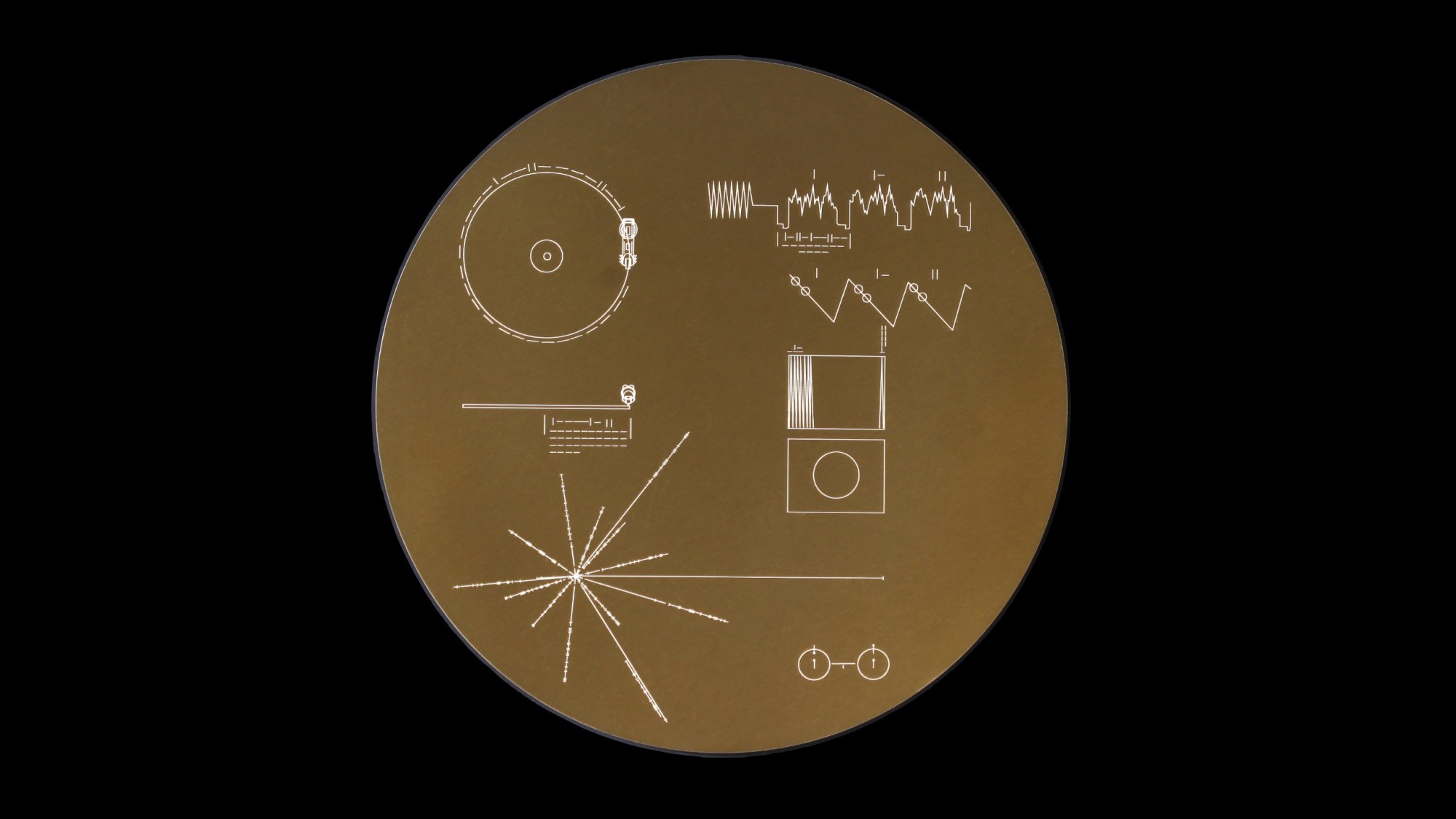
I feel this is the threshold that drawing actually brings us to. If we are not stuck in disciplinary boundaries, thinking that pen and pencil is drawing or that paper and ink is drawing, I think drawing is a very, very deep human act of expression, and it is very, very interesting to explore the frontiers of that. Thank you so much.
All images and videos are © courtesy of The Busride Design Studio.
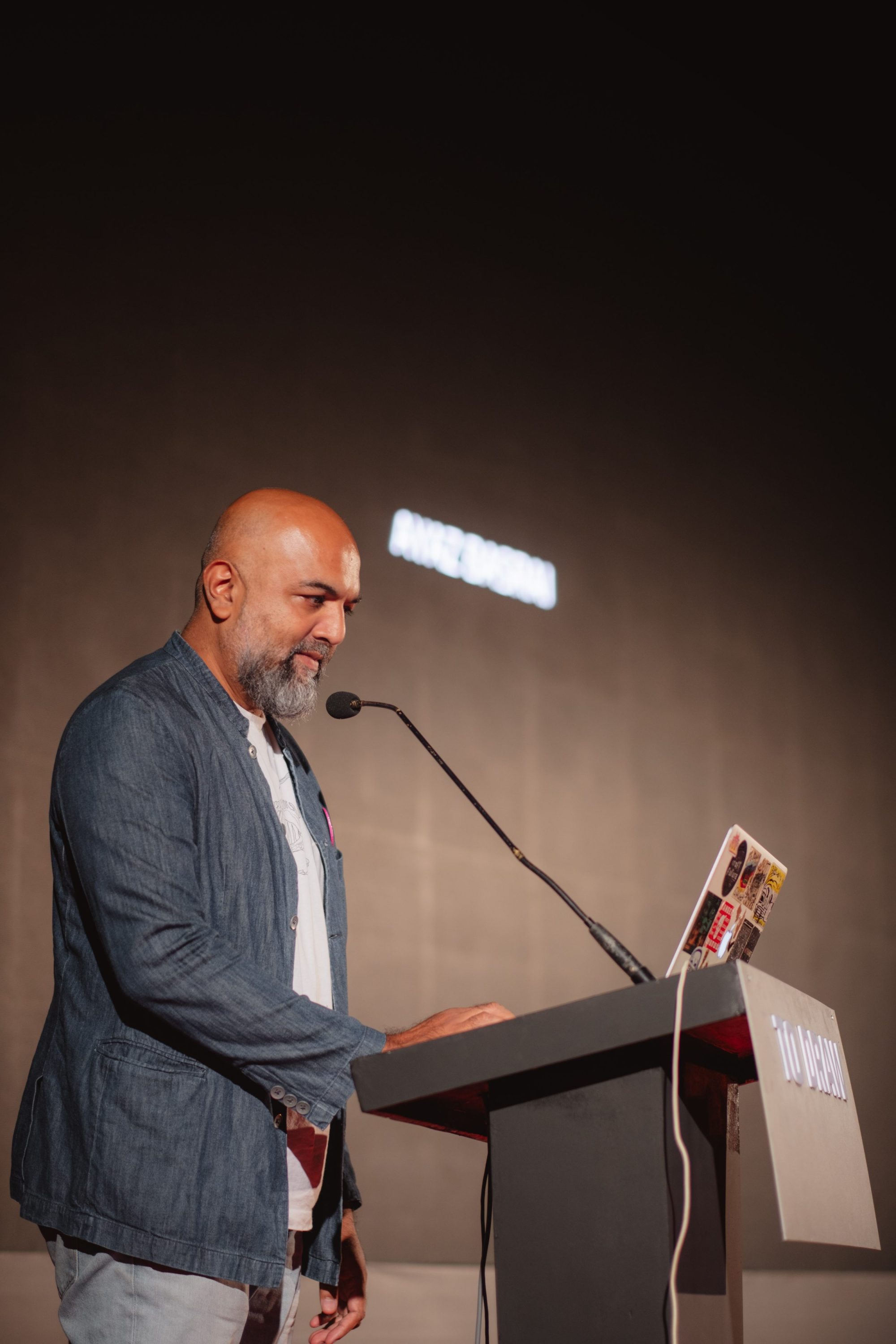
Ayaz Basrai is Co-founder of The Busride Design Studio, a leading Architecture and Interior design firm in India. Ayaz graduated in Industrial Design, specialising in Product Design from the National Institute of Design, Ahmedabad in 2003. In 2006, he set up The Busride Design Studio with his architect brother Zameer, as an independent design studio specialising in the design and creation of built environments. With wide ranging interests in illustration, immersive media, design and research, Ayaz is constantly dabbling in the ever-expanding latitude of design expression.
FRAME is an independent, biennial professional conclave on contemporary architecture in India, curated by Matter and organised in partnership with Takshila Educational Society. The intent of the conclave is to provoke thought on issues that are pertinent to pedagogy and practice of architecture in India. The second edition was organised on 02, 03 and 04 October 2025 at the National Institute of Oceanography, Goa, thematically aligned as ‘AUTHORING 01: TO DRAW’.
Organisation and Curation: MATTER
Supported by: Takshila Educational Society

