
MODERN SOUTH ASIA
A Visual Archive of South Asia’s Modernist Heritage
The Modern South Asia (MSA) series is dedicated to exploring modern architecture of historic importance in South Asia through photography-based books. The series will focus on architecture from the 20th century, designed and built by regional and international architects. Each book will provide the reader with an in-depth visual exploration of the architecture through contemporary photographs, architectural drawings, and newly commissioned writing by architects, thinkers, and academics.
The MSA series is edited and photographed by Randhir Singh. The project is supported and published by Arthshila Trust.
The Street As Stage: Charles Correa’s Kala Academy Goa
Essay by Rohan Shivkumar
Photographs by Randhir Singh
This could be a sequence from a Buster Keaton silent-era comedy. One summer evening, a man is sitting on the edge of the river, sipping his coffee. There is a warm breeze drifting over the water as the sun sets. He hears the gentle strains of a piano playing Beethoven’s ‘Moonlight Sonata’ over the sound of the waves lapping the shore. Caught in its spell, he walks towards the music. He must find out who is playing. In a daze, humming to himself, he climbs the steps of an amphitheatre to a blue-tiled terrace. In one of the rooms, he sees a woman playing the piano. A student stands over her shoulder watching her hands. The man wants to get as close as he can to the music. He walks straight towards her and collides directly into a pane of glass. The glass shatters. He falls. Everyone rushes to help him – the piano teacher, the watchmen of the building and other people enjoying the evening breeze off the river. Befuddled, he sits up. Luckily, he is not injured. Only his nose is a little bruised, and so is his pride.
After the flurry of worry and nervous laughter, this becomes a standing joke with him and the watchmen every time he returns to the building in later years. There is a smile exchanged between them – an acknowledgement of that moment when the beauty of art, of human error and of care between strangers came alive and became apparent. This story, or at least the basic form of it, was told to me by a friend of an evening he remembered at the Kala Academy.
I am sure the story transformed as he narrated it. This narration was probably designed for my ears. Certain aspects were highlighted and others discarded or played down. He chose the words carefully and structured his thoughts into language to express to me the ludicrousness of the situation. There was an embarrassed laugh inserted at the moment when the glass broke. As I recount his story, I too transform it. I render it in my tongue. I exaggerate and extrapolate – I hope to delight in my narration, even though I might fail.
Today, my friend probably remembers the event more as a story and not as an experience. In the story, he plays the eccentric befuddled man enamoured by music – a character that he performs for us and for himself. This is what art or kala can do. It allows us to ‘become’. We find ourselves reflected in the mirror of art. It shows us what we are and what we want to be. Architecture is also such an art. This essay explores this desire for transformation as expressed in the architecture of the Kala Academy.
Kala Academy as a Cultural Centre
The Kala Academy is a Cultural Centre – a unique institution in the history of modernity – perhaps even more specifically a postcolonial modernity, where an identity needed to be forged after the humiliations of colonialism. This is a building that meant to construct and distil in its programme and architecture that ambiguous and contested term – Culture. According to the dictionary, this word has two meanings. One is more broad-based – “the ideas, customs, and social behaviour of a particular people or society”1; while the other, at least at first glance, seems rather more specific – “the arts and other manifestations of human intellectual achievement regarded collectively”. To collapse both of these in the same word ‘culture’ seems to presume that in the latter definition, we can find the former, or in the arts of a particular society we can discover its ideals and customs. Consequently, a building to house these arts must be able to express those ideals.
What did this mean for the making of a Cultural Centre in the state of Goa in 1973 – the year in which the Kala Academy was initiated? This was a state with a unique history. It had been attached to the larger Indian nation only 12 years earlier, while the Indian state itself was also very young. It had been a mere 26 years since Indian Independence from British rule. The aspirations of making a new democratic nation had still not faded into the cynicism that followed after the national emergency imposed by Prime Minister Indira Gandhi that suspended civil and political rights for 21 months from 1975 to 1977. The conception of the Kala Academy preceded this period and had to express the desires and hopes of a democratic nation. It had to exemplify the aspirations of a community with a shared desire for freedom, equality and justice – where difference in religion, language, custom, and belief was celebrated. It is important to acknowledge that this was an aspiration – a desire – it was what India was meant to be, not what it was. The role of ‘culture’ was to inspire us towards becoming citizens of what Benedict Anderson has called the ‘Imagined Community’ of the nation-state. This didactic desire propelled artists in the visual arts, literature and cinema to join in this ‘nation-building’ project.
Architecture and Indian Identity
Architecture had also been enlisted to shape the physical landscape in which the modern Indian citizen would live, perhaps nowhere as vividly as in the design of Chandigarh, the new capital of Punjab designed by Le Corbusier. In his famous quotation about the design of Chandigarh, Prime Minister Jawaharlal Nehru had said, “It is totally immaterial whether you like it or not, it is the biggest thing because it makes you think. You may squirm at the impact, but it makes you imbibe new ideas. And one thing India requires in so many fields is to be hit on the head, so you may think”.2
The plaza of the Capitol Complex in Chandigarh is a space representative of this desire. Here architecture is meant to celebrate the ideologies upon which the newly independent nation was being built through built form and spatial experience. The monuments here are not to public figures or gods, but rather the relationship between man and nature, between the ground and the sky, and the movement of celestial bodies – the Monument to the Open Hand, the Geometric Hill, and the Tower of Shadows. In this space, specific histories and identities dissolve. A new citizenship is imagined unmoored from the trappings of the past. This was an architecture that was supposed to shock us to rise from our stupor and wake up in a new world. A future citizenry was being forged that could inhabit the relentless grid, the brutal concrete and the stark horizons of the city – in its streets and squares. Many architects of the 1950s and 1960s were deeply inspired by Chandigarh in their search for a spatial language through which they could write a modern Indian identity. The muscular architecture of Aditya Prakash and Shivnath Prasad seemed to be direct descendants of the Corbusian legacy.
However, there was another tendency towards the making of a modern Indian architecture that drew on the legacy of the Bauhaus. In the work of architects like Habib Rahman and Achyut Kanvinde, there was an urge to discover the poetic in the rational. Their buildings tended to be crystalline compositions where reason was held supreme. Despite their differences, in both of these tendencies, the Corbusian or the Bauhaus inspired, there was a messianic aspiration towards universalism, either in the promise of a sensual oneness of all human beings under the sun, or in the abstraction of mathematics.
In the period between the 1950s and 1970s, architects like Charles Correa and his contemporaries responded to these histories when forging a new path for Indian architecture and urbanism. They were naturally inspired by some of these ideas, while rejecting others. While Corbusier’s modernity celebrated the clarity of the plaza, Correa’s emerged out of the complexity of the street.
Charles Correa and the Modernity of the Street
The ‘plaza’ or the ‘square’ has in modern times been seen as the space of the city where citizens are to meet and mingle freely. Here, we are meant to sit and watch the theatre of public life being performed. In its architecture is the distillation and public display of ideology. It is no accident that it is in the plaza that we find the church, the temple and the seat of government. Historically, it was here that celebrations and punishments were enacted as ways of reinforcing what is allowed or forbidden in the city. The plaza is the space for the performance of collectivity – for mass gatherings and ostentatious displays of power. It is thus a space where an individual identity is subsumed into a larger narrative. Those that do not fit in with that narrative are rejected – disallowed from participating in the public realm. It is, in other words, the place where the ‘norm’ is celebrated, and the deviant marginalised. The plaza is a conflicted space for the performance of modernity. In a democracy, whose very being depends on the protection of the rights of the individual, there is a tension inherent in this imagination of the plaza – between the unfettered freedom that it promises and its deployment as a space where that very freedom is curtailed.
The street is entirely another matter. The street and plaza can be seen as complementary but opposing kinds of spaces. While they might be part of a continuous public realm, they have very different roles and effects. If the plaza is about oneness, the street is about plurality, of variety. Against the hyper visibility of the plaza, the street is visceral. The street is the space for movement, for drifting, to be a flaneur watching the world go by. It is the space of accidental encounters. The street is the space where we encounter the other; the space of the bazaar; where we begin to see ourselves through the eyes of the other. It is the space for banter, flirtation, danger and friendship – the space where we experience the thrill of the city. The space of the street leaks – it can’t be easily closed off and controlled. The street is the space for us to perform our modernity – our citizenship – as equals, free.
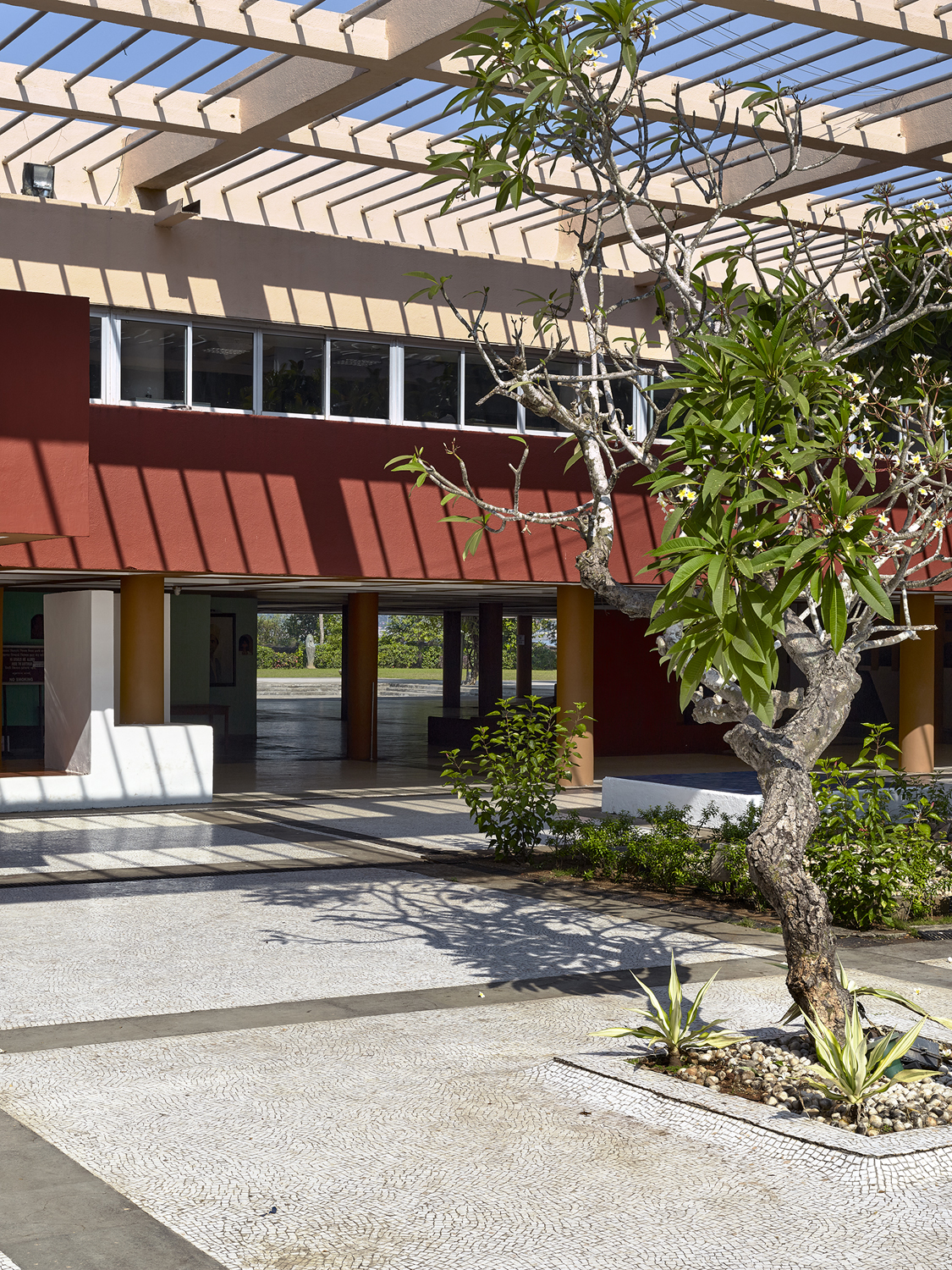
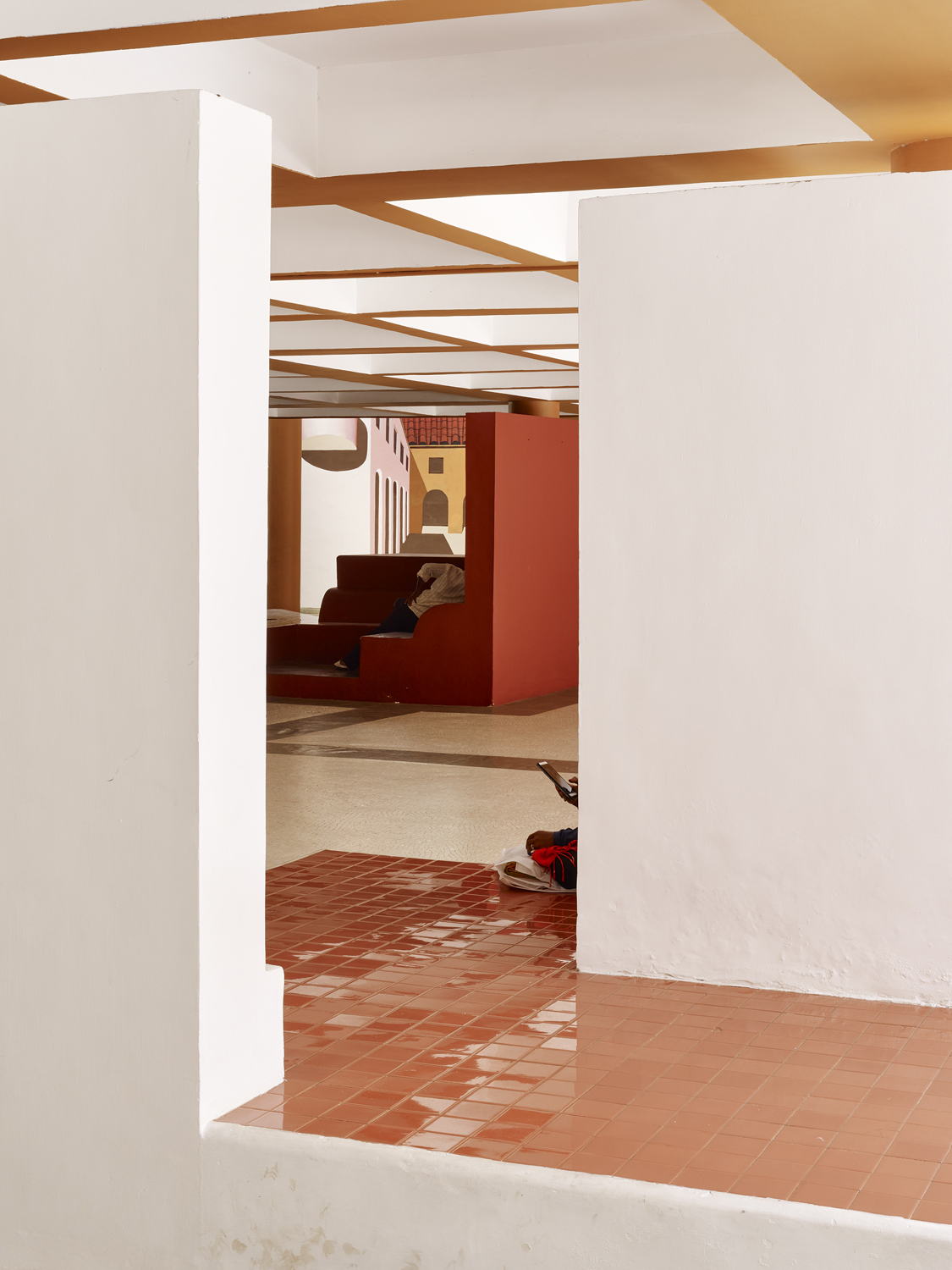
Charles Correa’s work from the 1950s and 1960s evokes a public realm that is uninterested in the spectacle of the plaza but is, instead, interested in evoking the unruliness of the street. This is especially true of his institutional projects. You can see this interest in his first public building, the Gandhi Smarak Ashram in Ahmedabad. The loose arrangement of the modules around a meandering space evokes a village street. Here open-to-sky and closed spaces are encountered casually as one drifts in from the outside. The boundary between interior and exterior is blurred as the building invites observers to enter, browse, wait and chat. This looseness is also characteristic of the building that he designed for Gandhi Darshan at Rajghat in New Delhi. The ‘non-building’ refuses to impress itself upon the user. It disappears into a series of courtyards, terraces and verandahs structured around a pedestrian path. Hyper-visibility is self-consciously eschewed in favour of a visceral sensuality.
Kenneth Frampton has identified Correa’s interest in movement as a generator of architecture in, what he calls, “the ritualistic pathway along a shifting axis”.3 However, in Correa’s work the rituals are not those within a temple with its practices confined to only a few to perform. Rituals for him are the rituals of modern life. The street is a space for the celebration of everyday life, available to all, ranging from the prosaic to the profound. At the Kala Academy he evokes the “ritualistic pathway” as the space of modernity, where encounters are staged between people and nature as phenomena, between people and other people as equals, and between people and their desires.
The Street as a Story
Correa in his lecture “Hornby Trains, Chinese Gardens and Architecture” delivered at Harvard in 1998 makes a distinction between architecture that might have strong conceptual ideas but does not linger beyond the first five minutes and architecture that does not seem to “involve any holistic schema at all”. He says that the latter can, “present you with a series of spellbinding effects, one after another, perhaps without any interrelationship – except, of course, that one set piece follows the previous one in a knock out sequence, rather like the way Gone With the Wind is structured around a series of unforgettable scenes”.4
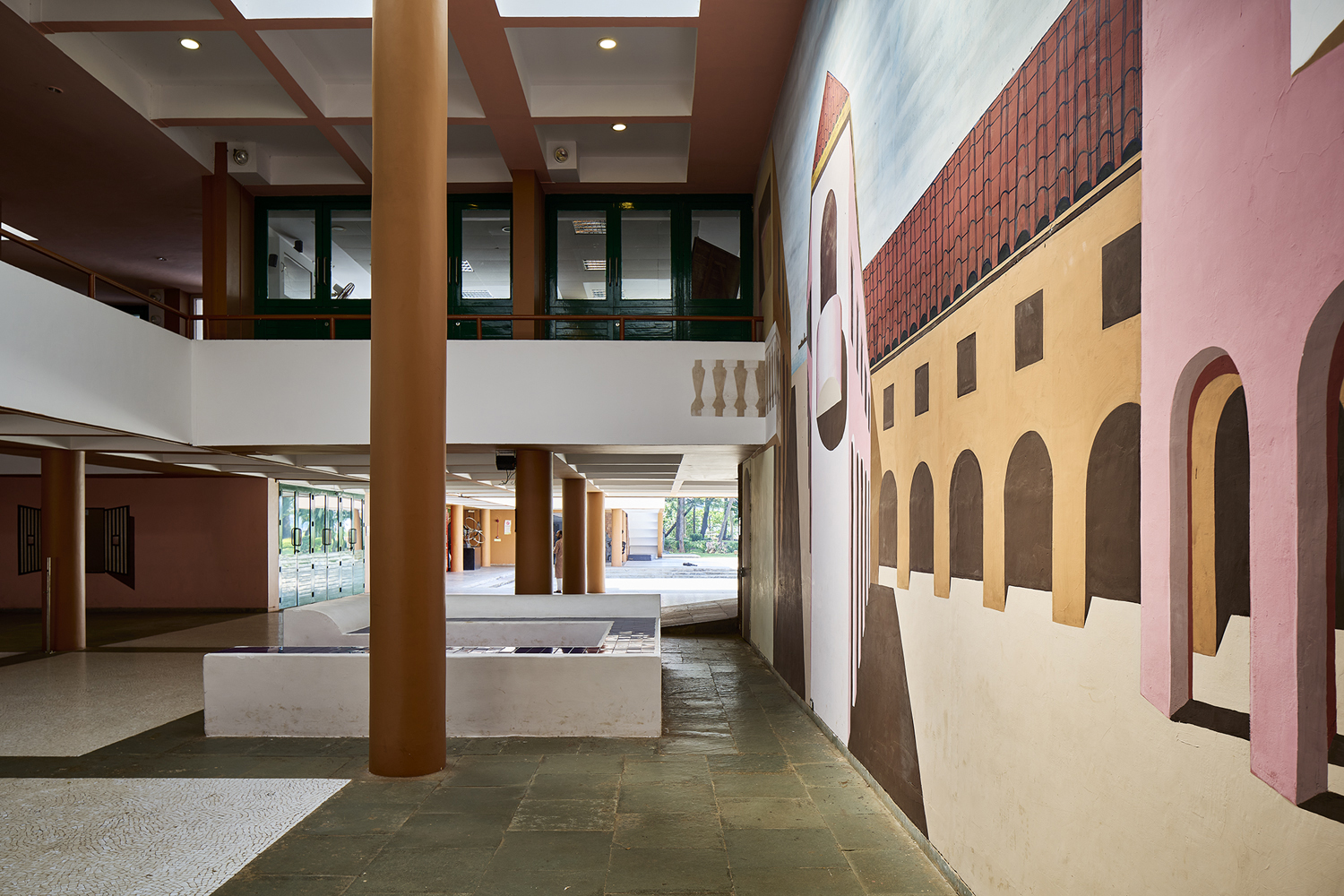
This interest in the cinematic sequencing of events is at the heart of the design of the Kala Academy. This is not merely a building but a backdrop for the performance of modern life. It is the street that Correa evokes as the stage for this purpose. The project is structured as a series of distinct scenes strung loosely along a path of movement. In each of these scenes, he seems inspired by some of the devices of the design of theatres, perhaps from Tiatr, the uniquely Goan tradition of theatrical performance. Tiatr performances usually involve 6 or 7 acts of short duration, usually around 15 minutes each and performed in Konkani. Tiatr combines elements of music, drama, comedy and social commentary and often feature live music, singing, dancing, and colourful costumes.
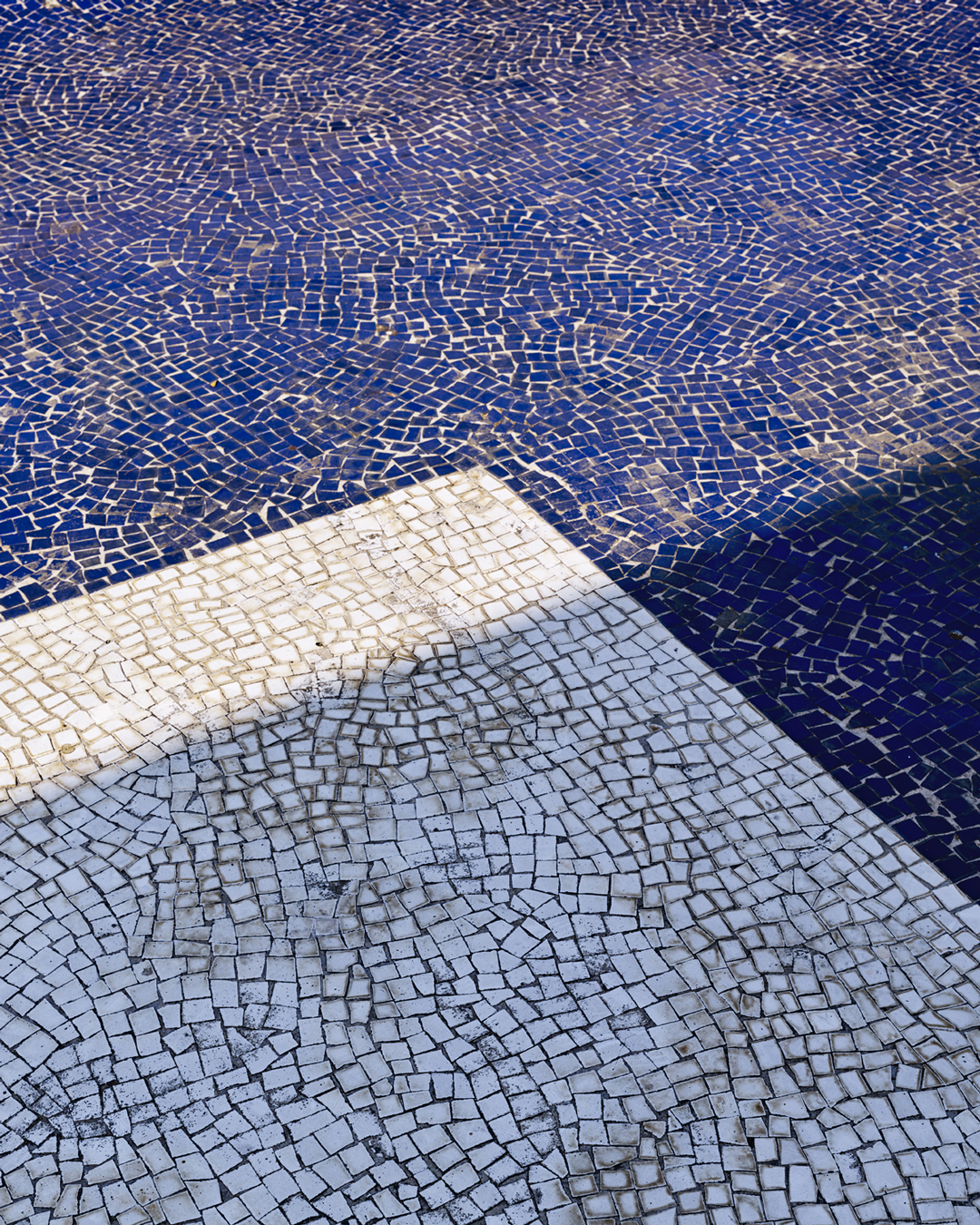
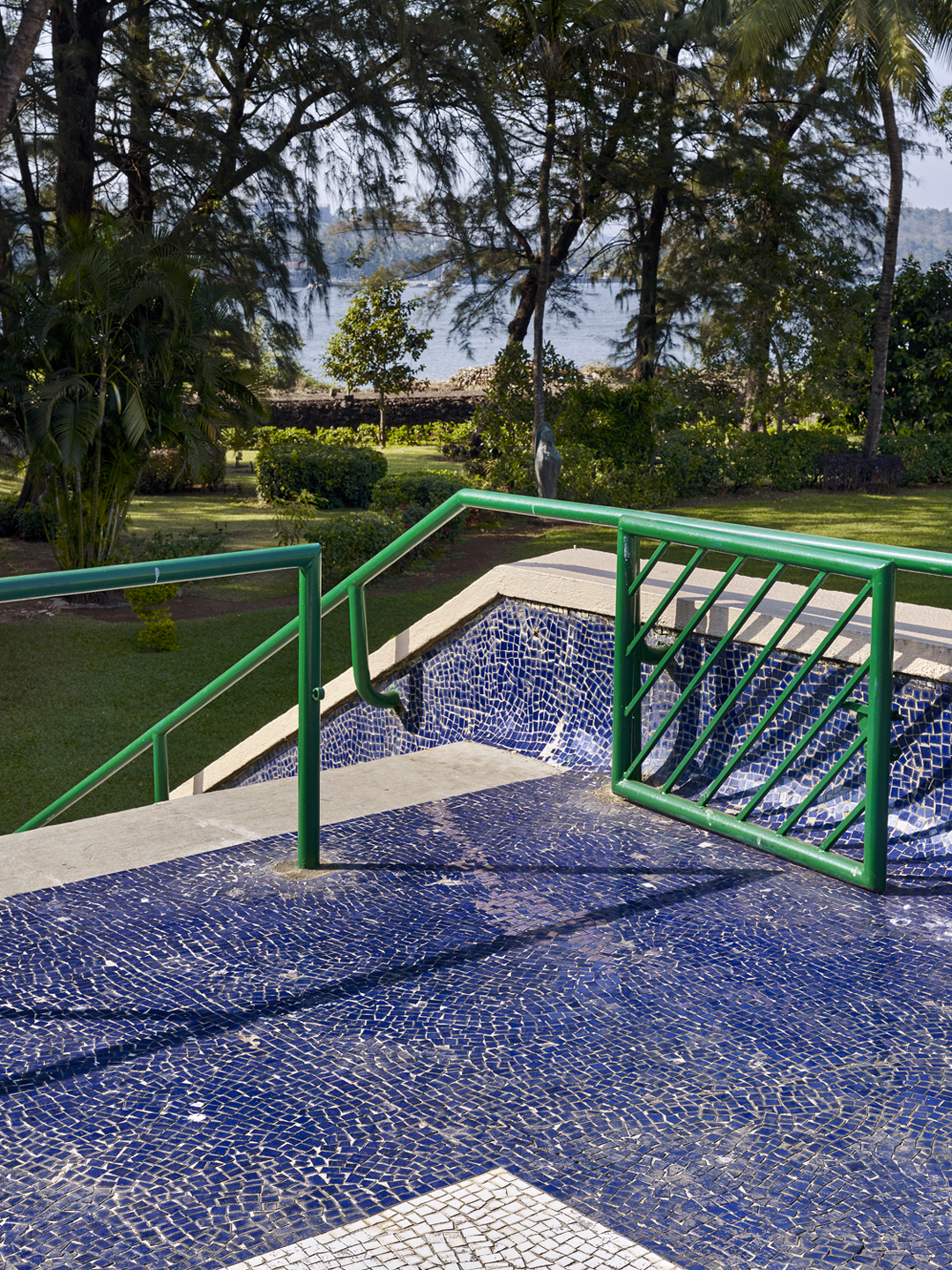
The Kala Academy can be seen as an act of set design where everyday life is on stage. Here the relationship between the audience and the performer is constantly shifting. One is performing as much as one is watching a performance. When you enter the gates of the project, you are instantly transformed into a character in a play that is constantly being rewritten and is never repeated. The painted backdrops that might be on a conventional stage reach beyond the confined space of the theatre and all the way to the outside. Trope l’oliel paintings on the walls provide the scenery where the action is to occur. There is no separation between the art on the walls and the architecture. These paintings give the illusion of streets that extend space into the walls. Vertical walls disintegrate into a three dimensional network of spaces – some real and some illusory, always in tension with one another. These spaces enable us to tell and listen to stories, to reinvent ourselves through those stories – this time as modern urban citizens on the streets of this town. For that is what the design of this project evokes – a meeting of two crossroads in a town in an imagined modern India. Here, we are meant to become better than what we are. After all, isn’t it in culture that we find the finest distillation of what we aspire to become, and the streets of the metaphorical town of the Kala Academy is the setting that allows us perform those aspirations.
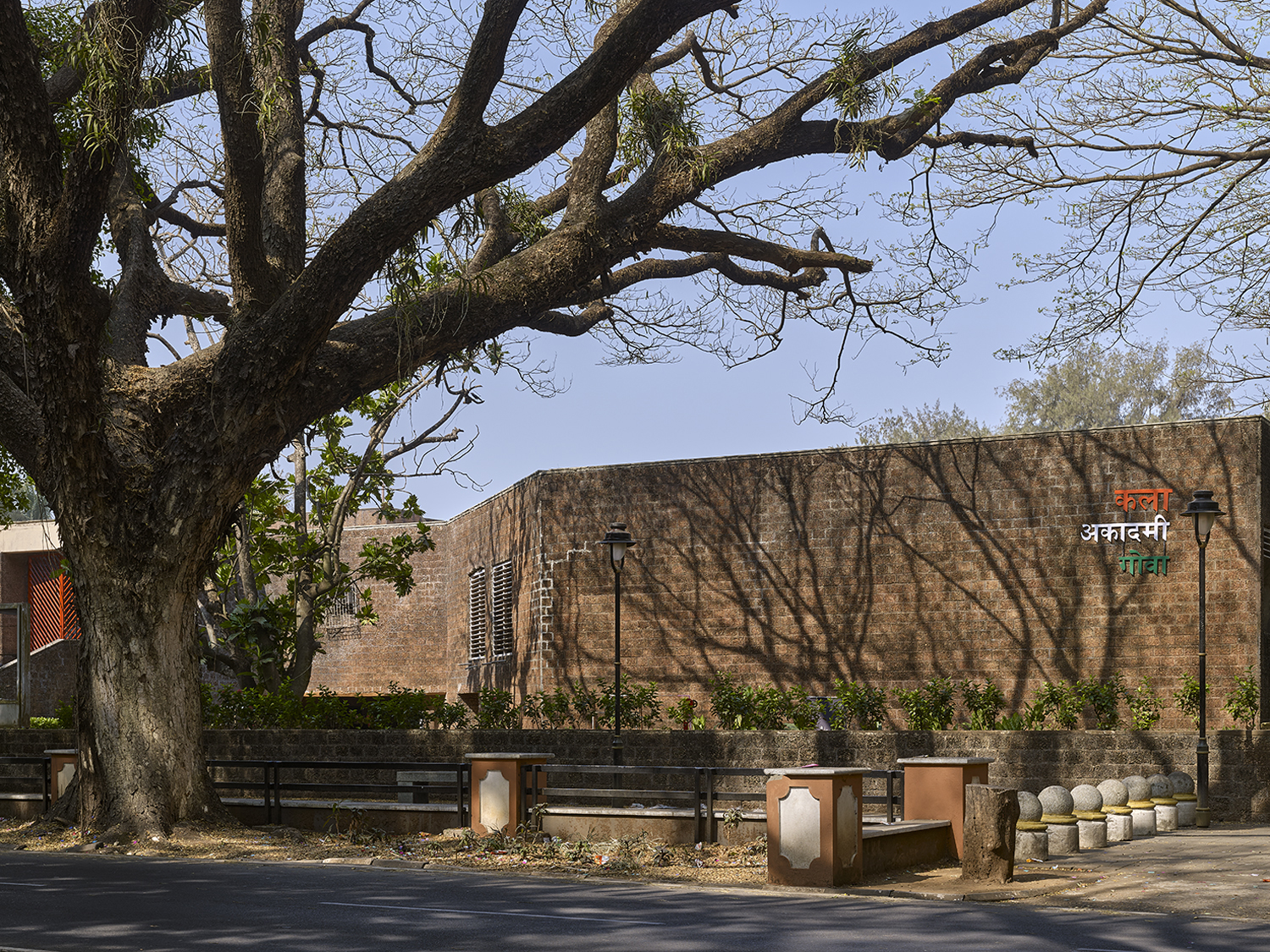
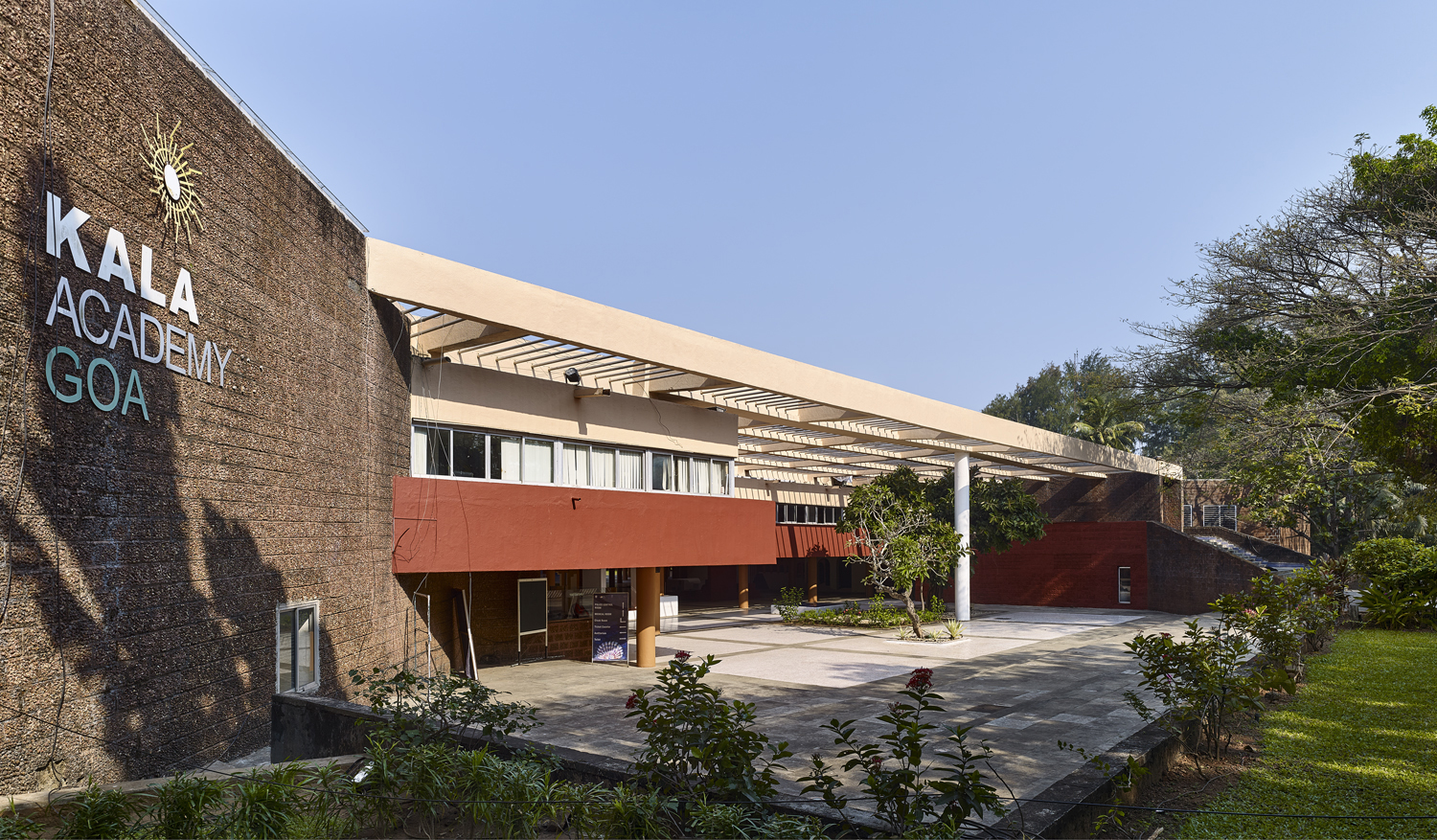
The building sits on one of the main roads in Panjim running from the old city in the north to Miramar Beach in the south, parallel to the Mandovi river as it empties into the Arabian Sea. The building lies in between the road and the river, and this generates the parti of the project based on the intersection of two streets. The main street is the one that leads from the road to the river along which are the discrete episodes that Correa stages. The first is the main entrance to the complex. It takes the form of a yawning gateway underneath a pergola. The external walls of the building into which this gateway sits are clad in the red laterite available in the region and reminiscent of the Reis Magos Fort across the river.
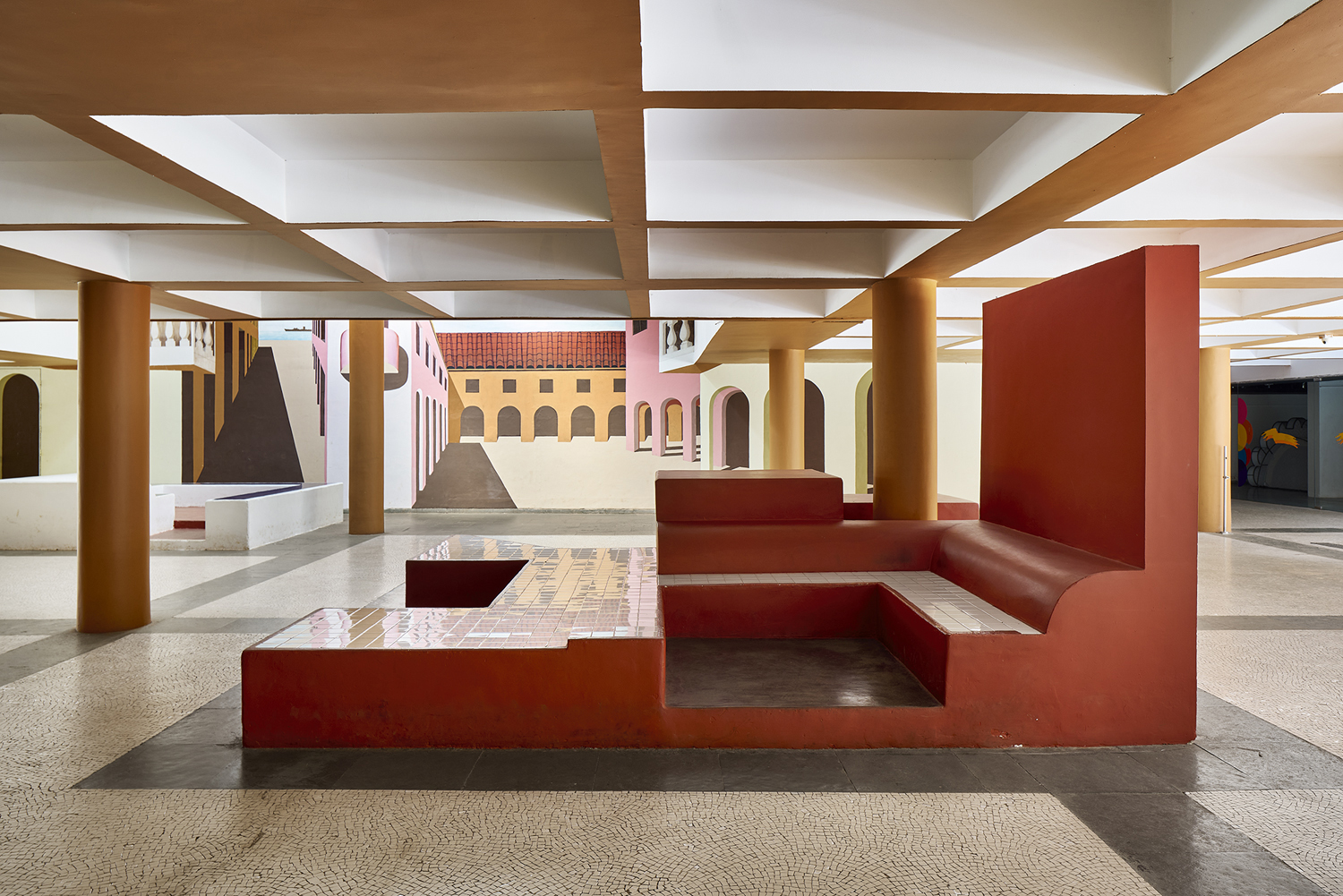
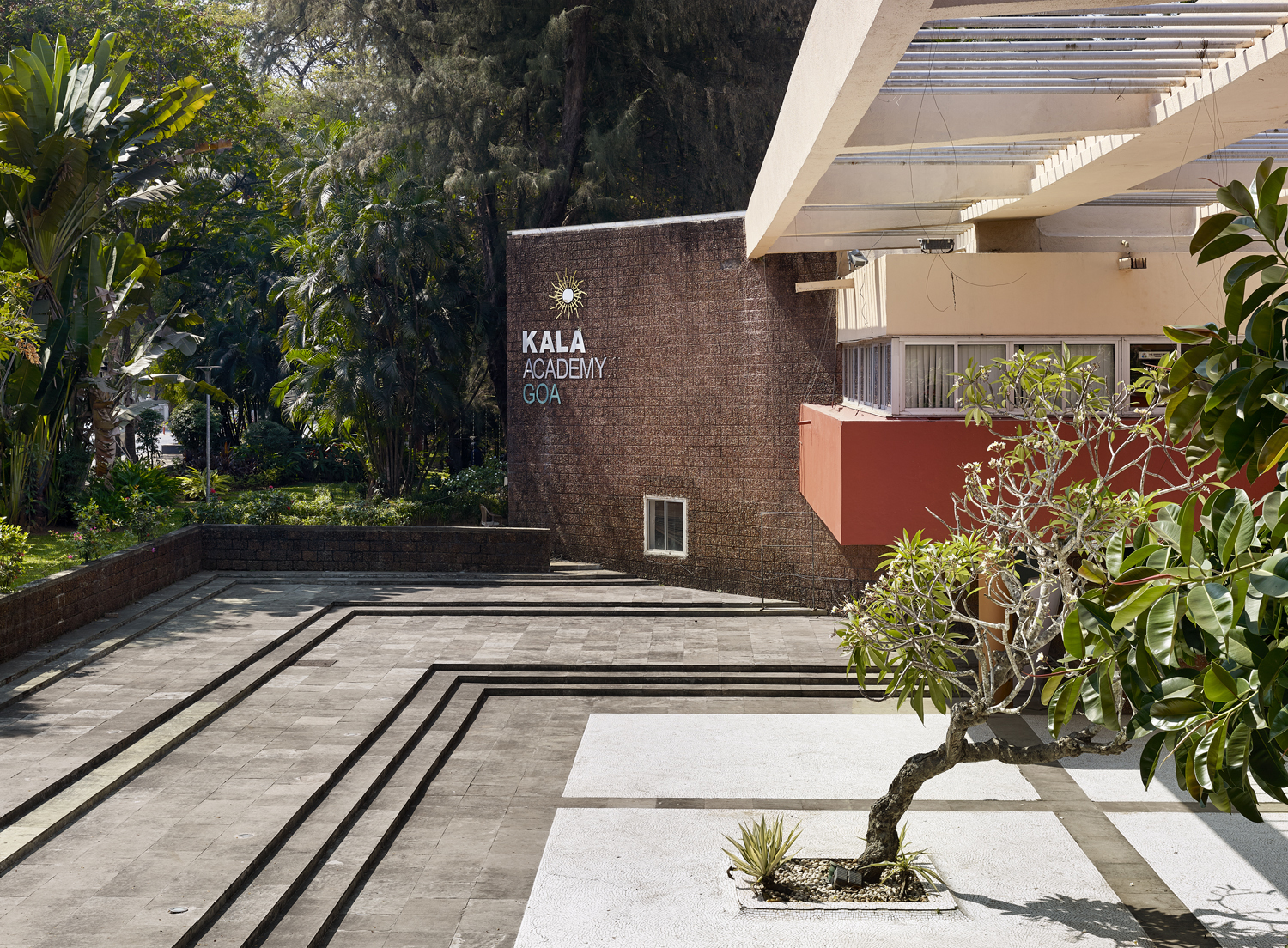
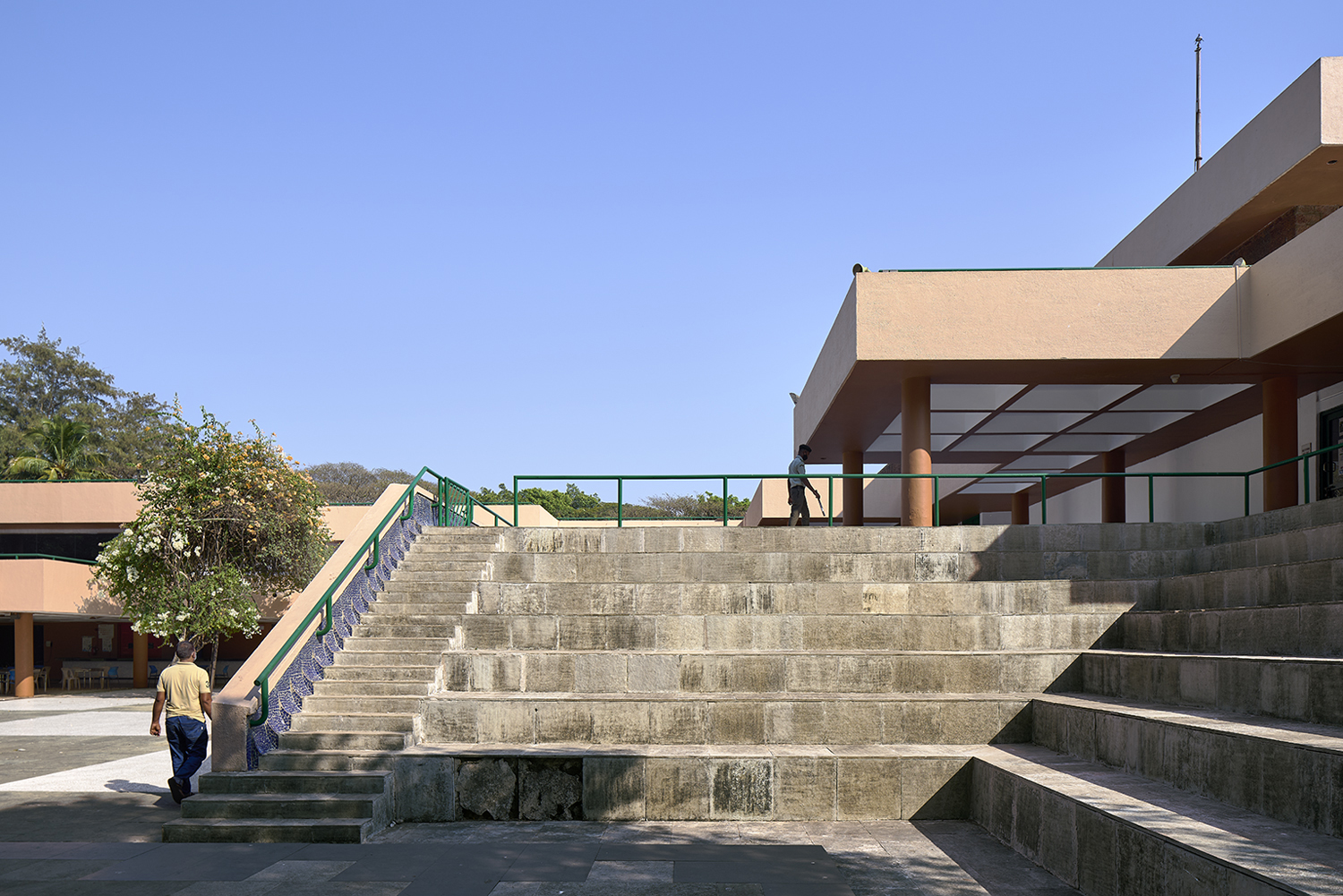
This could be the main gateway to Correa’s metaphorical town, or perhaps the proscenium of the stage/street upon which the theatre of modern life is to be performed. Below it, you can see glimpses of city streets painted on the walls in trompe l’oliel giving the impression of a larger city beyond. To the right of this gateway is a series of large steps that rise to a terrace from where you descend into an amphitheatre – the first performance space of the building – accessed directly off the main road.
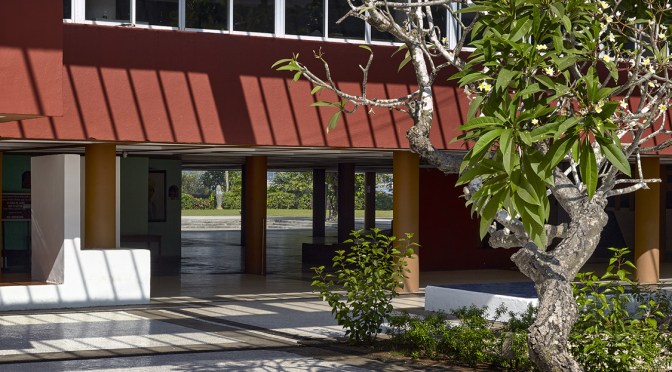
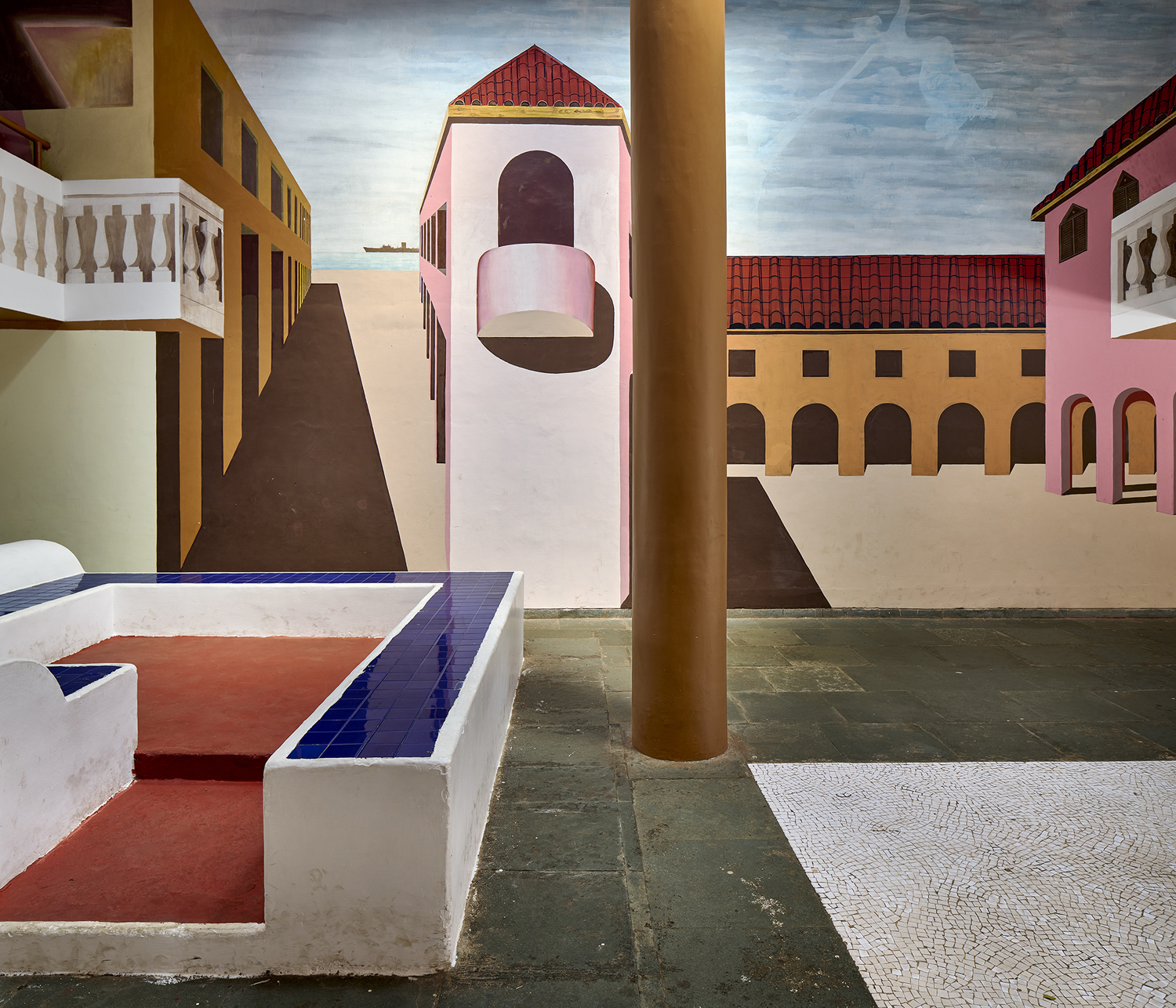
As this main access street cascades gently downwards towards the river past a tree, it meets a second street at a space that is an evocation of a chowk. These kinds of spaces are usually found on the edge of the settlement from where streets lead into the community. Here, there is an invitation to wait and meet before you enter. The seating that Correa provides in this lobby of sorts takes the form of geometric volumes arranged around columns – a reminder of the plinths around trees where people gather.
The second street that intersects this space leads inwards from the parking lot. Along this street is a painting of the riverfront with a balustrade in front of it. Across this image of the river is painted the other coast of the Mandovi as it would have been centuries ago. Further down are sit-outs that recall the traditional balcao or porches of Goan houses. This space provides access to the black box theatre and the art gallery below the amphitheatre.
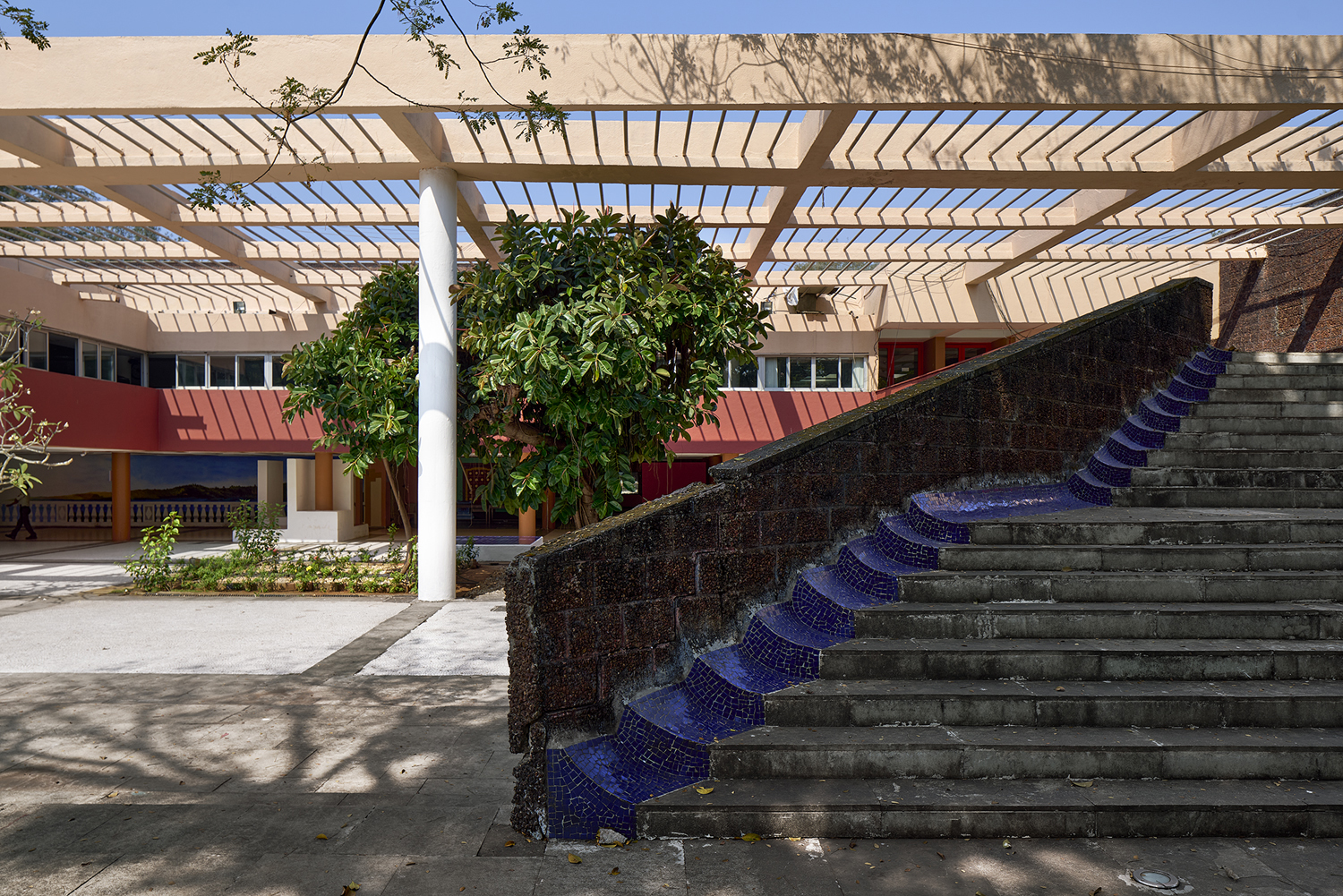
Further down the street as it heads to the river is the main square of the metaphorical town that Correa is evoking. This is a double- height space with skylights above. The walls of this space are painted with facades of buildings in the distorted perspectives that recall the work of the Italian painter Giorgio de Chirico. Like in his work, the drawings are reminiscent of a square in a city where strange things seem to occur. A boy stands on a balcony and watches us from above. A staircase leads up to the upper floors but also disappears into the illusory space of the wall. A painted window with the traditional oyster shell technique used in Goa at first appears to be fake, but turns out to be real, overlooks the library to the rear. In a corner, the architects Mies Van Der Rohe and Le Corbusier have a conversation with each other near the sea with a ship sailing in the distance. In this space, and indeed in the whole building, Correa is drawing on surrealist traditions of collage. Different people, spaces and times meet and encounters are staged between them – and with us. We are transposed into those encounters. We join them as performers. Our lives are played out with them. That is really the power of stories. In them we see ourselves, but also outside ourselves. It allows us insight into our place in the world through reflection and through difference. The Kala Academy revels in those possibilities.
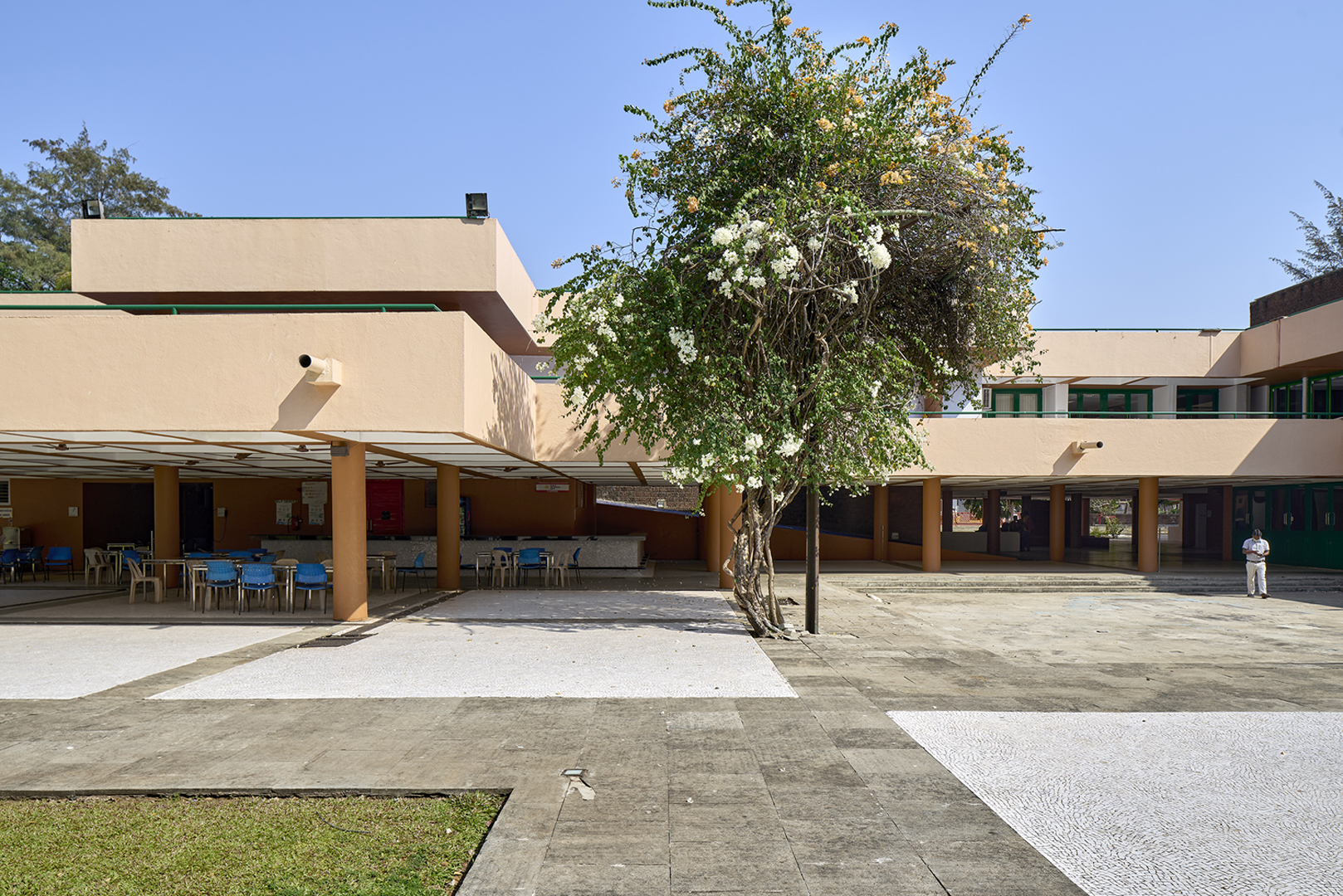
As we continue down the street past the main square we arrive upon the final episode in the story of the street- an open courtyard that overlooks the river. The building cascades onto this space with a series of terraces. A small amphitheatre leads up from this courtyard to the rooms above with spaces for practice and rehearsal. This is often the place for gatherings in the evening. From here you can walk down to the river watch the boats sail by and become a character in the story of the city. This is where my friend was drinking his coffee when he heard strains of Beethoven on the piano.
Nestled within this network of streets is the main performance theatre. Perhaps this space is the most scenographic of Correa’s interventions. It is designed as if it is an open plaza in the city. The walls around the auditorium are painted with balconies from which a cast of characters join us in watching the show. These characters were painted by the famous Goan caricaturist, Mario Miranda, whose work is a mordant and satirical look at humankind and specifically Goan idiosyncrasies and behaviour. His characters join us in the space of the auditorium, sometimes looking at us and sometimes at the stage. When the performance is about to begin, they fade out last, and come in first at the end of it. Over our heads the light in the ceiling also fades to reveal drawings of fronds of leaves from a forest. This is magic. The inside of the auditorium becomes a clearing in a forest. In the drawings for the building, Correa called it the “Jungle Scene”. This sudden return of nature in culture opens out the gap between the illusion of theatre and our everyday lives.
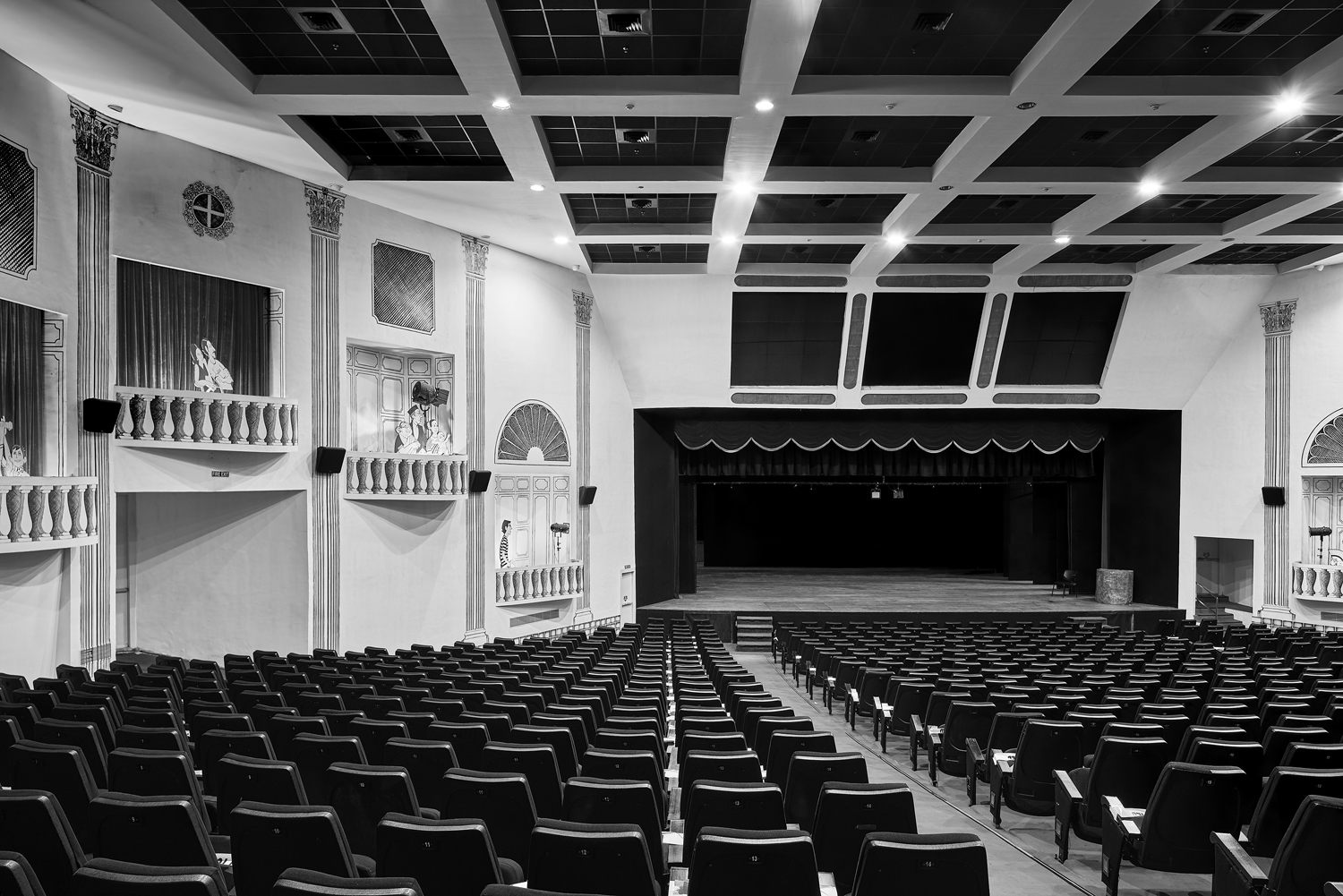
The German playwright and theatre practitioner Bertolt Brecht was interested in this gap. He believed that therein lay the possibility of culture as a tool for critical thinking and reflection rather than overt emotional identification with the characters and story5. When the storyteller reveals the tricks of the telling, he opens out the work to interpretation. He developed tools of breaking the fourth wall where the difference between the performer and the audience is constantly challenged and exaggerated theatrical gestures that highlighted the artificial nature of the performance. In the Kala Academy, Correa seems to mirror some of these devices. With its constant oscillation between reality and illusion and its stylised set design like streetscape, Correa revels in artifice. In those gestures he evokes a dream of a democratic public realm – a place for freedom, equality and justice; a place for chance encounters, conversations, romances, laughter and tears. We are summoned to become performers in this public realm, to tell ourselves stories, even sometimes exaggerating wildly, becoming heroes in our own epics, being able to finally be what the building imagines us to be – better than what we are.
Postscript
It would be remiss of this essay to not address one of the main reasons that Kala Academy has been in the news at the time of publication of this book. The building underwent a series of transformations when it was converted into the main venue for the International Film Festival of India in 2004. These included turning the main auditorium into a screening space along with other changes to the layout. Many of the older paintings on the walls were also redone – however, with harsher outlines and colours. The offices of Charles Correa were not consulted on any of these changes. In July of 2023, a part of the roof over the stage of the amphitheatre collapsed. This has raised questions and criticism among the public about the government’s decision-making process and reasoning. Currently this controversy still rages and the building is in urgent need of attention. Many civil society groups and architects, spearheaded by the Charles Correa Foundation, have tried to find ways of raising awareness about the building and protect it.
This neglect of the building is symptomatic of contemporary culture and its relationship with the modern moment. We see this in so many recent examples of “development” being vaunted by the government including the tragic case of the demolition of the Hall of Nations in New Delhi and the recent call for the demolition of the Sardar Vallabhbhai Patel Cricket stadium in Ahmedabad. It is instructive to observe what kinds of buildings are being proposed to replace these. Often these are generic glass and steel structures that emerge out of the desire to appear “world class”. This idea of the “world class” is an image to be consumed – one that traverses the world along with the movements of the neoliberal economy.
Modernity’s aspiration for a free citizenry is replaced by the idea of the docile and acquiescent consumer. This consumer must be placated, dazzled by images, made to submit to power. No dissent is tolerated. The street of chance encounters must be replaced by boulevards and monuments.
As more and more of Indian Modernist architecture ages, we find calls for upkeep and protection by architects being drowned by calls for demolition and rebuilding by the powers that be. This is more than a battle for architecture, it is a battle to reclaim the value systems of our democracy.
CITATIONS
- culture_1 noun – Definition, pictures, pronunciation and usage notes | Oxford Advanced Learner’s Dictionary at OxfordLearnersDictionaries.com. (n.d.). https://www.oxfordlearnersdictionaries.com/definition/english/culture_1?q=culture ↩︎
- Nehru, Jawaharlal. “Inaugural Address by Shri Jawaharlal Nehru, Prime Minister.” In Seminar on Architecture, edited by Achyut Kanvinde, 5-9. New Delhi: Lalit Kala Akademi, 1959. ↩︎
- Frampton, Kenneth. “An Essay by Kenneth Frampton”. In The Ritualistic Pathway. 5 Projects. A Portfolio of Architecture, edited by Charles Correa, Charles Correa Foundation, 1993. ↩︎
- Correa, Charles. “Hornby Trains, Chinese Gardens and Architecture”. In ‘A Place in the Shade. The New Landscape & Other Essays’, Charles Correa Foundation, 2010. ↩︎
- Mumford, Meg. “Bertold Brecht”, Routledge, 2009. ↩︎
ROHAN SHIVKUMAR
Rohan Shivkumar is an architect, urban designer and filmmaker practising in Mumbai. He is the Dean of the Architecture course at the Kamla Raheja Vidyanidhi Institute for Architecture and Environmental Studies. He also a principal of the architectural and urban practice the ‘Collaborative Design Studio’ and is a member of CRIT– an urban research collective based in Mumbai. His work ranges from architecture, urban research and consultancy projects to works in film and visual art. He is interested in issues concerning housing, public space and in exploring the many ways of reading and representing the city.
He has worked on several research and consultancy projects in Mumbai in collaboration with government agencies and NGOs including on initiatives such as the Churchgate Revival Project and the Tourist District Project. Through the school, he has worked on research projects in Dharavi and on the spaces of Dr Ambedkar in Mumbai called “City in the times of Ambedkar”. Rohan is the co-editor of the publication on an interdisciplinary research and art collaboration- ‘Project Cinema City’. He also curates film programmes and writes on cinema, architecture and urban issues. He has also made films on art, architecture and urbanism including Nostalgia for the future (2017), Squeeze Lime in Your Eye (2018) and Lovely Villa (2019).
RANDHIR SINGH
Randhir Singh is an architectural photographer based in New Delhi and Barcelona. He has a Bachelor of Architecture from Rensselaer Polytechnic Institute in New York and fifteen years of work experience as an architect. Over the it last decade, his photography practice has focused on issues related to architecture, modernism and the urban landscape. Singh was commissioned by the Museum of Modern Art, New York to photograph an extensive collection of architecture in South Asia for the exhibition The Project of Independence: Architectures of Decolonization in South Asia, 1947-1985 (New York, 2022). A selection of these photographs were acquired by MoMA for their permanent collection. Photographs from this body of work have been included in Tropical Modernism at the V&A Kensington (London, 2024) and Photo City at the V&A Dundee (Dundee, 2024). His photographs of modernist campus of the Indian Institute of Technology Delhi were included in a two person exhibition, with Madan Mahatta, at Photoink (New Delhi, 2020) and Arthshila (Ahmedabad, 2022).
He has collaborated with the artist Seher Shah on Studies in Form, a project exploring the overlaps between photography, architecture and drawing. This work was shown as a part of Bearing Points at the Dhaka Art Summit (Dhaka, 2018), the Jameel Arts Centre (Dubai, 2019), the Kiran Nadar Museum of Art (New Delhi, 2022) and the SCAD Museum of Art (Savannah, 2022). Singh’s extensive documentation of social housing projects in New Delhi, titled CPWD, was shown as a part of When is Space? at the Jawahar Kala Kendra (Jaipur, 2018).
His Water Towers series, exploring industrial architecture and urban landscape, was shown at the Pondy Photo Festival (Pondicherry, 2016) and as a part of the Body Building exhibition at the Ishara Art Foundation (Dubai, 2019). Continuing his interest in the urban landscape, a selection of his photographs examining waterways and hydraulic architecture were included in the award winning Yamuna River Project publication and exhibition (New Delhi, 2017). Singh is the photographer and editor of the Modern South Asia series. His photographs have been included multiple publications and magazines worldwide.
BOOK AVAILABLE ON:
AMAZON
ARTHSHILA.ORG
 thinkMATTER