
MODERN SOUTH ASIA
A Visual Archive of South Asia’s Modernist Heritage
The Modern South Asia (MSA) series is dedicated to exploring modern architecture of historic importance in South Asia through photography-based books. The series will focus on architecture from the 20th century, designed and built by regional and international architects. Each book will provide the reader with an in-depth visual exploration of the architecture through contemporary photographs, architectural drawings, and newly commissioned writing by architects, thinkers, and academics.
The MSA series is edited and photographed by Randhir Singh. The project is supported and published by Arthshila Trust.
NATIONAL COOPERATIVE DEVELOPMENT CORPORATION (NCDC)
Kuldip Singh, Mahendra Raj
COLLABORATIVE INVENTION AND THE ETHIC OF FRUGALITY: National Cooperative Development Corporation
Essay by Amit Srivastava & Peter Scriver
Photographs by Randhir Singh
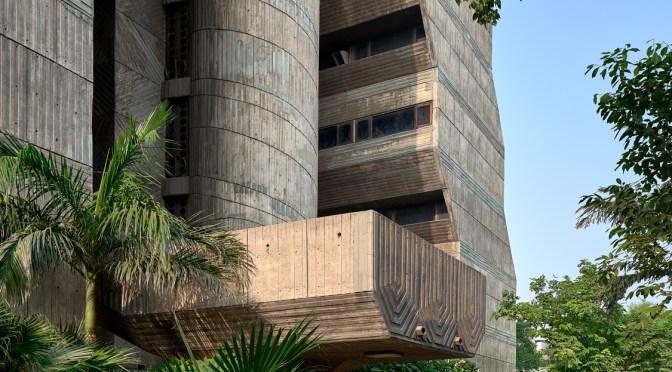
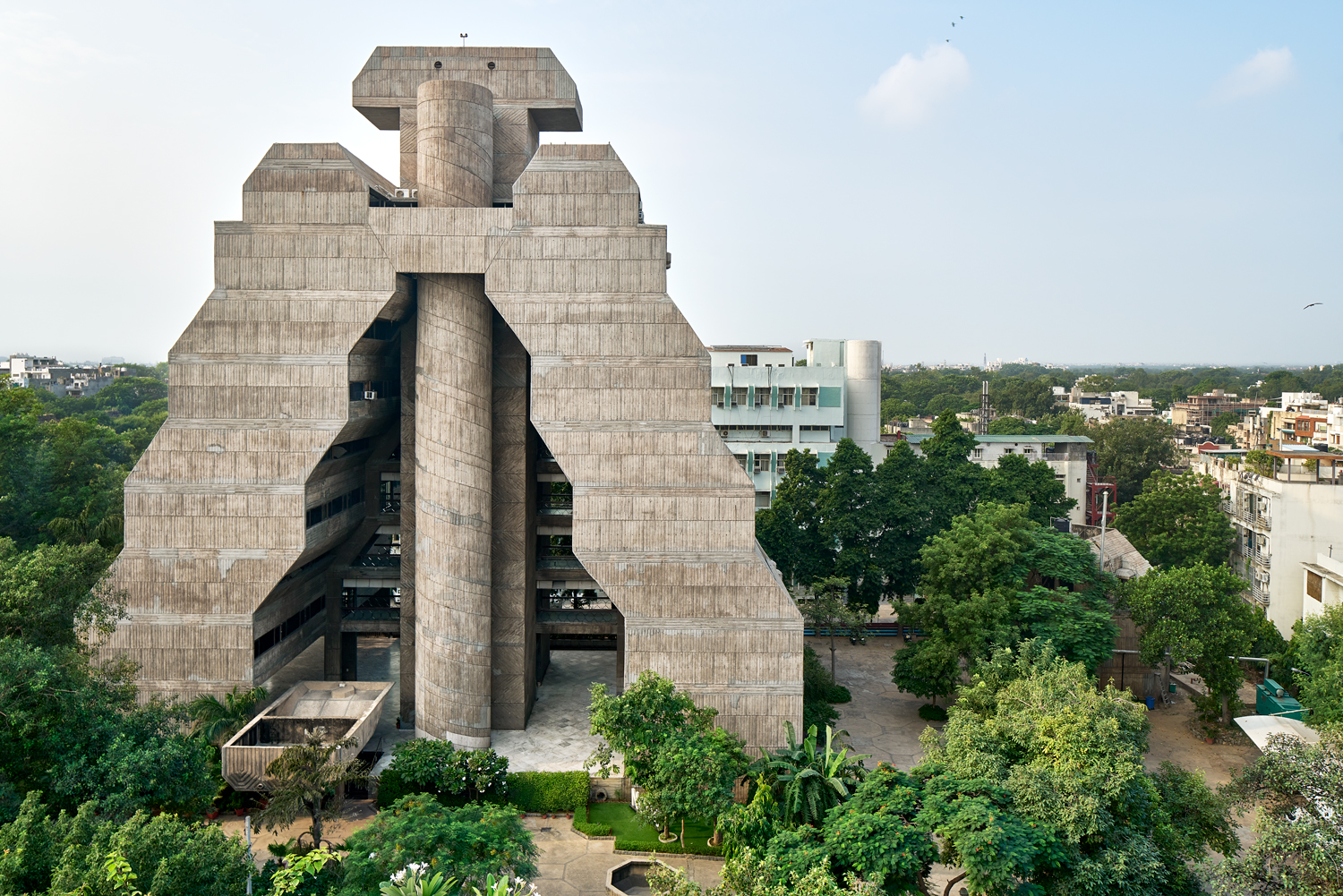
When it was built in the southern outskirts of metropolitan Delhi in the late 1970s, the National Cooperative Development Corporation (NCDC) headquarters was one of the relatively few new buildings that stood out, or even above, the sea of low-rise residential development that was then just beginning to expand the national capital beyond its first ring of post-colonial suburbs. But this was not just a taller structure and far from a merely generic modern office block. ‘Architecture’, modern or not, was still a relatively unfamiliar concept that few of the uninitiated public understood to apply to anything less exalted than the monumental tombs and ruined historic forts and palaces that dotted Delhi’s urban hinterland, such as in the neighbouring Siri Fort area. If ‘engineering’ had any better grip on the popular imagination, it was understood to be the equally heavy but more utilitarian stuff of infrastructure and industry that was progressing and building the young Indian nation’s economic capacity. Yet there was something about this strange, almost ungainly concrete edifice that defied categorisation; it was both monumental and ingeniously light-footed at the same time. Growing up in South Delhi in the 1990s, where the NCDC offices stood opposite the gates of the housing colony in which one of the present authors lived, it was the first and most conspicuous example to which an untutored prospective student of architecture could look with both awe and fascination.

This virtuosic hybrid – the collaborative work of architect Kuldip Singh and engineer Mahendra Raj – was nothing if not iconic. Local residents and passing rickshaw drivers would describe it as the ‘pyjama’ building owing to the cartoonish pantaloon-like profile of its two great legs and the striped, textile-like ribbing of its concrete flanks. For the other author in the present duo, who was once a young architectural graduate gaining overseas work experience in Delhi in the 1980s (along with some rudimentary Hindi), it was equally affectionately known and discussed with local colleagues as the hathi building as we could also imagine it as a great elephant standing guard at the city’s approaches, its flanks draped with battle armour or imperial regalia, topped with a diminutive howda. Other later commentators, the present authors included, would also come to recognise a further similarity between the distinctively canted and hollowed-out NCDC structure and the great temple gateways, or gopurums of South India. This was an even less intuitively obvious formal analogy, it would seem, but one that the architect himself would acknowledge was a probable albeit unwitting inspiration. But, equally sceptical of arbitrary form or expression purely for its own aesthetic sake, yet another reading that the architect found particularly felicitous was the belief of the client – the Chairman of the Board of NCDC – that the building was a “wonderful” architectural representation of “cooperation” itself, the two wings converging and meeting at the top but depending integrally on each other for mutual support and strength to get there! 1
Four decades on, the uncanny lightness of this monolithic post-tensioned concrete structure, the daring ingenuity of what would seem to be impossibly-thin shear walls, and the meticulous detailing of its off-form concrete surfaces and finishes are still remarkable. Arguably, it has proved to be one of the most exceptionally well-constructed and equally well-preserved exemplars of late-modern concrete architecture in South Asia and beyond, as recent international exhibitions and related efforts to document and conserve the misunderstood and increasingly at-risk ‘monsters’ of brutalist architecture worldwide have consistently affirmed.2
‘Brutalism’ offers a stylistic category and qualitative descriptor with which an architecturally informed observer could surely attempt to interpret the NCDC building in line with broader tendencies and potential precedents elsewhere. Typologically, for instance, one could speculate about the inspiration of the futuristic urbanism projected by the Japanese Metabolist architects of the early 1960s or the isolated realisation of similar ‘mega-structural’ propositions in the stand-alone corporate and university campus schemes of Paul Rudolf, John Andrews, and James Stirling, among others. But to fully appreciate the ingenuity of the NCDC offices, it is necessary to look more closely at the immediate historical context and contemporary building culture in which this particular mega-structural fragment was designed and constructed. It is important, first of all, to recognise how directly the novel architectural way-finding and experimentation of India’s own nation-building in the decades following her independence from colonial rule had contributed to the development of the Brutalist aesthetic in the global architectural culture of the mid-twentieth century. But even more important to highlight in attempting such a situated interpretation of the NCDC design was the ethic of frugality and authenticity of such a frank and fearless approach to material economy through structural innovation in the politically and economically isolated India of the 1970s in particular.

Whilst architect Singh and engineer Raj had not directly collaborated before the 1970s, both men had cut their teeth as young graduates two decades earlier, working on the design and construction of Chandigarh, the new capital for the Indian state of Punjab. This symbolically and technically seminal nation-building project (1951–65) had been a proving ground for fresh ideas about a new architecture and urbanism for modern India. Unfettered by the past, many of the emerging first generation of post-Independence architects and engineers would continue to test and develop this approach in their own practices in the years that followed. Consulting architect and city-planner Le Corbusier, the eminent Swiss-French modernist, had greatly extended and developed his own highly influential post-war experiments with the aesthetics of béton brut in his designs for key buildings at Chandigarh, such as the High Court. But it had been the fateful task of the young Mahendra Raj, as a junior engineer of the Punjab Public Works Department, to assist Le Corbusier with the structural design of the iconic concrete vaults and canopy roof of the High Court. Furthermore, Raj had to figure out how these would actually be constructed with the limited technical means and material resources at hand in an industrialising economy that was still heavily dependent on manual labour and only just beginning to redress centuries of colonial exploitation and underdevelopment.
Chandigarh was a comparably formative experience for the young Kuldip Singh as well. He had proceeded there immediately following his initial architectural training at the Delhi Polytechnic to work with the practice of J.K. Chowdhury, a pioneering modernist among India’s emerging architectural profession and one of the few independent consultants engaged in the Chandigarh project. During Singh’s time in Chandigarh, he worked primarily on the planning and architecture of a satellite township for the major hydroelectric scheme, the Bhakra Dam, that was to supply the new capital with its power and water. Inspired by this hands-on experience of the broader potential scope of an architect’s design capacities and agency – from humble residential design and construction to the planning of whole urban settlements and regional infrastructure – Singh had resolved to pursue further postgraduate training in town planning. Arriving in England in 1958 to enrol in courses at University College London, he would work part-time over the next three years, gaining further invaluable practical experience as well. As Singh later reflected (in a series of discussions with the authors), the two years he spent in the office of Sir Howard Robertson (Easton and Robertson), a prominent champion of modernism in interwar Britain, was particularly valuable for honing Singh’s understanding of structural design and the power of precise working drawings. Additional classes on structural engineering and particular experiences working on the floating foundations for a new university library and long-span heavy deck structures for an over-track redevelopment of Euston station, on which he worked through further part-time employment with British Railways, would provide long-term lessons and implications for the NCDC project, as well as other major urban design and infrastructure projects that would be undertaken years later.
For Singh and other emerging young design professionals of his generation, such as Mahendra Raj – who had travelled to the USA to pursue further studies in structural engineering in the mid-1950s – overseas study and work experience also offered critical distance and perspective to better appreciate contemporary realities and opportunities back home. Both men had returned to India by the mid-1960s, eager to explore the possibilities for the development of a modern Indian architecture distinct in subtle but significant ways from the normative presumptions of contemporary international design culture and practice. Collaborating initially in a joint practice with Raj Rewal, a former classmate of Singh’s who had recently returned from postgraduate training and work experience in France, they focused primarily on developing radical new housing typologies for India’s burgeoning cities. These were to challenge what they felt were the overly “tight” and “regimented” patterns that Singh had observed in the major new public housing developments of post-war Britain and Rewal in the comparable grand ensembles of France and North Africa. In India, such patterns were already being echoed in the more conventional ‘point’ and ‘slab-block’ typologies of medium-rise housing being built at that time by the modernising public works departments. Low-rise, medium-density housing schemes that Singh had begun to realise in Delhi by the later 1960s would be significant precursors to the open, three-dimensional planning and ‘gateway’-like compositional ideas explored a decade later in higher-rise institutional complexes such as the NCDC offices. Usha Niketan, a prototype for an innovative new middle-income housing system completed in 1968 and a much larger subsequent development of the system at Malviya Nagar, privileged the spatial weave of the social commons, using geometry and structure to open up and diffuse volume and density rather than concentrate it.33
By the early 1970s, the Singh-Rewal partnership was involved in the design of major new infrastructure at Pragati Maidan, Delhi’s public exhibition complex, for the Asia ‘72 International Trade Fair, which was to mark the twenty-fifth anniversary of the host nation. On this project, Rewal worked closely with engineer Mahendra Raj to design the lattice space-frame structures for the Hall of Nations and the adjacent Halls of Industries. These were constructed, contrary to the logic of lightweight and modular metal assemblies, in cast in-situ concrete. This labour-intensive approach proved cost-effective in the context of India’s still only semi-industrialised building industry. Moreover, it created an ethic of frugality and even boosted the ambition of the designers to erect a reinforced concrete structure of unprecedented scale. While the effectively hand-made concrete structural members of this reimagined space-frame were relatively bulky and rough in execution, alluding to the international brutalist aesthetic, Raj’s solution was a monumental triumph of structural rationalism.
Half a decade later, the NCDC project would be Singh’s opportunity to collaborate with Raj and marry the latter’s propensity for radical structural ingenuity with his own increasingly conscious aspiration for greater rigour and finesse in the architectural detailing of large structures that could be as delicate as they were bold. Singh was critical of the costly and inauthentic fetish for bush-hammering concrete in a brutalist manner, prevalent in the fully-mechanised construction industries of Western Europe and North America, where the aesthetic had become a dominant fashion by the 1970s. On the contrary, in India, not only was hand-cast board-worked concrete the most affordable technique by which larger buildings and engineered structures were being built, but a genuine medium through which these could be crafted to a higher level of both technical and decorative detail if the architect was prepared to invest the necessary care and control. As Singh later recalled,
“At that time, you had to mix the concrete on the site,.. [as]… we could not get decent cement. Obtaining good steel was also very difficult. … [T]reating the concrete in such a manner that the original texture is not lost…, all that had to be controlled on the site, including the colour of the cement, the sand and the aggregate. So it’s not just strength of concrete, but concrete being treated as a finish that requires an architectural input, which again has to be tied up with engineering input.”
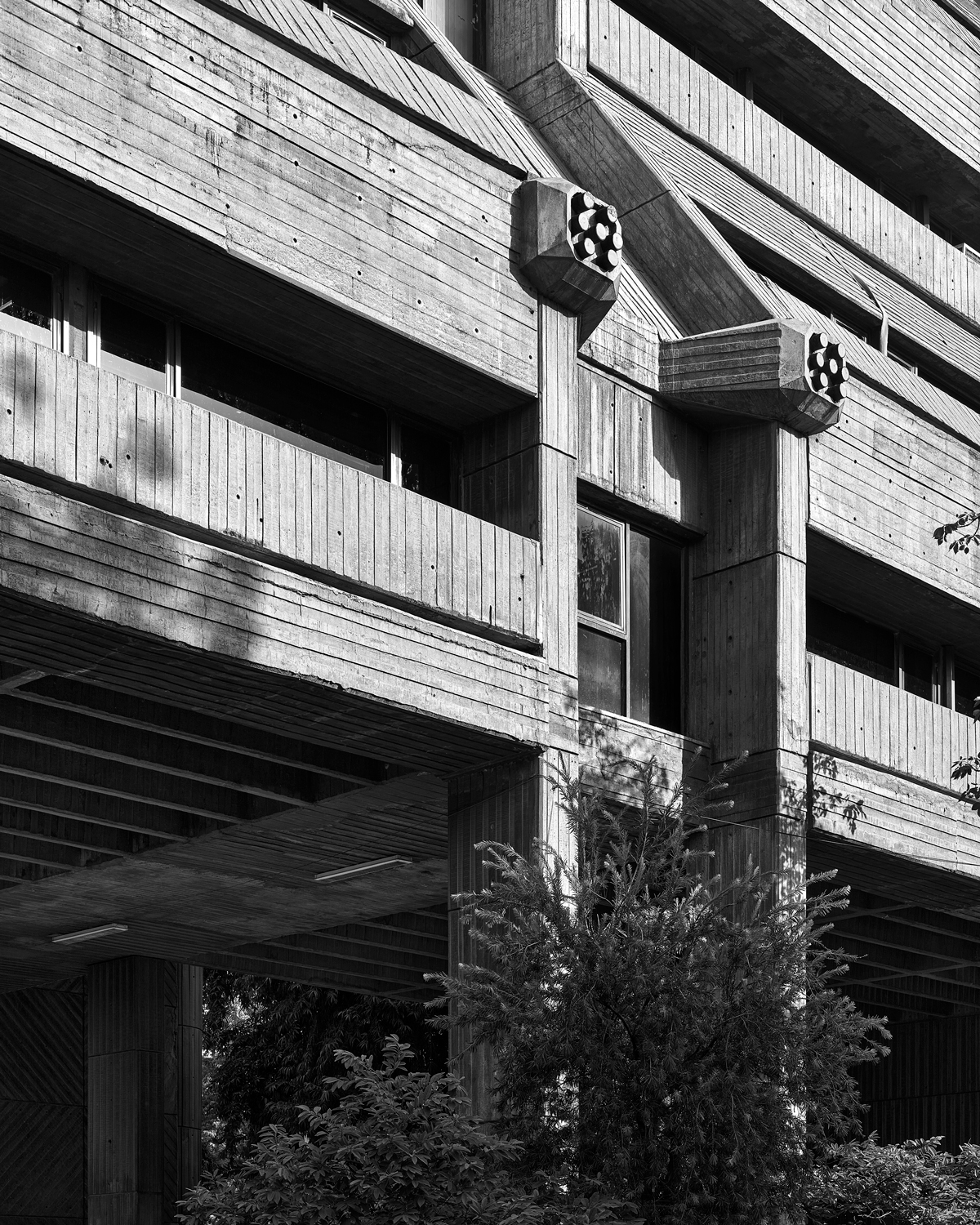
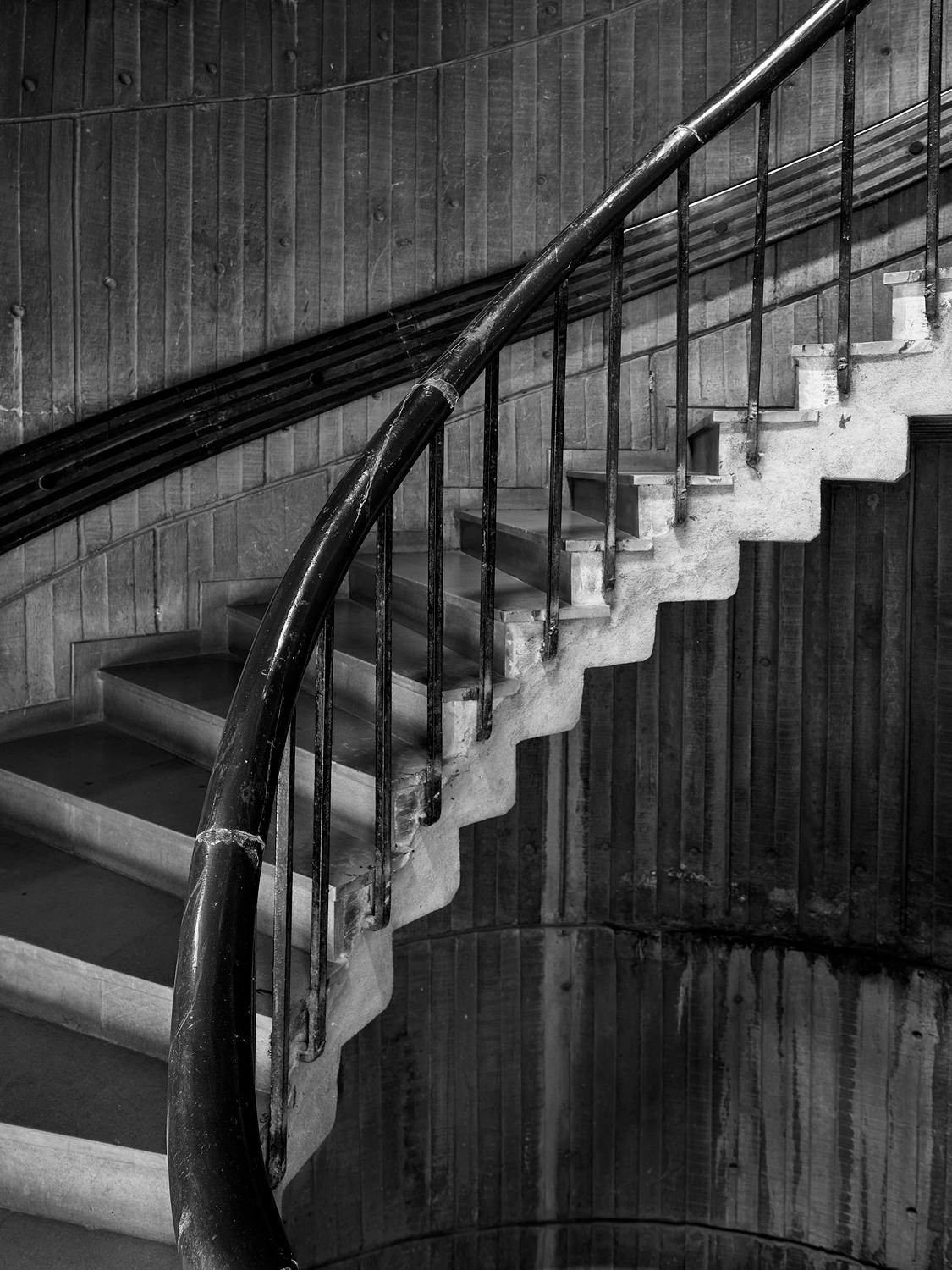
Developing the architectural details of the NCDC was an exploration of the concrete pouring process and an imagining of the interplay of light with the marks left behind by the process. Singh meticulously planned the process and made detailed drawings for the shuttering, specifying the use of rough-sawn un-planed timber so that the saw marks would be imprinted on the final concrete finish. The shuttering itself was designed to use a tongue and groove system in order to manage the leak of mortar along the joints, and bigger grooves were left with timber inserts for four months, allowing time for the blocks to shrink and release from the concrete. This uncompromising dedication to achieving the desired architectural form and finishes was complemented with nimble structural engineering.
Column-free office space had been a firm stipulation of the client. One of the NCDC’s chairmen had previously served as the chief bureaucrat in the Corbusier-designed Secretariat Building at Chandigarh, which he had abhorred for the fact that structure had obstructed every office space, high and low. As Singh mirthfully recounted the chairman’s critique: “…you open the door, and you run into a column […] architect has decided that this is the Secretariat. This is the Secretary’s room!” To allay such concerns, engineer Raj devised an ingenious solution that would maintain the “grace” of the exceptionally-thin shear walls that supported and contained the open office floors end-to-end by adjusting the loads so that there was a greater concentration on the central core. In turn, this post-tensioned concrete system offered further construction process details and surface artefacts for Singh to play with architecturally. Bolts were exposed at the knuckles, designed to express the post-tensioning points, contrasting with the holes left by bolts used to contain the shuttering. Revealing the increasing number of post-tensioning bolts from level to level was a subtly expressive yet rational way of developing the distinctive architectural character of the structure by articulating the growing stresses from top to bottom. Foundations were also posttensioned to contain and channel the enormous thrust down below and brace the lofty atrium space in the core of the structure allowing it to rise to its full height.

This was a significant expansion on the spatial idea of gateways and the looser, more generous notions of megastructure that Singh had first explored in the earlier low-rise housing projects in Delhi, which were already being emulated in the evolving typology of neighbouring housing developments. For example, in the adjacent Khel Gaon enclave (the residential ‘village’ concurrently designed by Raj Rewal for the athletes of the 1982 Asian Games), structural and geometric variations on the pattern of neighbourhood clusters at the human scale clearly echoed the precedent of Singh’s Malviya Nagar scheme, with a series of gateway-like compositions to punctuate the transition from cluster to cluster. The use of interlinking terraces to shade pedestrian walkways was another idea first investigated in the Usha Niketan prototype that was evidently further developed in Rewal’s later scheme, but direct references to the traditional urban morphology and architectural character of historic desert towns in nearby Rajasthan were equally apparent. The narrow streets and dense clustering of the adjacent urban village of Shahpur Jat further tie this evolving new open, yet intimate and integrating, residential typology back to the history of Delhi itself and the pedestrian experience of the neighbourhood as you arrive at the open yet shaded and surprisingly intimate plaza of the NCDC.
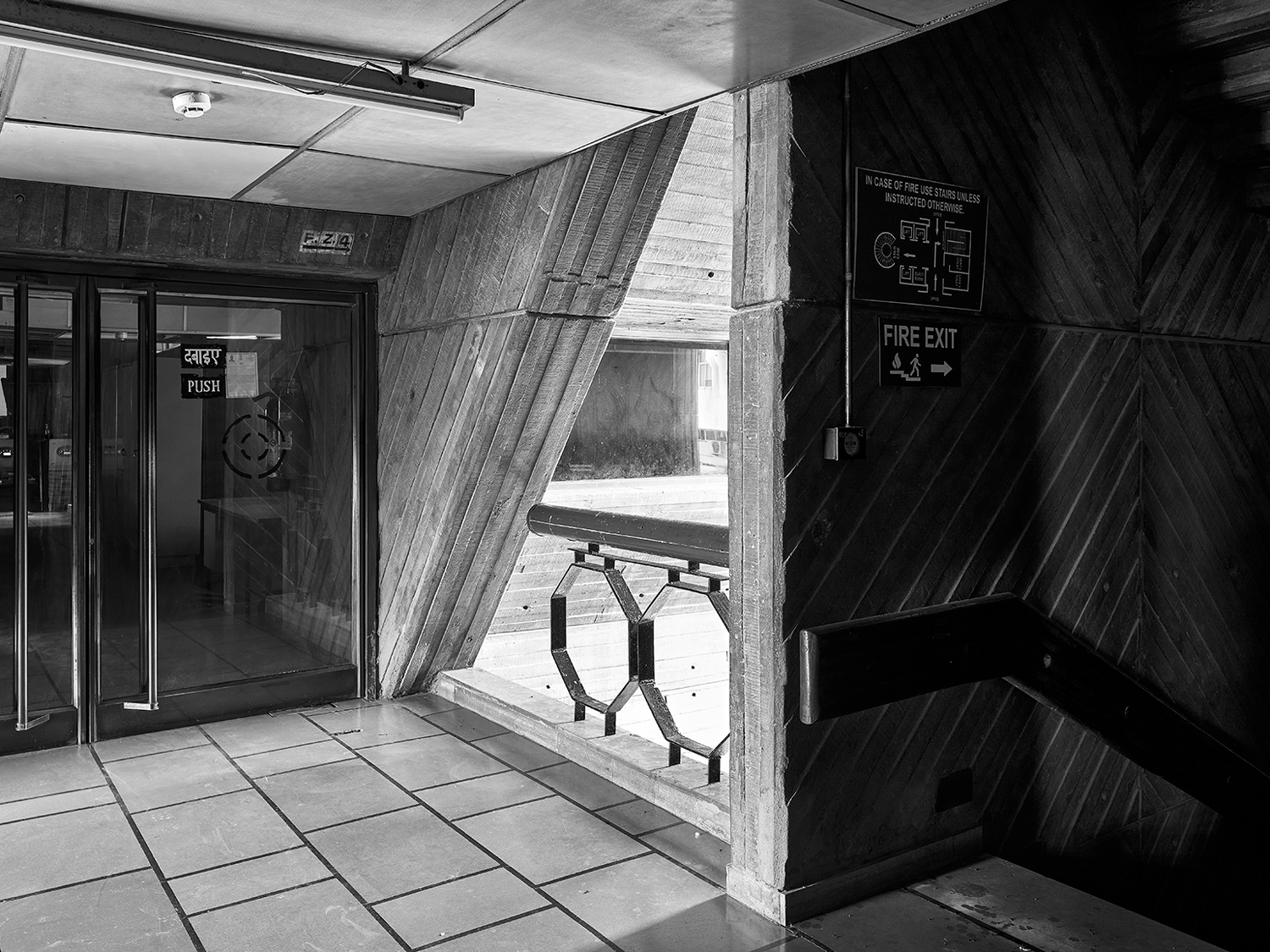
Ultimately, the gateway-like character of the NCDC complex might best be interpreted less literally as an iconic piece of the larger puzzle of the modern Indian city that Singh and his collaborators – Rewal, Raj, and others – were working collectively to re-imagine. To gain the support and conviction of the powerful public agencies and state corporations that could bring these radical new forms into being was no small achievement. However, it would be a much longer game to realise the greater urban vision in which they might all link up. Singh, Raj and their contemporaries had no naïve illusions that such would be easily won. Singh’s next major project would be the even more monumental offices of the New Delhi Municipal Corporation (NDMC) at Palika Kendra in Connaught Place. Even in his final years, Singh lived with the hope that the as-yet unrealised integrated urban design elements of that scheme would ultimately be built. This was a vision that would necessarily be pursued at the macro-scale of urban planning rules that could guide and constrain development, as well as the finer grain of the spatial fabric that these socially-focused and situated designers were crafting, allowing this emerging new urbanism to cohere in culturally meaningful and sustainable ways. The challenge resided in the integrity as much as the structural ingenuity of the built fabric itself. This would ensure not only that it could be so brazenly upstanding, but that it could be built in the first place in a resource-substitution economy. The project, thus, reinforced the ethics of frugality and self-sufficiency on which India’s political and social freedom had been won. Surrounded today by the advancing sea of global-style institutional, commercial and residential developments that have extended the urban sprawl of the national capital many kilometres to the South, the still remarkable NCDC structure is no longer so obviously the proud tower at the limits of the future city yet to be built, but a paragon of the architecture of the modern Indian city that might have been.
CITATIONS
- Unless otherwise noted, words and text highlighted with quotation marks are extracts from the transcripts of a series of interviews conducted by the authors with Kuldip Singh in 2017, 2018, and 2020. ↩︎
- For example, see: O. Elser, P. Kurz, and P.C. Schmal, SOS Brutalism: A Global Survey, (Park Books, 2017) [and related exhibition at Deutsches Architekturmuseum (DAM) in 2017]; M. Stierli, A. Pieris, and S. Anderson, The Project of Independence: Architectures of Decolonization in South Asia, 1947-1985, (New York: MoMA, 2022) [and related exhibition at Museum of Modern Art (MoMA) in 2022]. ↩︎
- Shobhana Menon, ‘Tribute to Architect Kuldip Singh on his 86th Birthday’, viewed 28/07/2023: https:// architecture.live/tag/kuldip-singh/; P. Serenyi, ‘From Lutyens to Young Indian Architecture: Sixty Years of Housing in New Delhi’, Techniques and Architecture no.361 (Aug-Sept 1985): 58. See also P. Scriver and A. Srivastava, India: Modern Architectures in History, (London: Reaktion, 2015), 232. ↩︎
AMIT SRIVASTAVA
Amit Srivastava is the Director (India) for the Centre of Asian and Middle Eastern Architecture (CAMEA) based at the University of Adelaide, Australia. Having trained and practiced as an architect in India, his primary research focuses on the architectural and construction histories of colonial and postcolonial India. His 2009 publication, Encountering Materials in Architectural Production: The Case of Kahn and Brick at IIM explored the context of Louis Kahn’s work in India with special focus on the socio-political conditions generated by the intersection of de-colonizing and nationalist policies. His subsequent book publication, India: Modern Architectures in History with co-author Peter Scriver, published by Reaktion Books and University of Chicago Press in 2015, offers the long history of architectural modernity in India, from its beginnings in the colonial modern enterprise of the British PWD to the late twentieth century struggles with post-colonial identities. His other work on Analytical Drawings and Global Architecture History titled The Elements of Modern Architecture: Understanding Contemporary Buildings, has been translated into nine languages across the world since 2014, with a second edition published in 2020. Srivastava’s work has also been presented in international exhibitions including SOS Brutalism at DAM, Frankfurt in 2017 and The Project of Independence: Architectures of Decolonization in South Asia, 1947-1985 at MoMA, New York in 2022.
PETER SCRIVER
Peter Scriver is a founding director of the Centre for Asian and Middle-Eastern Architecture (CAMEA) at the University of Adelaide, Australia, where he has taught Architectural History, Theory and Design and directed postgraduate research since 1996. He is a critical authority on the architecture, construction and planning histories of colonial and contemporary India publishing After the Masters: Contemporary Indian Architecture (1990) and India: Modern Architectures in History (2015). Scriver’s work has been pioneering in its theoretical exploration of relationships between cultural and cognitive practices in the design, operation and reproduction of colonial built environments, and the institutional frameworks and professional networks in which the architectural and engineering disciplines have typically operated in contexts of colonial and post-colonial development. His extensive early research and publication on the built legacy of the British Indian Department of Public Works and its archives, Rationalization, Standardization, and Control (1994), examined the instrumental role of the technocratic agency in the propagation and institutionalization of modern architectural and engineering knowledge in colonial South Asia. Subsequent work on Colonial Modernities (2007) and The Scaffolding of Empire (2007) have been seminal in spearheading the broader and fast-growing body of critical historical and theoretical research on the material and cognitive construction of the Global South and its colonial-modern underpinnings.
RANDHIR SINGH
Randhir Singh is an architectural photographer based in New Delhi and Barcelona. He has a Bachelor of Architecture from Rensselaer Polytechnic Institute in New York and fifteen years of work experience as an architect. Over the it last decade, his photography practice has focused on issues related to architecture, modernism and the urban landscape. Singh was commissioned by the Museum of Modern Art, New York to photograph an extensive collection of architecture in South Asia for the exhibition The Project of Independence: Architectures of Decolonization in South Asia, 1947-1985 (New York, 2022). A selection of these photographs were acquired by MoMA for their permanent collection. Photographs from this body of work have been included in Tropical Modernism at the V&A Kensington (London, 2024) and Photo City at the V&A Dundee (Dundee, 2024). His 1 photographs of modernist campus of the Indian Institute of e Technology Delhi were included in a two person exhibition, with Madan Mahatta, at Photoink (New Delhi, 2020) and Arthshila (Ahmedabad, 2022).
He has collaborated with the artist Seher Shah on Studies in Form, a project exploring the overlaps between photography, architecture and drawing. This work was shown as a part of Bearing Points at the Dhaka Art Summit (Dhaka, 2018), the Jameel Arts Centre (Dubai, 2019), the Kiran Nadar Museum of Art (New Delhi, 2022) and the SCAD Museum of Art (Savannah, 2022). Singh’s extensive documentation of social housing projects in New Delhi, titled CPWD, was shown as a part of When is Space? at the Jawahar Kala Kendra (Jaipur, 2018).
His Water Towers series, exploring industrial architecture and urban landscape, was shown at the Pondy Photo Festival (Pondicherry, 2016) and as a part of the Body Building exhibition at the Ishara Art Foundation (Dubai, 2019). Continuing his interest in the urban landscape, a selection of his photographs examining waterways and hydraulic architecture were included in the award winning Yamuna River Project publication and exhibition (New Delhi, 2017). Singh is the photographer and editor of the Modern South Asia series. His photographs have been included multiple publications and magazines worldwide.
KULDIP SINGH
1934 – 2020
Architect, City Planner & Builder
Kuldip Singh was born in Simla in ‘1934 and completed his Bachelor of Architecture degree in 1957 from Delhi polytechnic (later renamed to the School of Planning and Architecture). He worked for two years under the rnentorship of J.K. Chowdhury in Chandigarh before leaving for England in 1959 to complete a Masters in Town Planning at the University College, London. While at university, he worked at the office of Easton and Robertson and, upon completion of his degree, briefly with the British Railways.
Singh returned to India in 1964 and began teaching at the School of Planning and Architecture. He formed a decade long partnership with his old classmate, Raj Rewal before setting up his own consultancy known as Kuldip Singh & Associates. During this period, Singh began an eduring collaboration and friendship with the structural engineer, Mahendra Raj. Together, 0 they crafted sculptural iconic buildings that used concrete in an expressive manner as exemplified by designs for the NCDC offices (New Delhi, 1980), the NDMC complex (New Delhi, 1983) and the Koyambedu Wholesale Flower Market (Chennai, 1989).
Working for the Delhi Development Authority (DDA), Singh is credited with transforming New Delhi’s landscape with innovative projects. These include high density housing projects at Usha Niketan and Malviya Nagar in the 1970’s and the development of the 45 acre District Centre in Saket in the 1990’s. In Kochi, he worked for Greater Cochin Development Authority to design the expansive Marine Drive housing project.
Singh was an avid collector of Thanjavur and Mysore paintings which were exhibited at the Kiran Nadar Museum of Art, New Delhi in 2017 and subsequently the collection of over 300 works was donated to the Chatrapati Shivaji Maharaj Vastu Sangrahalaya (CSMVS), Mumbai. His architectural drawings are in the collection of the Centre Pompidou, Paris.
MAHENDRA RAJ
1924 – 2022
Structural Engineer
Mahendra Raj (1924-2022) was born in Gujranwala and graduated as a civil engineer from the Punjab College of Engineering and Technology, Lahore in 1946. He subsequently joined the Punjab Public Works Department and was introduced to structural design came in 1952 when he was assigned to work with Gulzar Singh on the design for the Chandigarh High Court and Secretariat. This experience led him to pursue a Masters degree from the University of Minnesota in 1956. Raj then moved to New York City and spent a few years working at Ammann & Whitney Consulting Engineers where he was associated with a number of innovative structures. Raj returned to India in 1960 and set up a consultancy in Mumbai where he worked for a decade before relocating to New Delhi.
Over the course of a lengthy career, Raj worked with a wide range of Indian and international architects producing ground breaking structural solutions to complex problems. His first few projects came through Charles Correa (Municipal Stadium, Ahmedabad, 1965) and B.V. Doshi (Tagore Memorial Theatre, Ahmedabad, 1965). Other notable projects include Shri Ram Centre (New Delhi, 1968), Premabhai Hall (Ahmedabad, 1974), Indoor Sports Stadium (Srinagar, 1982), NDMC Office (New Delhi, 1983), State Trading Corporation (New Delhi, 1988), Vidhan Bhavan (Bhopal, 1994) and the Bihar Museum (Patna, 2015). His work with Raj Rewal led to his most iconic project, the Hall of Nations and Halls of Industries (New Delhi, 1972. Demolished 2017). Designed and built in 22 months for the International Trade Fair, this project featured a first of its kind, cast in-situ concrete space frame structure.
Raj was the first engineer to be awarded the Chairman’s Award (1995) by JK Cement Works. He has been honoured with Lifetime Achievement Awards by the Indian Concrete Institute (2001), the Institution of Engineers (2001), the Consulting Engineers Association of India (2009), the Institute for Steel Development & Growth (2014), Indian Building Congress (2017), Engineering Council of India (2022) and IAStructE India (20220. The Structural Engineers World Congress- India awarded him the Sundaram Medal (2013) and the Association of Consulting Civil Engineers (India) the Visvesvaraya Eminent Engineers Award (2014).
BOOK AVAILABLE ON:
AMAZON
ARTHSHILA.ORG
 thinkMATTER