
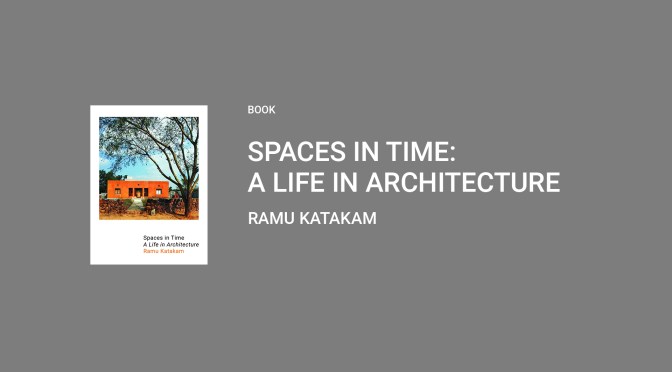
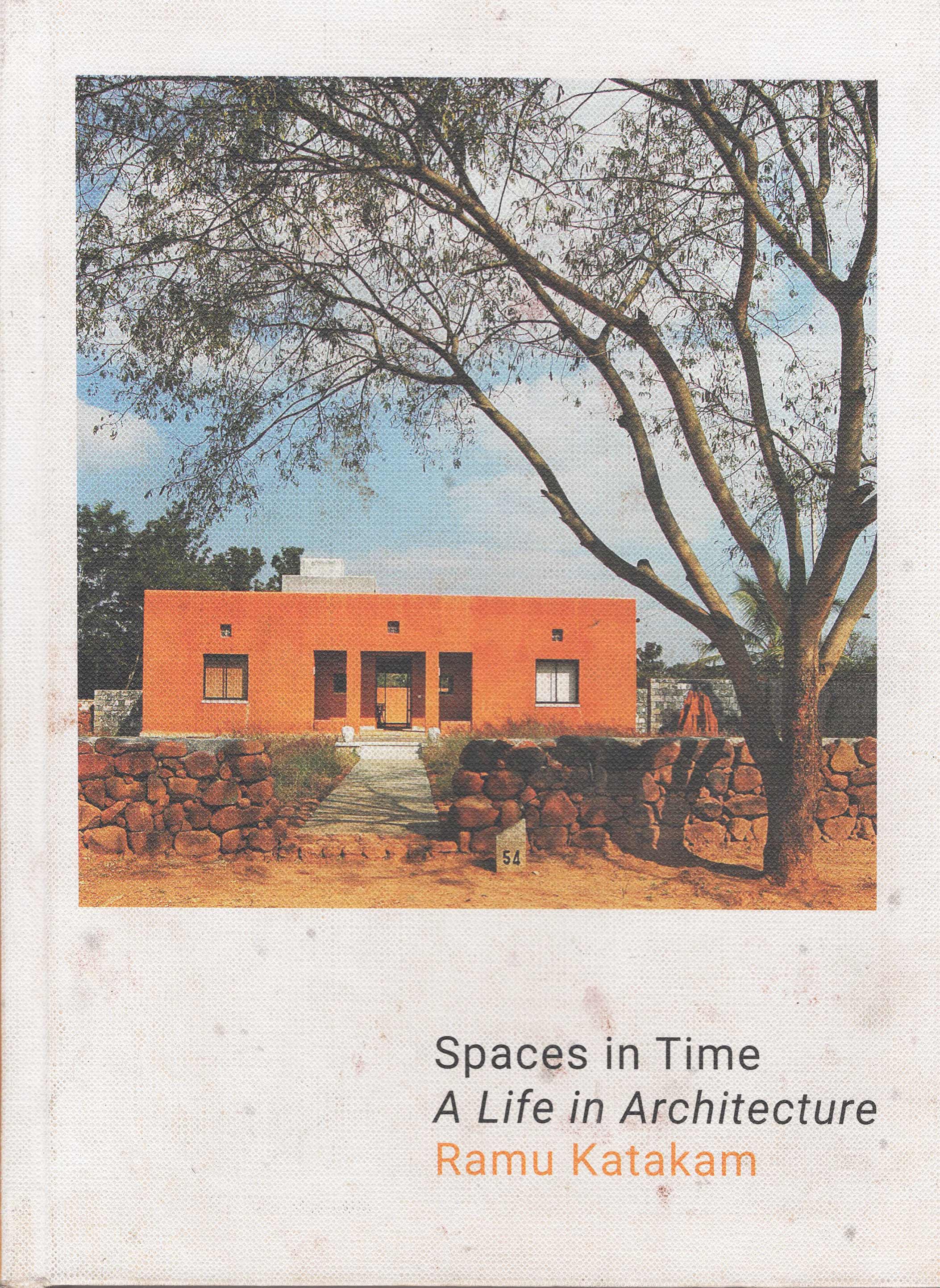
This book puts into print the universe of architect Ramu Katakam’s ideas, inspirations and thoughts and their translation into his work. The essays and accompanying visuals chronicle the initiation and growth of a practice in the context of a newly independent India. Spaces in Time: A Life in Architecture passes down an intuitive model of design to a new generation of architects.
Text: Aliptha Govindu
Reflecting at the culmination of over five decades of practice, the book is about the life and works of architect Ramu Katakam. Through his life he has gathered experiences from place to place with his artist mother and his father who was in diplomatic service. This exposure continued with his own education and work taking him around the world. Ramu has led a peripatetic life. As mentioned in the introduction of the book, the colonial thinking and way of life was dominating and finding one’s way in emerging India was a lifetime of work and study. His work reflects the shaping of a fresh Indian identity. This extensive inquiry into space making spanned Ramu’s career.
The book is a collection of essays that give the reader an insight into factors that play a role directly and indirectly in his life and works. An architect’s oeuvre is shaped by several influences, but in the semantics of building the ideology of a practice is often not explicit. However, it does find relevance when locating a practice within a time and context. Ramu articulates and documents these fragments here. Additionally, the crux of the book is that the progression of an architect’s craft is not tied to one discipline or one studio. It chronicles his work as an independent architect, as an architect working with other practices, when he established his own practice and his research work now.
The narrative follows cities, spaces, travels, people and references, and nuances of a place. For instance, in the essay about a villa Ramu’s family lived in in Hyderabad, homes abandoned by Muslim families who migrated to Pakistan in 1947 are mentioned. In this way the book displays India and all its complexities to familiarise the reader to the Indian scenario as Ramu encounters it.
Following a lucid language, the author presents his version of the context including connections, learnings, opportunities and challenges.
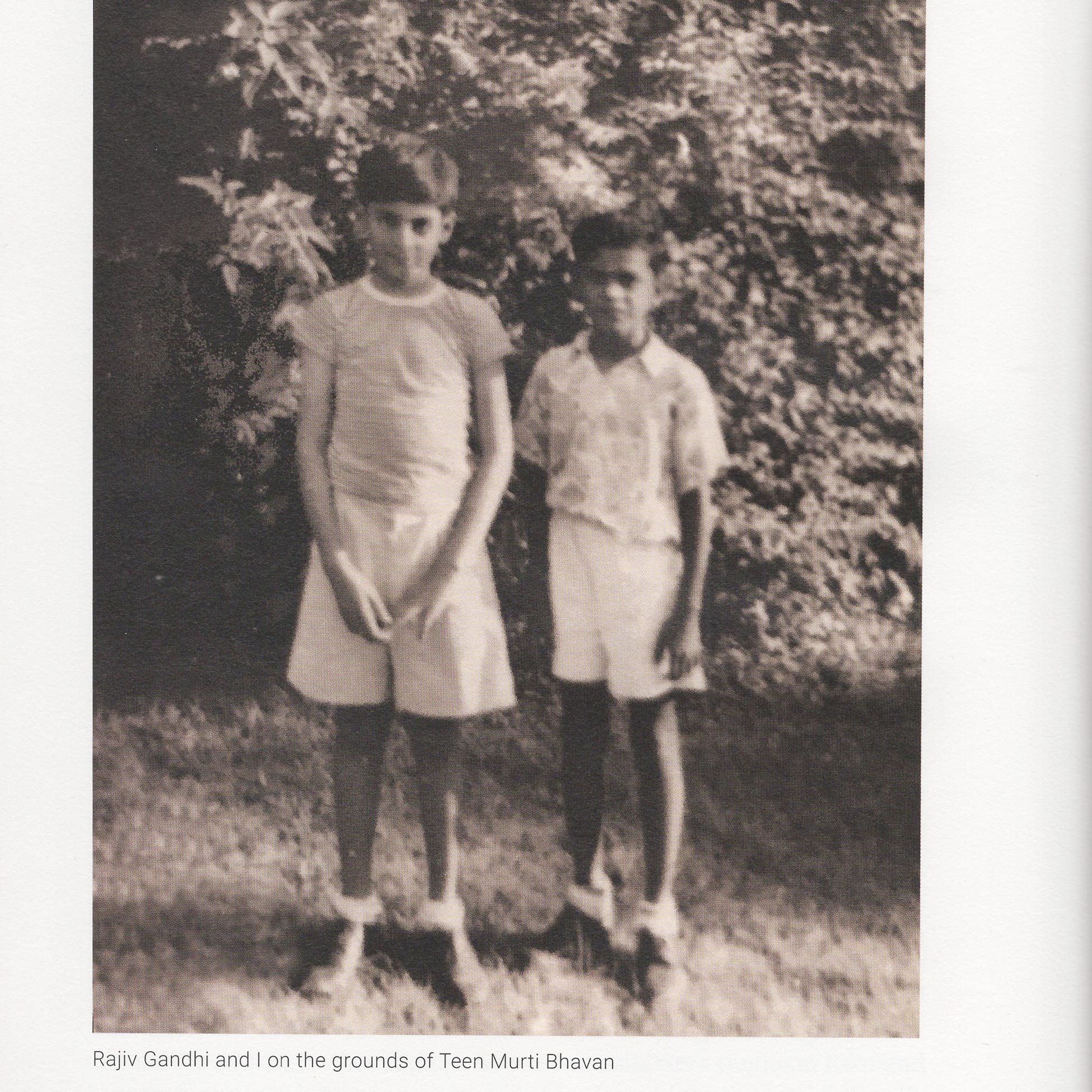
The writing is conversational, concise and nuanced and does not shy away from informal personal anecdotes such as the author’s childhood friendship with Rajiv Gandhi.
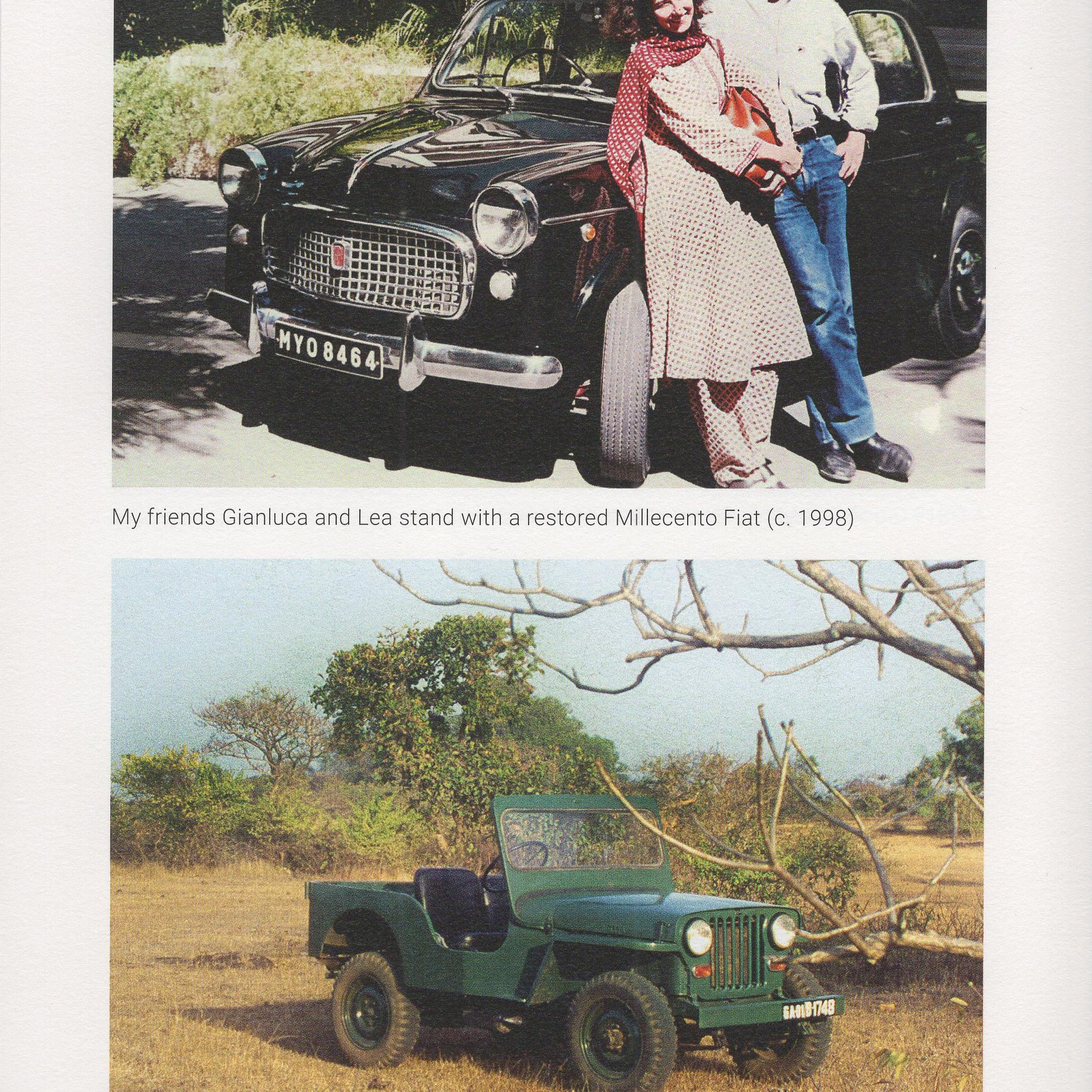


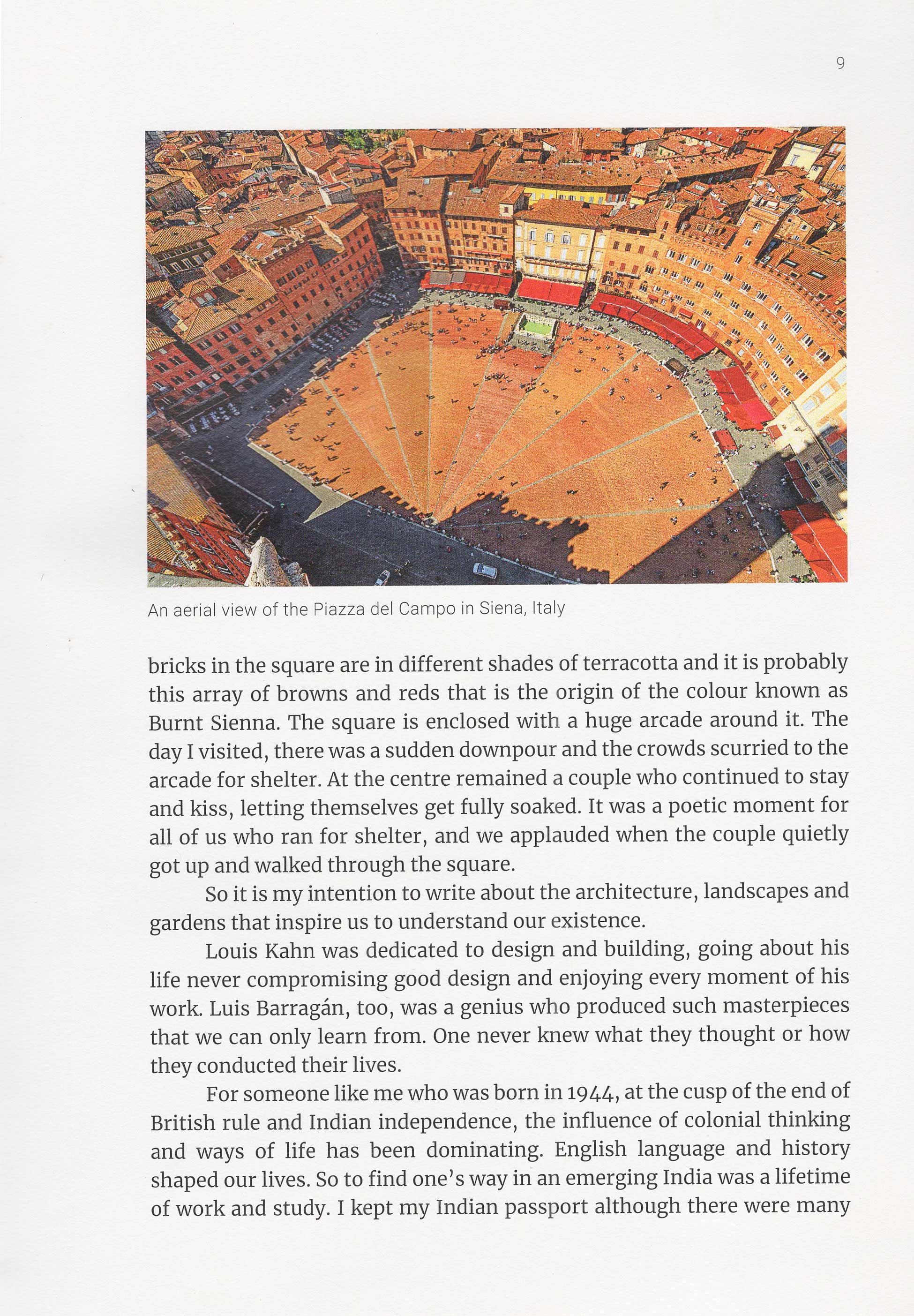
As a reflection of his career the book showcases the genesis and maturing of certain ideas that span through multiple projects. The essay ‘HOLEMANE: House by the River’ includes a mention about the plinth of the house which lends itself to farmers from the neighbouring village to have a smoke and admire the view. Projects are not organised into categories or programmes and are viewed as having a life of their own. Designed by Rukminee Guha Thakurta, the layout is clean, spacious, and generous. It is interspersed with imagery and diagrams that capture the concept of a project. Sketches and images from those who have inhabited the space are also featured in some essays.
Architecture is discussed here as beyond the architect’s concern alone.
The spirit of the building is captured without depending on an explanation of the usual plan and section. In the essay on Axis Mundi, the project featured on the cover of the book, Ramu elaborates on the spatial arrangement that facilitates passage through the house along one axis and asserts equal importance to the anthill found on site which lends its colour to the building.


Architects can often box themselves within the profession. One vision for the book as articulated by Ramu is to persuade the reader to look outwards. The book breaks the binary of the architect and their craft.
The author is simultaneously an architect, a recreational pilot, a traveller, an art enthusiast, an automobile restorer, an author, and a teacher. He stands on his own. Similarly, the book escapes categorisation. It does not move from project to project. It is interjected with certain notes about spirituality, homeopathy, music, golf, cars, etc. In today’s atmosphere of endless information and algorithmic references, this book makes way for an intuitive practice. It becomes representative of how one’s life is not always linear. There are tangential paths encountered. Ramu embraces that the search for knowledge is constant and ubiquitous in all aspects of life ♦
About the Book
Ramu Katakam was born in the final days of British rule in India and raised in the early years of Independence. He has thus been witness to the shaping of a country over the past seven decades. This book is a record of the highlights of his life through the many houses he has lived in and the many more he has designed for others. The book also offers the reader glimpses of architectural marvels, both old and new, in all parts of the world, through the eyes of an avid traveller. Not least, it introduces us to the numerous fascinating individuals Katakam has encountered and all too often befriended.
Katakam’s life has revolved around design and building, and has evolved almost in step with an independent India as it has attempted to find itself after it gained freedom. He hopes this description of an architect’s life — of events, people, places and buildings — can suggest a design path for the future.
About Ramu Katakam
Ramu Katakam has been practising architecture in India since 1977. Initially based in Delhi, he moved to Bangalore in 1997. Before that, in 1990, he moved to Goa to live there for stretches. He finally returned to Goa for good in 2013. His practice has included homes, hotels, libraries, schools and religious buildings built in all parts of India — from a housing project in Bhuj in the western deserts, to a hotel in Kohima in the easternmost part of India; in the north, he has designed a golf club in Srinagar, Kashmir, and in the deep south a house in Kottayam, Kerala.
He has also been involved with the restoration of historic buildings and working with sustainable technologies. Among his other interests was the creation of a sculpture gallery in the heart of a Delhi village. He was part of the founding team of the TVB School of Habitat Studies in Delhi, where he taught for four years. He was also instrumental in helping design and set up Dilli Haat, a novel crafts bazaar in Delhi that allows craftspersons to sell directly to the customer.
Educated at the universities of Delhi and Cambridge, he was elected a member of the RIBA (Royal Institute of British Architects) in 1974 and the IIA (Indian Institute of Architects) in 1977.
His work has been published widely and he has written two books on traditional Indian architecture: Glimpses of Architecture in Kerala (Rupa, 2006) and Cosmic Dance in Stone (Niyogi Books, 2017).
Title: Spaces in Time: A Life in Architecture
Publisher: Arthshila Trust
Designer: Rukminee Guha Thakurta
Editor: Nayantara Patel
Language: English
ISBN: 819545458-5
Year of Publication: 2022
Spreads: From the book; © Arthshila Trust
 thinkMATTER