
Through archival material, and insights into practical and lived experiences, the book curates a deep understanding of the Indian Institute of Management, Bangalore‘s architectural evolution. This prose captures not solely spaces but the dynamic interactions it contains and engenders as an institution, emphasising on how it has shaped the campus over time. Thus, reinforcing what brings the architecture to life and that the true spirit of the campus lies in the experiences of its users.
Text: V V Kusum Priya
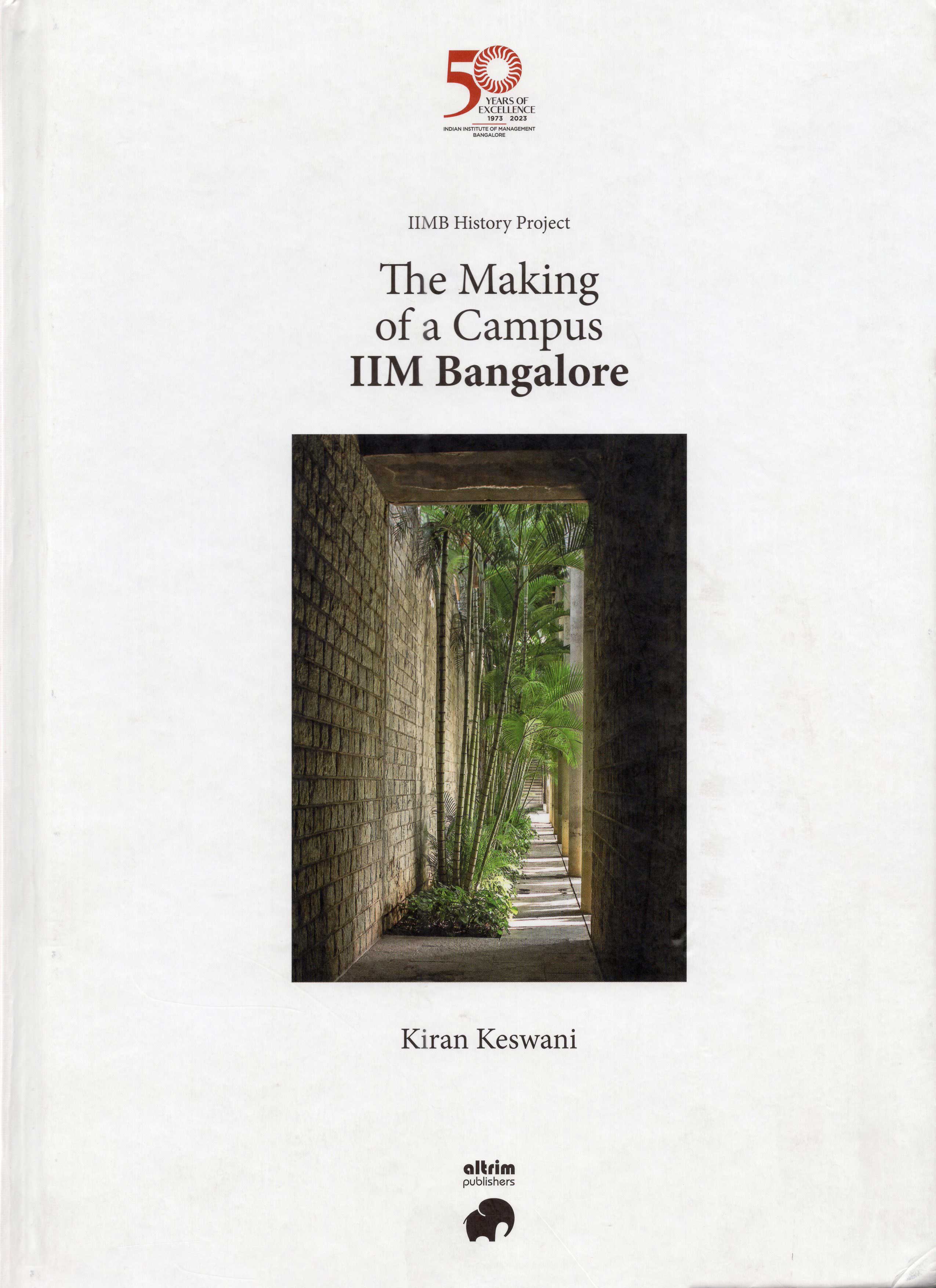
Reputed for its rigorous programmes in academia, research, and leadership, the Indian Institute of Management Bangalore is recognised as a prestigious management institution in India since its establishment in 1973. In the book, ‘The Making of a Campus: IIM Bangalore’, the author, Kiran Keswani, offers a compelling exploration of how this iconic institution was spatially conceptualised and built. For the book, the institution opens up not merely a collection of structures but a living, breathing, communal and social space. Through archival materials and anecdotal references, Keswani takes one through a tapestry of stories that illustrate how the physical spaces of the campus have been influenced by and, in turn, have influenced the lives of those who have called it home.
Undertaken to commemorate the institution’s 50th anniversary, this effort was developed collaboratively with the author and the IIMB History Project team. Thus emerges a multifaceted narrative, broadening the horizon of how the campus is conventionally viewed. As an architect and academic herself, Keswani delves deeply into the process of its making and activity. Her focus on the interplay between the architecture and its users makes for an alternate insight.
The structure meanders through the ingenuity of its architectural detail, yet keeps into focus the people who truly bring a space to life. This reflection, which forms the heart of the book, might resonate deeply with a reader.
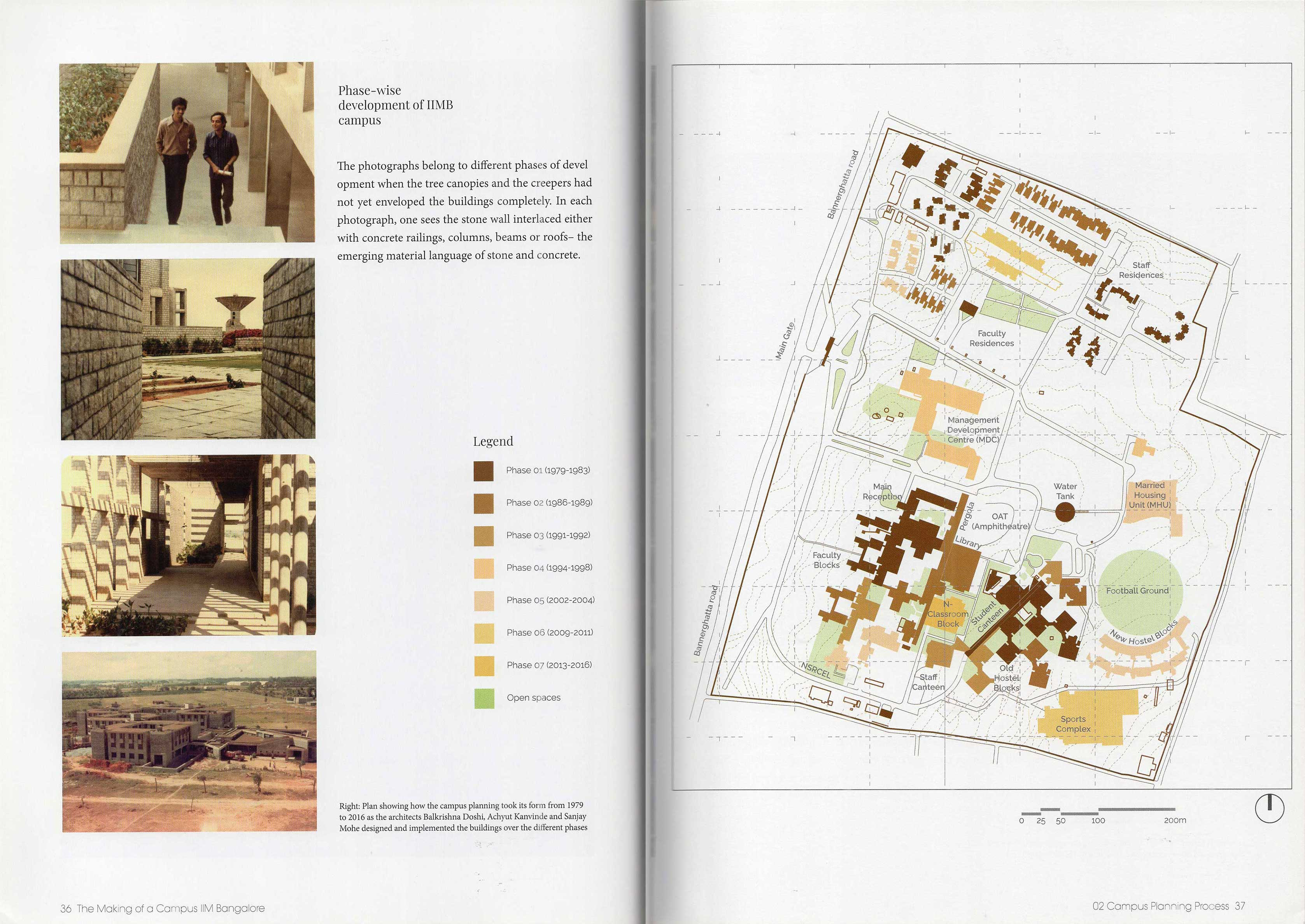
In the process, the physical space becomes an anchor and an entry-point for the book. Starting with the chapter titled ‘The Beginning’ which explores the historical significance of the initial site at Langford Road, the book further forms a poignant study of the design in chapters such as ‘The Campus Planning Process’. It astutely excavates the synergistic evolution of the campus – an ever-shifting dialogue of the current campus, arriving as a vision that has developed incrementally under the guidance of three architects from the years, 1977-1992: Balkrishna Doshi, 1977-1985: Achyut Kanvinde and 2000-2023: Sanjay Mohe.
The author emphasises keenly on the spirit of these layers that come together to form what the campus currently represents. “The interplay of various disciplines—from architecture to landscape design—created a cohesive environment that was both functional and inspiring,” she notes.
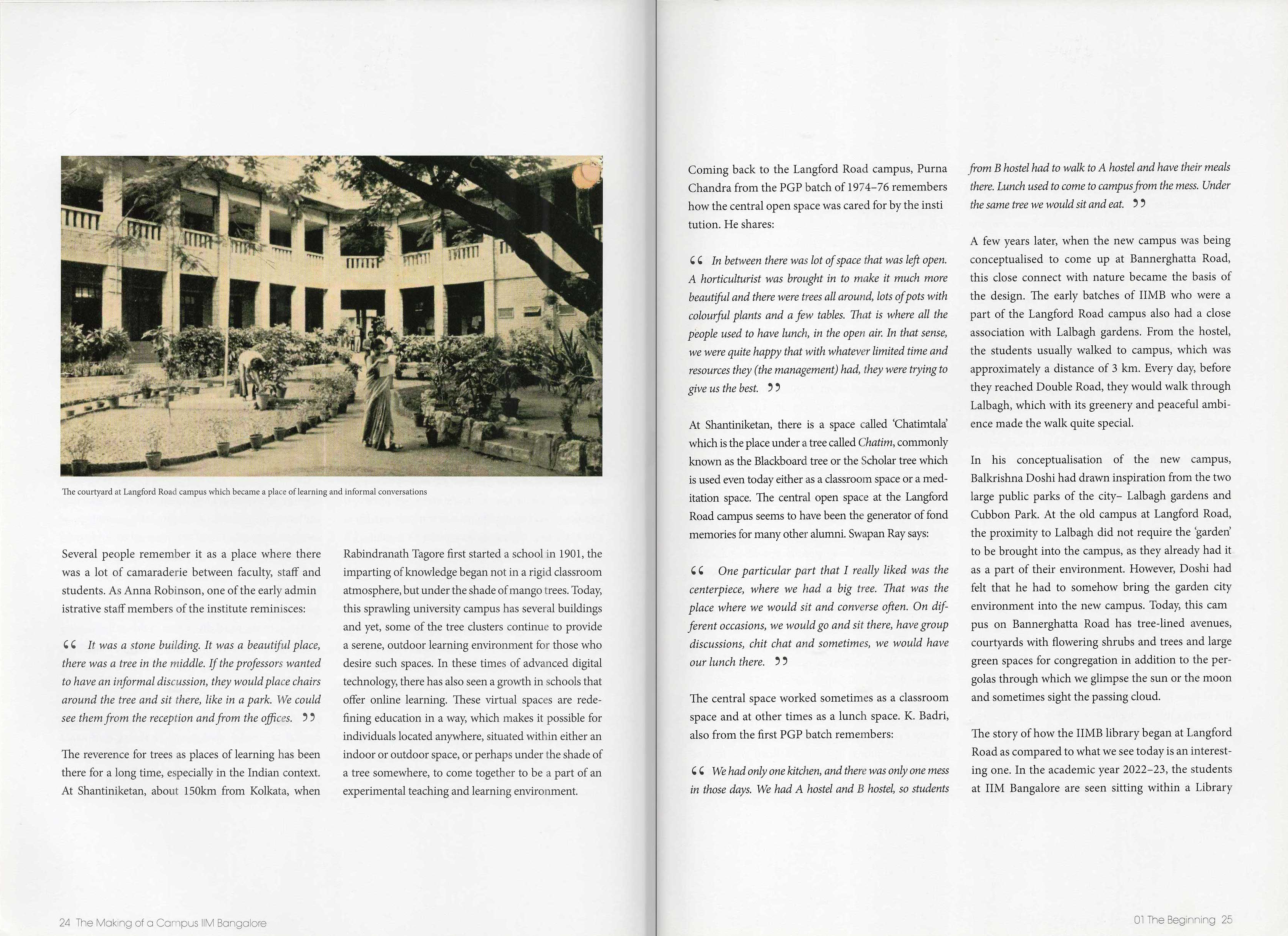
With its rich cultural heritage and natural beauty, the city of Bengaluru played a pivotal role in the design choices that followed. The architect, Balkrishna Doshi, envisioned a place where nature and built form would engage in constant dialogue, evidenced by a quote highlighted in the book: “The garden city must have a garden campus – a green campus; but, will it be a campus or will it be an ashram?” The book deliberately foregrounds these ideas.
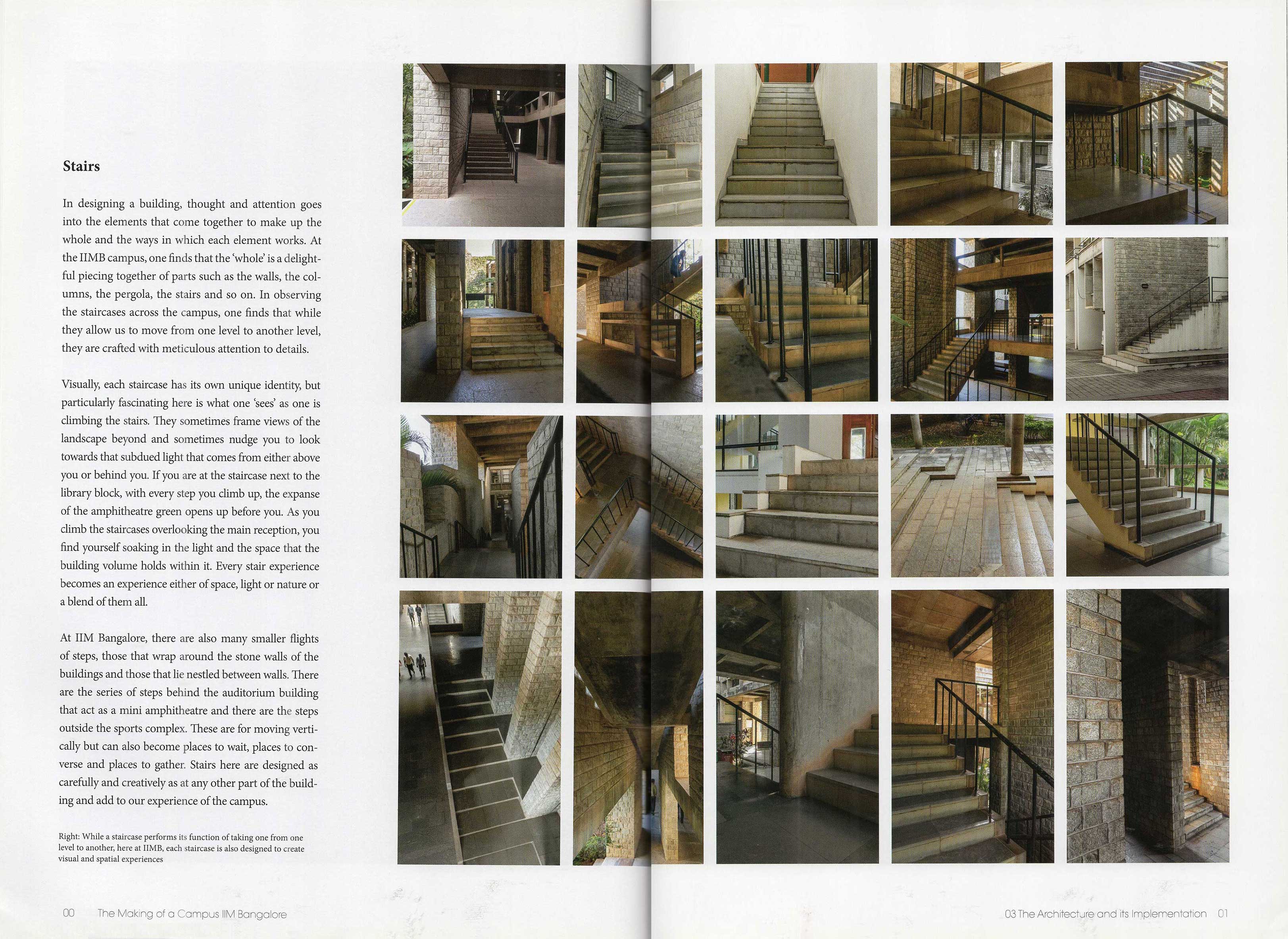
This narrative wades into more familiar, more personal stories, with many excerpts from the author’s interviews with faculty, staff, and alumni. As the book suggests, ‘the architecture has a way to adapt itself to activities on campus’, these stories highlight the primacy of the space lends itself to ‘open conversations within closed networks’, and how the environment facilitates these conversations. Some dwell on the ‘formidable water tank structure’ which becomes a place for quiet reflection, while the author herself inserts a pertinent observation on elements that create diverse moments of engagement – ‘At the IIMB campus, one finds that the ‘whole’ is a delightful piecing together of parts such as the walls, the column, the pergola, the stairs and so on’. Her intention to create a foundation for a broader cultural discourse for the campus built on the thoughts and reflections of the people is amplified by her inclusion of a reference to the onsite filming of the popular Bollywood film, 3 Idiots.


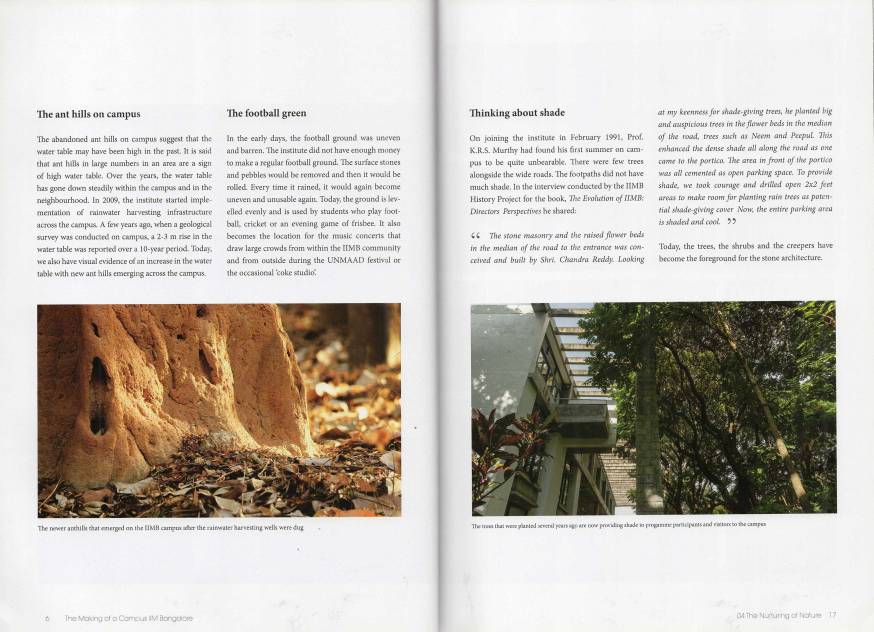
The production of the book itself mirrors the care that went into documenting such a significant project. In its visual and tactile presence, it makes for an immersive and simplified reading experience with a directed, clear charted layout. The ample margins allow for focused attention on individual images. The thoughtful placement of photographs, both archival and recent, complements the text effectively. The selection of images, ranging from the master plan of the campus to intimate shots of students lounging in courtyards, speaks volumes about the relationship between the built space and the people.
The book neatly locates itself in an interesting encounter – between architecture and life.
In locating itself, it examines and redefines for many architects, and perhaps other readers, the institution of IIM-B beyond its architectural expression. It simulates a search: for more purpose and meaning, and towards an ask, as the author outlines, “In an institutional campus, how does one allow for change and simultaneously express a continuity with the past?” In this effort, it emerges an important record: of an expanding vision, and of an archive of material cultures, and lived experiences.

About the Book
A campus is a place formed by its buildings but also by the spaces in between. This book tells the story of the making of the IIM Bangalore campus and of the people who have inhabited its spaces and made it into the place that it is. It shares how this campus came into being and how it has been experienced over time. The key question it asks is: In an institutional campus, how does one allow for change and simultaneously express a continuity with the past? It is hoped that it would be interesting for both those who have been a part of its growth as well as the architectural community who admire it immensely for the creative inputs and the evolving design language that have shaped it.
About the Author
Kiran Keswani is the Co-founder, of Everyday City Lab which focuses on design, research, and teaching pertaining to public spaces. Prior to this, Kiran has had an architectural and urban design practice for over twenty years. She trained with the architect Balkrishna Doshi at his studio, Sangath in Ahmedabad (1991–92), and holds a PhD in Urban design. She has taught Urban Design studios at CEPT University, Ahmedabad, and elective courses on architecture and design at Azim Premji University and IIM Bangalore. Her recent publications include a paper in the Journal of Urban Design (2019) and a chapter in the Routledge Handbook on Urban Design Research Methods (2023). She is a recipient of the Earthwatch Europe Grant for 2022–23 for research related to nature in the city.
Title: The Making of a Campus: IIM Bangalore
Publisher: Altrim Publishers
Design: Eklavya Koralkar, C. Aparnaa, Kiran Keswani, Núria Sordé Orpinell
Editor: Neha Krishana Kumar
Language: English
ISBN: 978-8412622263
Year of Publication: 2023
Spreads: From the book; © Indian Institute of Management, Bangalore (2023)
 thinkMATTER